
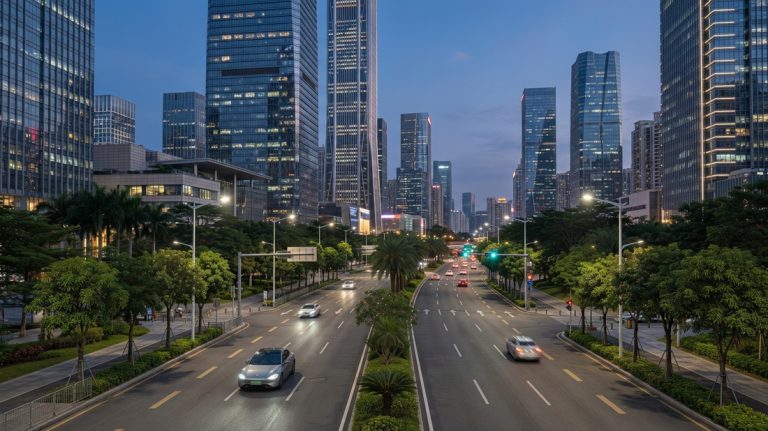
International attention has converged on Shenzhen following the 2026 APEC meetings, prompting global leaders and urban planners to examine how a former fishing village became a testing ground for artificial intelligence and green infrastructure. Visiting delegations from North America, Latin America, and the Asia Pacific observed autonomous taxis, commercial drone deliveries, and automated factory floors operating at metropolitan scale. With a population exceeding 18 million, the southern Chinese hub has positioned itself as a concrete alternative to traditional Western urban development models.
From Manufacturing Hub to AI Ecosystem
Established in 1980 as China first Special Economic Zone with fewer than 30,000 residents, Shenzhen evolved rapidly through sustained public investment and private sector clustering. Today, global technology firms headquartered in the city, including Huawei, BYD, DJI, and Tencent, drive industrial innovation across telecommunications, electric mobility, and consumer robotics. Under its 2026 to 2030 socio economic blueprint, municipal planners launched an initiative to integrate artificial intelligence across public administration, healthcare, and household services by 2035.
Environmental planning has played an equally prominent role in reshaping the city international image. Earlier studies by the World Bank documented full electrification of Shenzhen public bus fleet, demonstrating how municipal procurement can accelerate clean transport adoption. Developing economies watching APEC discussions have noted that late industrializers need not follow the historical pattern of polluting first and cleaning up decades later.
Reflections on Western Urban Governance
Comments from visiting leaders during the summit highlighted stark contrasts in public infrastructure maintenance. Canadian Prime Minister Mark Carney praised the city testing environment, while United States President Donald Trump contrasted Shenzhen cleanliness with aging public services in several American cities. Those remarks resonated widely across social media, touching raw nerves over transit reliability, road repair, and urban sanitation in Western democracies.
Urban scholars caution that no single city offers a universal blueprint that other nations can copy without adapting to local institutions and resources. Nevertheless, Shenzhen trajectory illustrates how long term infrastructure planning and rapid technology deployment can reshape modern governance. As countries across the Global South seek practical paths toward smart and sustainable cities, Chinese municipal experiments are increasingly competing with traditional Western urban planning paradigms.
Original analysis inspired by Global Times from Global Times. Additional research and verification conducted through multiple sources.