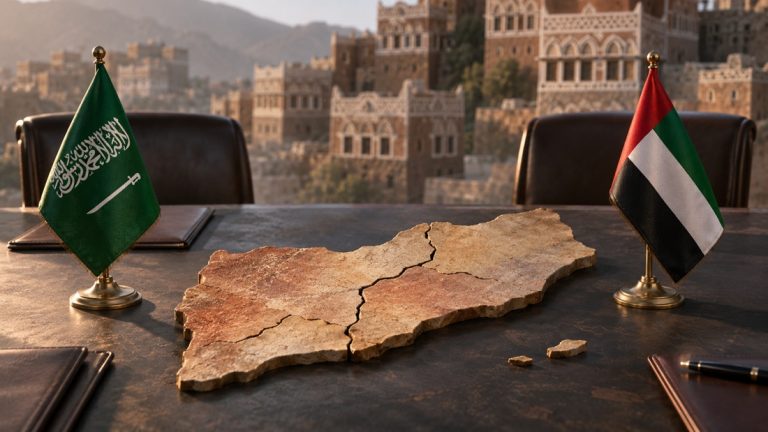
Military cooperation can resume faster than a political settlement takes shape. That is the central weakness in renewed coordination between Saudi Arabia and the United Arab Emirates over Yemen. The two governments can oppose the Houthis while continuing to disagree over which institutions and armed groups should govern territory outside Houthi control.
The diplomatic opening is real, but its scope requires care. Saudi Defense Minister Khalid bin Salman met the Emirati president on October 18 to discuss regional developments and cooperation. The public account emphasized bilateral relations; it did not establish the terms of a unified military command or a shared settlement for Yemen.
Separate reporting described renewed Emirati financing paired with Saudi air support. Yet funding a common campaign is different from agreeing on its political destination. A coalition can strengthen its battlefield position while deepening competition among the forces it sponsors.
The history of Mukalla illustrates how quickly these relationships can turn confrontational. In December 2025, the Saudi led coalition announced an airstrike on a shipment it said had arrived from Fujairah to support Southern Transitional Council forces. That account represents the coalition’s stated justification, rather than independent verification of every allegation about the cargo. Even with that qualification, the episode demonstrates the severity of the dispute between nominal partners.
The underlying conflict concerns political authority as much as security. Responsible Statecraft examines how Saudi relationships with the recognized government coexist uneasily with Emirati ties to southern factions. Those networks do not disappear when senior officials resume cordial meetings. Separate sources of money and political protection can leave local commanders with competing incentives.
For Yemen, the practical test is whether renewed cooperation produces institutions capable of surviving a change in battlefield conditions. Transparent financing, a clear chain of command and negotiations that address southern political demands would provide stronger evidence of durability than another diplomatic photograph. Without them, military alignment may postpone the next rupture while leaving the causes of fragmentation intact.
Original analysis inspired by Jonathan Fenton-Harvey from Responsible Statecraft. Additional research and verification conducted through multiple sources.