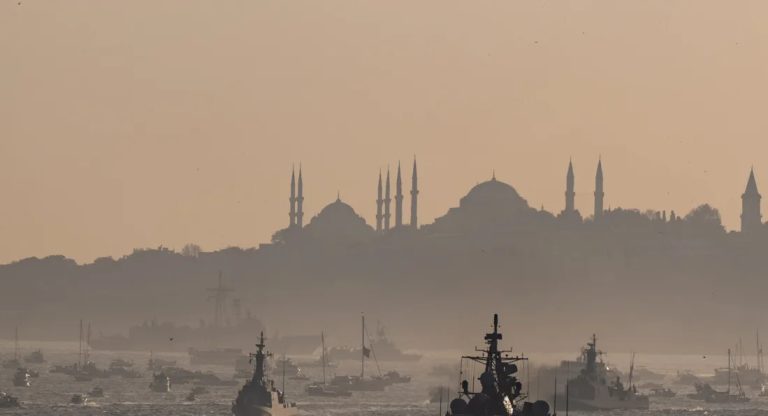
On July 20, 2026, the Montreux Convention turns ninety years old. The document signed at Montreux Palace in Switzerland in July 1936 governs the Bosporus and Dardanelles straits in Turkey, addressing the long-running question of who should control the strategically vital link between the Black and Mediterranean seas. Nine decades later, it remains one of the most consequential pieces of international maritime law in operation, and no country has benefited more from its durability than Turkey. The Russia-Ukraine war has not weakened Ankara’s grip on the Black Sea. It has tightened it.
By deciding what constitutes “war,” Turkey positions itself as gatekeeper of the Black Sea’s security and militarization, enhancing its diplomatic leverage with Russia and NATO simultaneously. That leverage, carefully managed since February 2022, now shapes every serious conversation about how Ukraine survives economically, how a postwar security architecture in the Black Sea gets built, and who gets to lead it.
The February 2022 Decision and Its Lasting Consequences
When Russia launched its full-scale invasion of Ukraine, Turkey moved within days. On February 27, 2022, the Turkish Foreign Ministry announced that Turkey would exercise its rights under Montreux to close the straits to ships from nations at war, thereby qualifying the Russian invasion of Ukraine as a war. That single declaration changed the naval geometry of the conflict.
The practical effects were immediate and lasting. Under the verbal arrangements Turkey struck with both Russia and NATO countries — described by one Turkish official as “Montreux Plus” — Russian warships already outside the Black Sea could not return to their bases, while non-littoral NATO countries agreed not to send their own warships through the straits. In peacetime, military vessels are limited in number, tonnage and weaponry, with specific provisions governing their mode of entry and duration of stay, and warships must provide advance notification to the Turkish authorities. In wartime, Turkey’s discretionary authority is far broader — and Ankara used it deliberately.
Russia calculated, reasonably, that those warships kept out of the Black Sea were safer in the Mediterranean or Baltic than in waters where Ukraine’s maritime drone campaign was proving devastatingly effective. As the NATO member with the longest coastline on the Black Sea, Turkey has prevented a potential NATO-Russia war by closing the Turkish Straits to military vessel traffic for the warring parties under Articles 19 to 21 of the Montreux Convention. That is a remarkable claim — and one that is difficult to entirely dismiss.
Regional Ownership as Strategic Doctrine
Turkey’s Black Sea posture rests on a principle it calls “regional ownership” — the idea that the sea’s security is the business of its six littoral states, not of outside powers. That principle shapes every decision Ankara makes, from minesweeping mandates to the new maritime command it has established in Istanbul’s Beykoz district on the Bosphorus.
The details of the maritime command were agreed at a meeting of the Coalition of the Willing countries in Ankara in April 2025, where Turkey persuaded its partners to continue leading planning activities in the maritime domain under the legal framework established by the Montreux Convention. Fourteen countries have declared their intention to contribute to the Maritime Component Command; however, contributions involving naval platforms will be provided only by the littoral states, namely Turkey, Romania, and Bulgaria. The distinction matters. Turkey is building a structure that institutionalizes its leadership while keeping the alliance’s non-Black Sea navies at arm’s length — entirely consistent with a ninety-year pattern of Turkish policy.
For decades Ankara has sought to preserve a delicate equilibrium between Russia and the West in the Black Sea, relying on the Montreux Convention to restrict the military presence of non-littoral powers and prevent the region from becoming a theater of direct confrontation between NATO and Moscow. Successive Turkish governments viewed the convention not only as a cornerstone of national sovereignty but also as an essential instrument for managing relations with Russia, a major supplier of energy and an important trading partner. That dual utility has not disappeared. It has become more complex.
Managed Rivalry on the Bosphorus
Turkey’s relationship with Russia in the Black Sea context is best described as what one Turkish academic calls “managed rivalry” — long-standing contestation combined with a common agenda of minimal Western interference and mutually beneficial economic cooperation. There is no doubt that the emergence of a permanent multinational maritime headquarters in Istanbul would become another source of friction in Turkey’s increasingly complex relationship with Russia. While Ankara has maintained political and economic ties with Moscow and continues to portray itself as a mediator, the newly disclosed plans show that Turkey is simultaneously preparing to play a leading military role in postwar security arrangements designed to bolster Ukraine and limit Russian influence in the Black Sea region.
Russia has not missed this. The Russian embassy avoided directly criticizing Turkey, saying it appreciated Ankara’s balanced and responsible stance in implementing the convention. The politeness is deliberate. Moscow understands that an open confrontation with Ankara over the straits carries risks that outweigh any short-term gain. But Russian warnings about Montreux violations have escalated steadily, and the April 2026 Russian embassy social media post depicting a 1936 newspaper headline about the convention was not a nostalgic gesture. It was a signal.
Ukraine, meanwhile, is frustrated for different reasons. Russian attacks on Ukrainian port infrastructure in the three Odesa ports have intensified since spring 2025, and Kyiv has repeatedly urged Turkey to do more to protect Ukrainian shipping rather than simply maintain procedural neutrality. The British-donated mine hunters that Turkey has blocked from entering the Black Sea under Article 19 remain based in Portsmouth, waiting for a change in circumstances that Turkey alone controls.
What Comes Next — and Who Decides It
Turkey is shaping security in the Black Sea not only through military balances but also through regional and multi-layered cooperation mechanisms. That influence will only grow as peace negotiations proceed. Turkish officials have been explicit that a ceasefire alone will not lift the Montreux restrictions — only a durable peace settlement qualifies. That gives Ankara structural leverage over the timeline of any postwar normalization.
The practical priorities for Ukraine’s European and NATO partners are clear. Building up Romania’s and Bulgaria’s naval capacity — both to strengthen the littoral coalition and to reduce its dependence on Turkish goodwill — is one lever. The Mine Countermeasures task group was formed by three NATO members in 2024 as naval mines planted by Russia and Ukraine to protect their coastlines drifted due to storms and other factors into other parts of the Black Sea, endangering maritime security. That trilateral framework, modest as it is, represents exactly the kind of regional capacity-building that the Montreux logic permits and that Western partners should be scaling up.
The harder question is whether the convention itself is fit for purpose. While it was designed for a particular geopolitical context and remains unchanged since its adoption, the Montreux Convention has endured as a “solid example of a rules-based international order,” since most of its terms are still followed. Its archaic references to the League of Nations and its silence on drone warfare, autonomous surface vessels, and shadow fleet tankers all create gaps that Turkey fills with discretionary judgment. In this environment, Turkey is emerging not merely as a balancing actor but as a security-generating power, thanks to its military capabilities, diplomatic flexibility, and strategic vision. Whether that is reassuring or alarming depends entirely on which side of the straits you are standing.
Original analysis inspired by Thomas de Waal from Carnegie Europe. Additional research and verification conducted through multiple sources.