At precisely the moment American public opinion is turning sharply against the U.S.-Israel relationship, Congress is moving to make that relationship structurally permanent. The contradiction is hard to ignore. Only 16 percent of Americans now want the United States to keep supplying Israel with weapons without new restrictions, while 38 percent want weapons transfers stopped entirely. Yet legislators are racing to embed Israel deeper into U.S. defense and intelligence systems than any ally has ever been — including the Five Eyes partners.
Section 224 of the House Armed Services Committee’s version of the FY2027 National Defense Authorization Act proposes a United States-Israel Defense Technology Cooperation Initiative that could mark a significant shift, moving the two countries from a relationship centered on U.S. military aid toward one in which their defense industries are more deeply intertwined. A parallel FY2027 Intelligence Authorization Act would require broader intelligence sharing between the two countries, covering cybersecurity threats, terrorism, sanctions evasion, missile threats, and adversarial technologies. Critics note that the mandated intelligence sharing in the bill would tie the president’s hands and prevent any administration from using management of the intelligence liaison relationship as leverage to deter destructive conduct by Israel.
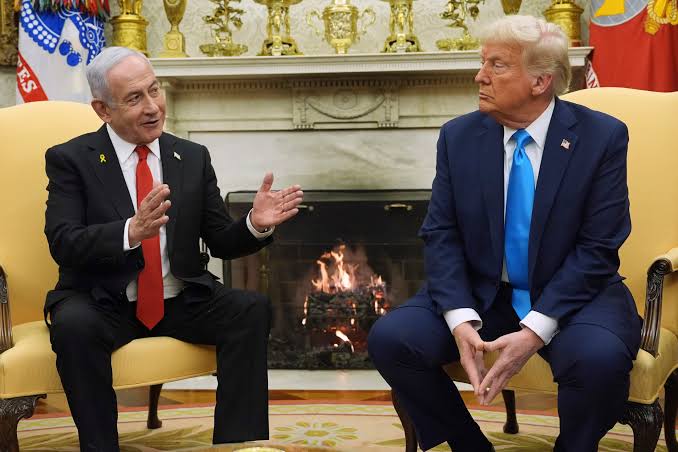
That leverage matters enormously right now, because the man who would benefit most from these laws is also the man making Trump’s life most difficult. Netanyahu played a central role in drawing Washington into the Iran conflict. Now, as the administration seeks an exit, he has every incentive to slow-roll the ceasefire and extract maximum concessions before Israeli voters head to the polls. The Knesset approved a motion to dissolve itself, leaving possible election dates ranging from September 8 to October 20, and Israel has become deeply entangled in Lebanon while Netanyahu quarrels with Trump. Every week without a durable ceasefire is a week Netanyahu can campaign as a wartime leader.
Netanyahu’s Clock Is Running
On April 26, Naftali Bennett and centrist Yair Lapid announced the formation of a new party, officially named Beyachad, to contest the upcoming legislative elections due by October 27, 2026. The opposition is already consolidating around a single alternative to the prime minister. Netanyahu’s coalition government failed to pass legislation that would exempt ultra-Orthodox yeshiva students from mandatory military service, prompting key parties to call to disband the Knesset. His domestic position is weakening. His international credibility is fraying. And the war that was supposed to define his legacy has instead produced a grinding stalemate in Lebanon and a ceasefire in Iran that settled nothing.
This is Netanyahu’s core problem: he needs to deliver something voters can recognize as a win before October arrives. That means he needs American military power, American diplomatic cover, and American legislation that cements Israeli access to U.S. defense technology regardless of who wins the next Israeli election. He needs all three simultaneously. Trump, if he chooses to act strategically, need only withhold one of them to reorder the entire negotiation.
The Three-Track Opportunity
Trump’s stated goals are not complicated. He wants out of the Iran war. He wants Israel to reduce its dependency on American military hardware. And he wants enough progress on Palestinian self-determination to revive the Abraham Accords and give Saudi Arabia the political cover to normalize relations with Israel. Netanyahu has frustrated all three objectives. From Gaza to Lebanon to Iran, Israeli military operations have consistently expanded the theater of conflict rather than contracted it.
The solution lies in combining what are currently treated as three separate negotiations into one. Republicans could lose at least one chamber of Congress in the November 2026 midterm elections, which is precisely why Israel’s most fervent supporters in Congress are trying to seize the current window of Republican control to push through legislation that would cement the relationship. Netanyahu understands this calculus better than most. The legislation is only valuable to him if it passes before the political winds shift. That dependency is the source of Trump’s leverage — and it is substantial.
The administration reportedly signaled this in recent weeks when reports emerged about Israeli espionage against the United States. Whether those stories were strategically timed or not, their effect was to remind Jerusalem that the intelligence cooperation under consideration in Congress exists at Washington’s discretion, not Tel Aviv’s. The White House pushed back publicly on the reporting but did not extinguish it entirely. That ambiguity may have been the point.
Playing the Hand
The path forward is straightforward even if politically demanding. The White House should signal to Republican leadership in Congress that Section 224 and the intelligence authorization provisions proceed only if Israel demonstrably cooperates on the ceasefire and engages seriously with Palestinian self-determination frameworks. That conditionality does not require a public confrontation. It requires Trump to do what he does best — use transactional pressure behind closed doors while projecting strength publicly.
The administration also retains tools it has been reluctant to use. Arms transfer decisions, diplomatic posture at the ICC, and the timing of any Congressional vote on defense integration all sit within executive influence. Gallup reported in February 2026 that Israelis no longer lead Palestinians in Americans’ sympathies, with independent-leaning voters now sympathizing more with Palestinians than Israelis. The political risk of applying pressure on Israel is lower today than at any point in recent memory. The risk of not applying it is a ceasefire that collapses, an Abraham Accords revival that stalls, and a congressional gift handed to a foreign leader who has spent months undermining American interests.
The upcoming elections for the Knesset are the first to take place since the October 7 attack and the resulting Israel-Hamas War, Israel-Hezbollah war, and the 2026 Iran war — making them a genuine inflection point for Israeli political direction. A post-Netanyahu government may prove far easier to work with on all three tracks. But that outcome becomes more likely if Washington makes clear now that the legislative prize Netanyahu is counting on is not guaranteed. Trump holds the cards. The question is whether he uses them before the window closes.
Original analysis inspired by Josh Paul from The American Conservative. Additional research and verification conducted through multiple sources.
By ThinkTanksMonitor