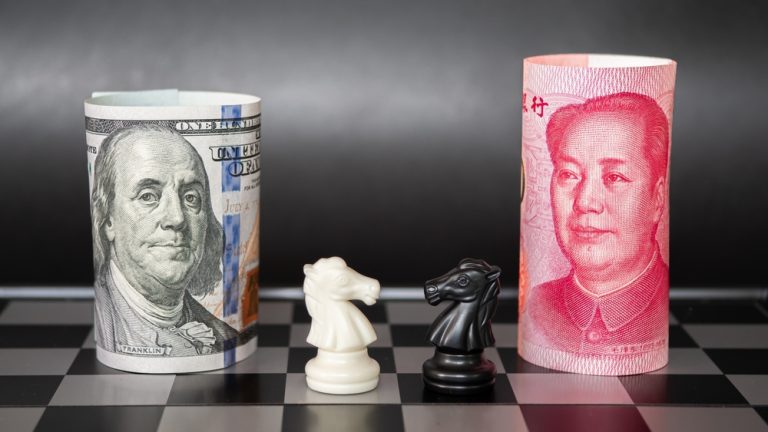
When Xi Jinping addressed the Fourth China-CELAC Forum Ministerial Meeting in May 2025, pledging 66 billion yuan in credit lines to Latin American and Caribbean countries, the choice of currency was deliberate and historically significant. At comparable previous summits, Beijing had typically denominated its commitments in dollars. This time it chose renminbi explicitly. The shift did not happen because Chinese financial infrastructure suddenly became more attractive. It happened because Washington systematically degraded the credibility of the alternative, creating a vacuum that Beijing had spent a decade quietly preparing to fill.
The conventional Washington interpretation frames yuan adoption in Latin America as a Chinese offensive requiring American countermeasures. That framing is backwards. The more accurate description is that American policy choices have converted the dollar from a neutral international medium of exchange into a politically conditional instrument — and every Latin American government that has watched that transformation has drawn rational conclusions about the risks of concentrated dollar dependence.
How Washington Built the Opening
The dollar’s reserve status rests on three foundational properties: credibility, predictability, and rule-of-law consistency. Countries hold dollars and invoice trade in dollars because they trust that access will not be revoked for political reasons and that the Federal Reserve will remain independent from partisan pressure. American policy has systematically weakened all three foundations simultaneously.
The Office of Foreign Assets Control’s sanctions list has roughly tripled in size since 2010. The 2022 freeze of approximately $300 billion in Russian central bank reserves concentrated the attention of every finance ministry in the Global South on a single uncomfortable question: if dollar reserves can be frozen for geopolitical reasons, what conditions would trigger the same treatment for other sovereigns? The answer, for most emerging market central banks, was “unclear enough to justify hedging.”
Tariff policy under the second Trump administration has compounded the problem by transforming dollar reserves from a stable store of value into a politically exposed asset. Mexico, Brazil, and Colombia have all faced abrupt tariff threats deployed as leverage for unrelated policy demands — including immigration enforcement cooperation — with minimal warning. For a central bank treasurer, holding dollar reserves in that environment is no longer a neutral technical decision. It is a political exposure that requires active management.
A Decade of Quiet Infrastructure Building
China has spent a decade constructing the plumbing required to make yuan use practical at scale. The People’s Bank of China operates bilateral swap lines totaling approximately 4.16 trillion yuan with more than 40 central banks. CIPS, China’s Cross-Border Interbank Payment System, has emerged as a functional alternative to SWIFT for yuan clearing, particularly for trade between China and countries under American sanctions pressure. In Latin America specifically, Beijing established the continent’s first yuan clearing bank in Chile in 2016 and signed a memorandum to establish another in Brazil in 2023. That infrastructure sat largely dormant as long as the dollar remained reliably accessible. Washington’s policy trajectory has activated it.
The results are already measurable. In 2018, Brazil’s central bank held no yuan reserves. By 2023, yuan had surpassed the euro to become the second-largest foreign reserve on its balance sheet. Brazil now settles an increasing share of its bilateral trade with China in their respective currencies, bypassing dollar conversion for major export categories including soybeans, iron ore, and beef. Argentina’s case is starker still: Buenos Aires became the first country in history to use Chinese yuan to partially repay IMF debt obligations during a 2023 dollar shortage, an act that would have been inconceivable without the infrastructure Beijing had quietly assembled and the dollar access uncertainty Washington had created.
What Preservation of Dollar Status Actually Requires
The yuan will not displace the dollar as the primary global reserve currency in the near term. The dollar’s institutional depth — the sheer volume of dollar-denominated financial instruments, the depth of US Treasury markets, the network effects of decades of dollar invoicing — provides structural resilience that no Chinese financial initiative can overcome quickly. But displacement is not the only relevant threshold. A world in which the dollar retains nominal dominance while its practical monopoly in emerging market reserves erodes measurably is a world in which American sanctions power diminishes, American financial intelligence capabilities weaken, and American ability to impose economic costs on adversaries declines — all without any single dramatic moment of displacement.
Preserving dollar status requires treating sanctions as a depletable resource rather than a costless political instrument, extending Federal Reserve dollar swap lines beyond Mexico and Brazil to Latin American partners who currently face dollar liquidity crises without American backstops, and competing seriously on infrastructure investment through the Development Finance Corporation and EXIM Bank rather than leaving Chinese state financing as the only alternative on offer. None of those measures is currently being prioritized by an administration that treats dollar dominance as a fixed endowment rather than a reputation that requires continuous maintenance to retain.
Original analysis inspired by Eric Lin from FPIF. Additional research and verification conducted through multiple sources.