Wars are often entered with the quiet confidence that they will be short. This one was no different. On February 28, 2026, the United States and Israel launched a coordinated military operation against Iran; Tehran responded almost immediately with strikes against American assets across the Middle East. Each side had a theory of how the other would break. Neither theory has held up.
The US bet was essentially sociological. Washington assumed that a combination of precision strikes and severe economic pressure would fracture Iranian society — that a population already straining under sanctions, a collapsing currency, and mass protests would turn its anger inward, toward the regime. It is a logic that has failed before, and it has failed again. External attack can initially produce a rally-around-the-flag effect, strengthening national cohesion and temporarily reinforcing regime legitimacy — a dynamic that mirrors the early stages of the Syrian uprising, during which widespread protests revealed the regime’s vulnerability but did not immediately fracture elite unity. History offered a clear precedent: the Iran-Iraq War did not weaken the Islamic Republic — the conflict shocked Iranian society, unleashing new emotions and forms of mobilization, as the regime used Shiite symbolism and the martyrdom of soldiers and civilians to portray itself as a defender of the nation, spurring exactly this kind of cohesion.
The regime’s coercive capacity compounds the problem. Iran’s dual institutional structure — combining clerical authority with a powerful military-security apparatus — creates overlapping and mutually reinforcing elite networks, with ideological cohesion among core elites reducing the likelihood of rapid defection, supported by an extensive coercive apparatus including the IRGC and Basij. The Islamic Republic has maintained remarkable cohesion since the attacks started: its command-and-control system remains intact despite the loss of many leaders, and it has retained enough firepower to continue launching strikes against US bases, Israel, and Gulf Arab states.
Tehran’s Wager, and Its Limits
Iran’s own miscalculation runs in a different direction. Tehran has embraced attrition as a strategy — not seeking a quick end to the war, but trying to sustain pressure over time, militarily, politically, and economically, in order to alter the adversary’s cost-benefit calculation, with the objective being not battlefield victory in the conventional sense, but producing a new strategic equation in which the threshold for attacking Iran is permanently raised.
The problem is where that economic pain actually lands. Closing the Strait of Hormuz and targeting Gulf energy infrastructure was supposed to create unbearable pressure on Washington’s decision-makers. Instead, it has struck at the countries least responsible for the war. Iran’s strategy has also exposed a deeper shift in modern warfare: Tehran’s Shahed drones — costing between $20,000 and $50,000 each — impose disproportionate costs on US and allied air defenses, with one study calculating that for every dollar Iran spends manufacturing a Shahed, it costs adversaries $20 to $28 to bring it down. That arithmetic is punishing — but it does not translate into diplomatic leverage over Washington. The United States possesses overwhelming military power but faces domestic political risks in a prolonged conflict — yet those risks are not the same as an energy crisis devastating Asian and European economies that had no say in starting the war.
Iran’s targeting of Gulf infrastructure has also backfired politically. As a result of the US-Israeli attack, Iran retaliated against installations in Gulf states hosting American military bases, striking targets in Bahrain, Kuwait, the UAE, Oman, Saudi Arabia, and Qatar, with rising anger in these countries that Washington has done little to shield them while doing a great deal to protect Israel. Rather than pressuring Gulf states to push Washington toward an exit, the strikes have hardened their alignment — US-allied Gulf states including Saudi Arabia, the UAE, Kuwait, and Bahrain have reportedly pushed Trump to continue the war until there are significant changes in Iran’s leadership.
The Trap of Shared Misperception
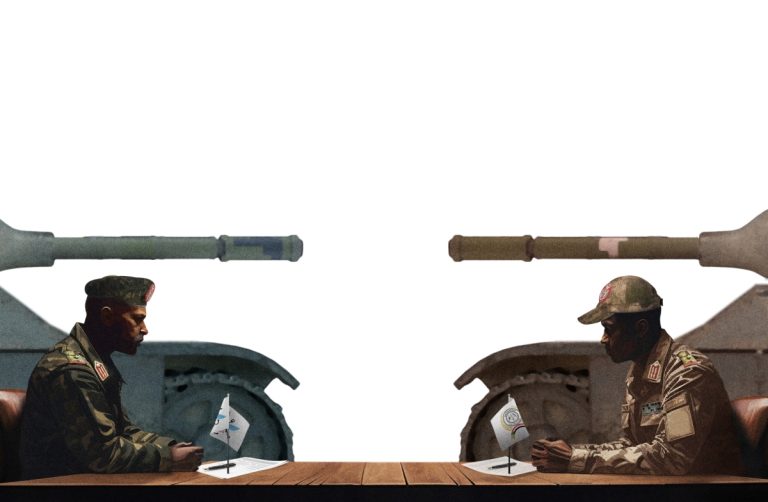
What makes this conflict so resistant to resolution is that both sides remain committed to strategies that have already shown their limits. A slow, protracted war of attrition is probably Iran’s intended outcome, with Iranian leaders calculating that their country is more willing to absorb pain than either the United States or Gulf countries. Washington, meanwhile, keeps reaching for more pressure in the belief that the next escalation will finally produce the fracture it has been waiting for. Tehran has discerned a predictable pattern in US behavior — a preference for short, high-intensity kinetic campaigns followed by mid-cycle armistices — with this cycle steering Iran toward a war of attrition intended to precipitate systemic collapse.
The costs of this deadlock are not abstract. Iran uses Shahed drones to strike targets at a cost of roughly $20,000 each, while the US intercepts them with missiles costing anywhere from $2 million to $10 million apiece — with the daily cost of the war to American taxpayers approaching one billion dollars. Neither the interceptor stockpile nor the political patience of Washington’s Gulf partners is infinite.
The collapse of diplomacy and the outbreak of war have forced Iran’s leadership to confront a reality: their belief that the US would ultimately act rationally may have been a profound miscalculation. The same could be said of Washington’s belief that a society under fire would direct its anger at its own government rather than at the foreign power dropping the bombs. Two miscalculations have not cancelled each other out. They have converged — and the bill, so far, is being paid by everyone except the strategists who drew up the original plans.
Original analysis inspired by Asharq Al-Awsat Opinion from Asharq Al-Awsat. Additional research and verification conducted through multiple sources.