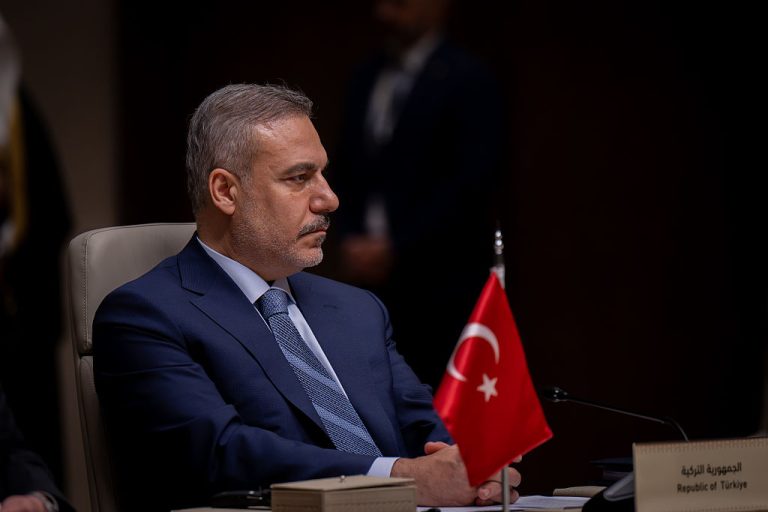
When Turkish Foreign Minister Hakan Fidan told reporters that Israel bears primary responsibility for a war that has “drawn our region into an unprecedented crisis,” he wasn’t making a moral argument. He was signaling a strategy. Fidan has since visited Saudi Arabia, the UAE, and Qatar, pressing Gulf states to hold back from the conflict while positioning Ankara as the Muslim world’s most credible diplomatic broker. The framing is peace-oriented. The motivation is almost entirely defensive.
Turkey, a NATO member, shares a 350-mile border with Iran — a fact that concentrates the mind considerably. Unlike Gulf Arab states that have absorbed Iranian drone and missile strikes since February 28, Turkey has largely been spared direct military damage. Iran is assumed to have targeted Turkey with three missile attacks, all three neutralized by NATO interceptors. That thin margin of security is one reason Erdogan is moving fast.
The Economic Pressure Behind the Diplomacy
Strip away the geopolitical language and Turkey’s urgency becomes straightforward arithmetic. Every $10 increase in oil prices adds an estimated $4.5–5 billion to Turkey’s current account deficit, and Turkey’s 2026 budget was built on an oil price assumption of $65 per barrel — a figure overtaken by events in the war’s first week. With Brent crude now trading above $110, the fiscal damage is compounding weekly. Iran cut natural gas exports to Turkey following an Israeli strike on the South Pars gas field — a supply that covered roughly 13% of Turkish imports and whose contract was already due to expire in July. The war didn’t just disrupt Turkey’s energy supply. It accelerated a crisis that was already building.
The political stakes for Erdogan are direct. He is seeking a fourth term and has spent the past year exploring ways to move the election date forward, but rising consumer prices are the last thing he needs at a time when most Turks are struggling to pay rent and buy basic groceries. Add to that the refugee dimension: Turkey already hosts four million Syrians, the vast majority still there, and there is no public appetite for another wave of displaced people. An Iranian collapse would almost certainly produce one.
The Kurdish Question Above All
Economic anxiety and refugee fears are real, but they are not Ankara’s deepest concern. That distinction belongs to the Kurdish question. Turkey is home to the world’s largest Kurdish population (approximately 15–20 million people, or roughly 18–25% of Turkey’s total population), and since 1984 the Turkish state has been locked in conflict with the PKK — a war that has killed more than 40,000 people over four decades. Any scenario that strengthens Kurdish armed movements along Turkey’s borders activates an alarm that overrides nearly every other consideration in Ankara.
One of the Iranian Kurdish groups, PJAK, is allied with the PKK — meaning Turkish opposition to any U.S. or Israeli effort to arm the Iranian Kurds is essentially guaranteed. Reports that Washington and Jerusalem had discussed using Iranian Kurdish factions as a potential ground component against Tehran triggered immediate pushback from Ankara. Turkey is currently attempting to resolve the PKK conflict under a “terror-free Turkey” initiative, and regional spoilers could derail the conclusion of an almost fifty-year conflict. Trump publicly distanced himself from the Kurdish option on March 7, but his administration’s characteristic inconsistency means Ankara cannot bank on that position holding.
The current crisis risks extending the Turkey-Israel competition into Iranian soil, especially amid signs of Israeli and U.S. support for Kurdish factions including the PKK-affiliated Kurdistan Free Life Party. From Ankara’s perspective, a U.S.-backed Kurdish autonomous zone in northwestern Iran would be the Syria scenario replayed at larger scale and closer range — and Turkey spent years conducting military incursions into Syria to contain exactly that dynamic.
A Broker With Its Own Agenda
Turkey has offered Ankara as neutral ground for framework discussions, with Fidan engaging both sides. But the conditions for successful mediation remain structurally weak: Iranian officials have rejected claims that negotiations are underway, highlighting the gap between diplomatic messaging and political reality.
Turkey’s diplomatic push is therefore less about peacemaking than about preempting a convergence of threats — economic strain, domestic unrest, refugee flows, and Kurdish autonomy movements along its borders. For Ankara, the urgency lies not only in stopping the war but in shaping its outcome. That distinction matters. A mediator seeking peace and a government managing its own exposure will not always pursue the same outcome — and the difference will become visible the moment a settlement requires Turkey to absorb costs it cannot afford.
Original analysis inspired by Sinan Ciddi and Ahmad Sharawi from Foundation for Defense of Democracies. Additional research and verification conducted through multiple sources.