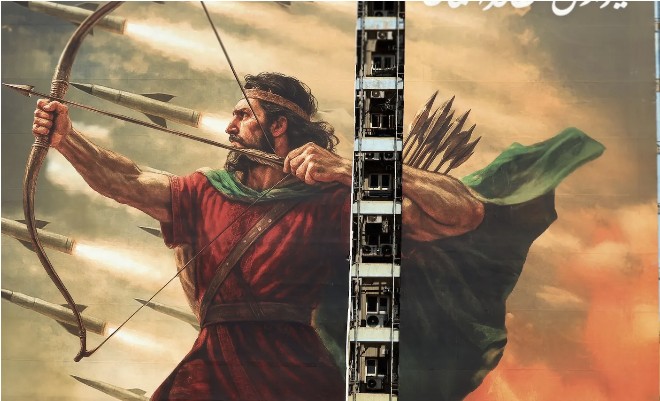
Three weeks into Operation Epic Fury, Donald Trump expressed genuine bewilderment at the situation he had created. “All of their leaders are dead,” he said. “We don’t know who we’re dealing with.” It was a rare moment of candor — and it pointed to the fundamental miscalculation at the heart of the campaign. Destroying a government’s leadership is not the same as breaking a civilization. Iran’s enemies have spent three weeks learning that distinction the hard way.
The assumption behind the war — that enough pressure would produce either regime collapse or popular uprising — has not been validated by events. Trump urged Iranians to “take over your government” in the opening days. He has since revised that expectation downward, acknowledging that security forces have been “machine-gunning people down” to prevent protests. What a few basic inquiries might have revealed beforehand is now being discovered in real time, at considerable cost to everyone involved.
A Civilization That Has Outlasted Its Conquerors
Iran’s resilience is not simply political — it is structural, rooted in layers of identity that predate the Islamic Republic by more than a millennium. The Persian language survived the Arab invasions of the seventh century not diminished but strengthened, becoming the vehicle for some of the greatest poetry in human history. Shia Islam fused with Persian cultural forms to create an aesthetic and spiritual identity that spread across Central Asia and into India. The country’s geographic logic — a highland plateau ringed by mountains and sea — has given it a natural coherence that artificial colonial constructs like Iraq and Afghanistan lack entirely.
This is why comparisons to those countries’ post-invasion fragmentation do not apply. Iran has a dominant language (Persian/Farsi, spoken by over 50% as a first language and nearly all as a lingua franca), a shared sectarian identity (Shia Islam, adhered to by roughly 90-95% of the population), and a sense of civilizational exceptionalism that functions as social glue even when the government is despised. The Kurdish (10%), Baluch (2%), and Arab (2%) minorities being encouraged by the CIA toward separatism represent real fault lines — but not structural ones capable of splitting the country apart. Iran is not held together by a colonial boundary drawn in London. It is held together by fifteen centuries of shared culture.
The Shia tradition itself reinforces this. The founding martyrdom of Imam Hussein at Karbala in 680 AD established a template in which heroic resistance against overwhelming force is not merely acceptable but sacred. For nations animated by this kind of identity — Iran, Ukraine, the Palestinians — foreign military pressure tends to consolidate rather than fracture social cohesion, at least in the short term. Ali Larijani said as much at a Tehran rally days before his assassination: that Trump’s problem was failing to understand that increased pressure strengthens the Iranian people. It was self-serving, but it wasn’t wrong.
A Harder Regime on the Other Side
The more consequential question is not whether Iran breaks, but what it becomes. Mojtaba Khamenei — who lost his father, his wife, and reportedly a leg in the opening strike — is the new supreme leader. His theological credentials are thin. His elevation was engineered by the Islamic Revolutionary Guard Corps, and his rule will likely accelerate the transformation of the Islamic Republic from a clerical state into something closer to a uniformed nationalist dictatorship. The IRGC, for whom this war represents both a threat and an opportunity, is the institution that stands to gain most from the conflict’s continuation.
Larijani’s assassination removed the one figure with both the institutional standing and the negotiating experience to engineer a diplomatic exit. Whether that was Netanyahu’s calculation is disputed, but the effect is clear: the Iranian side of any future negotiation is now led by hardliners who have every incentive to fight on and none to settle. The ICC’s jurisdiction over attacks on civilian infrastructure remains a theoretical constraint; in practice, both sides are operating well beyond the limits of earlier regional conflicts.
Meanwhile, Iranian families observed Nowruz — the Persian New Year — under Israeli airstrikes, gathering around the traditional seven-item display in homes across Tehran. Weddings, funerals, and new year celebrations have continued in the shadow of a war that kills civilians and destroys schools. The ordinary Iranian life continuing around the conflict is not propaganda. It is evidence of something the White House does not appear to have modeled: a society that can absorb punishment without surrendering its sense of self.
The real danger for Iran is not disintegration from outside. It is implosion — an internal reckoning between the IRGC’s militarized grip and the population that was already on the streets in January. When the bombs stop, that unresolved tension will still be there. And it will have even less room to breathe.
Original analysis inspired by Christopher de Bellaigue from UnHerd. Additional research and verification conducted through multiple sources.