Tag: Nuclear Proliferation

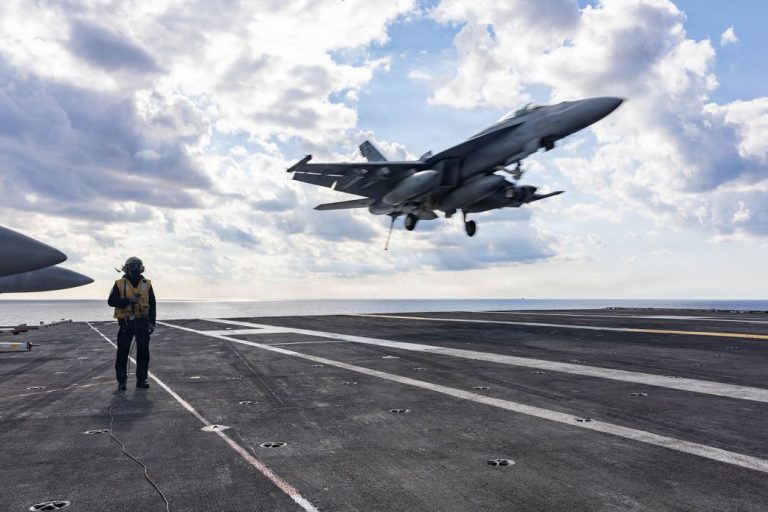
A flight deck crew member in a green vest watching a fighter jet take off or land on an aircraft carrier.

What the Iran War Taught the Pentagon About Missiles

Operation Epic Fury has provided the Pentagon with a critical reality check on missile warfare. While interception rates in the Gulf reached an impressive 90%, the “magazine depth” crisis is now a strategic liability. With the U.S. depleting nearly 30% of its Tomahawk arsenal and 40% of its global THAAD inventory in just weeks, the conflict has exposed a dangerous replenishment gap that could compromise deterrence in the Indo-Pacific theater against more sophisticated hypersonic threats.

Read More »
Donald Trump speaking at a podium with the White House logo in the background.

Global Flashpoints Shaping 2026

Halfway through 2026, global stability is under siege. From the $100 billion annual funding gap in Ukraine to the dangerous vacuum in nuclear arms control, nations are scrambling to adapt. Rising tariffs, the race for critical minerals, and deep cuts in foreign aid are redefining geopolitical alliances and forcing a shift toward a fragmented, multipolar reality.

Read More »
Close-up portrait of Donald Trump wearing a white "USA" hat with an American flag on the side.

America Lit the Fire and Now 40 Nations Are Cleaning Up

The geopolitical fallout of the Iran war has entered a phase of “fractured leadership.” While the United States remains the primary military aggressor, it has become a secondary actor in the diplomatic and maritime cleanup, leaving a coalition of 40 nations to navigate the chaos left in the wake of Operation Epic Fury.

Read More »
A person holding a Tehran Times newspaper featuring a headline about Iran-US talks and an image of a missile.

Bombing the Negotiating Table: How Washington Killed Its Own Diplomacy

The initiation of Operation Epic Fury on February 28, 2026, did more than just dismantle military targets—it effectively dismantled the very concept of U.S.-led nuclear diplomacy. By striking while a major breakthrough was being announced by Omani mediators, Washington has signaled that even total compliance may not be enough to avert a military “solution.”

Read More »
A hand-drawn sign on a chain-link fence with a heart and an atom symbol, reading "Fordo is our heart," near a military facility.

The Nuclear Double Standard Fueling the Iran War

The strike near Dimona on March 22, 2026, has crystallized a long-standing debate over the “nuclear double standard” in the Middle East. While Washington justifies Operation Epic Fury as a necessary measure to prevent Iranian nuclear proliferation, critics point to the immunity granted to Israel’s unacknowledged arsenal as evidence of a fundamentally asymmetric global order.

Read More »
A yellow Komatsu excavator clearing rubble from a heavily damaged multi-story residential building.

How the Iran War Became America’s Ukraine

The U.S. strategy in Iran has devolved into a grinding war of attrition mirroring Russia’s quagmire in Ukraine, as initial hopes for a swift “decapitation strike” fail against Iran’s geographic leverage. With the Strait of Hormuz blockade triggering the largest energy disruption in history and U.S. precision munition stockpiles depleting at an unsustainable rate, Washington faces a strategic stalemate with no viable ground option and no clear path to a decisive victory.

Read More »
A military bomber aircraft on an airfield at dusk, viewed through a silhouette of barbed wire.

Why America’s Iran War Has No Winning Strategy

Operation Epic Fury faces a strategic deadlock as tactical successes—such as degrading 90% of Iran’s missiles—fail to yield a clear political end state. Analysts warn that the campaign has supercharged Iran’s resolve to rebuild while depleting U.S. munitions earmarked for the Pacific, effectively rescuing the Russian war budget through $120-per-barrel oil.

Read More »
Donald Trump speaking at a microphone with a portrait of Ronald Reagan in the background.

Talks, Troops, and a Strike Near Bushehr: The War at Week Four

On Tuesday, March 24, 2026, the war reached a volatile crossroads as President Trump claimed a deal was near while the Pentagon moved 3,000 elite paratroopers toward the Gulf. Despite reported negotiations over the Strait of Hormuz, strikes near the Bushehr nuclear plant have raised fears of a radiological catastrophe.

Read More »
Soldiers lifting a silver metal crate with a yellow radiation warning symbol at a desert excavation site at night with military helicopters.

Leave Iran’s Uranium Buried

Iran’s enriched uranium lies buried under tons of rubble at Isfahan — and experts argue that’s exactly where it should stay. Extracting it would require a weeks‑long engineering operation under fire, while poisoning and sealing it in place would neutralize its weapons potential. Sometimes containment, not commando raids, is the smarter strategy.

Read More »