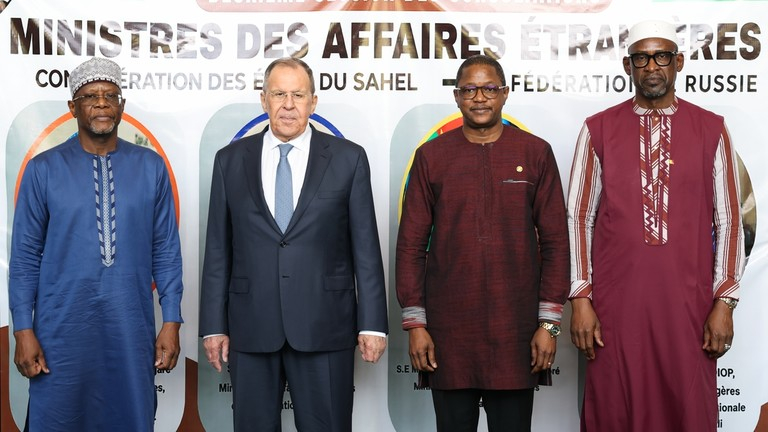
As Western influence in the Sahel recedes, Moscow is moving decisively to fill the void, cementing a new strategic axis that challenges the post-colonial order. Russian Foreign Minister Sergey Lavrov’s recent tour of Africa, culminating in high-level talks in Niger with the Alliance of Sahel States (AES), is the latest and most visible sign of this geopolitical shift. By positioning itself as a partner of equals, Russia is successfully capitalizing on deep-seated anti-Western sentiment and a security vacuum left by the withdrawal of French forces.
The core of Russia’s strategy is a blend of military support, diplomatic backing, and economic promises, all framed within a narrative of mutual respect and non-interference. This approach has found a receptive audience in the military juntas of Mali, Niger, and Burkina Faso, which have severed defense ties with France and formed the AES as a new security bloc. Moscow is formalizing this partnership through regular ministerial consultations and has pledged to strengthen the operational capabilities of the AES armed forces. Beyond security, Russia is also dangling economic incentives, including a landmark deal to develop Ethiopia’s first nuclear power plant, signaling a long-term commitment to the continent.
A Partnership of Pragmatism
Russia’s success is built on its ability to offer a straightforward, “no-strings-attached” alternative to Western engagement. While Western powers have often linked aid and cooperation to democratic reforms and human rights, Moscow provides military hardware and security assistance without such conditions. This has proven highly attractive to the new military governments in the Sahel, which came to power through coups and are focused on regime survival and combating persistent jihadist insurgencies.
The Kremlin’s primary instrument for this security cooperation is the Africa Corps, the successor to the notorious Wagner Group. These state-controlled paramilitary forces provide direct combat support, training, and intelligence, effectively acting as a security guarantor for the ruling juntas. In return, Russia gains significant political influence, access to strategic natural resources, and military footholds near Europe’s southern flank. This model of exchanging security for influence and resources has allowed Moscow to rapidly displace France and other Western actors as the dominant external power in the central Sahel.
The West’s Waning Influence
The West’s declining influence is a result of both its own policy failures and Russia’s skillful exploitation of them. Decades of French military presence in the Sahel failed to defeat the jihadist threat, leading to widespread popular frustration and accusations of neocolonialism. A series of military coups across the region saw new leaders turn away from Paris and toward Moscow, which was ready to offer a different kind of partnership.
This shift has left Western nations in a difficult position, struggling to reconcile their stated commitment to democracy with the pragmatic need to engage with the new realities on the ground. Russia, unburdened by such concerns, has presented itself as a champion of African sovereignty, supporting the continent’s push for a greater voice in international forums like the UN Security Council. While the long-term consequences of this realignment are still unfolding, it is clear that a new geopolitical competition is underway. Russia is not offering a path to democracy or development, but a partnership focused on regime security. For now, in the capitals of the Sahel, that is an offer many are willing to accept.
Original analysis inspired by Egountchi Behanzin from RT. Additional research and verification conducted through multiple sources.