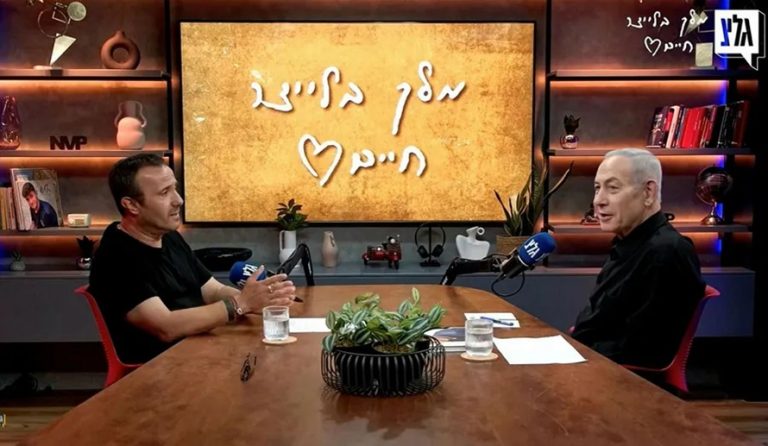
Israel’s election campaign is exposing a growing weakness in political transparency: the boundary between official party advertising and supposedly independent online content. A production company that works for Benjamin Netanyahu’s Likud party is also providing studios and services to podcasters and creators whose political messages frequently support Netanyahu and attack his opponents. Likud acknowledges paying the company for campaign work but denies that the creators themselves belong to its campaign operation. The unanswered question is whether voters can reliably distinguish independent political commentary from coordinated campaign messaging.
Businessman Avi Gross is behind New Vision Production, which has provided media services to Likud while operating studios used by several Netanyahu supporters. Haaretz reported that Likud confirmed paying the company for campaign services. Gross also participated in political media projects during previous elections, including production connected to The Trial, a film challenging the media, prosecutors, and investigations involving Netanyahu.
Political influence is moving beyond advertisements
Traditional election rules assume voters can identify political advertising. Israeli campaign finance regulations require parties to document election expenses, advertising agreements, suppliers, and significant contributions. Election propaganda rules also impose disclosure requirements on certain forms of political advertising and identify who ordered or financed campaign materials.
Podcasting, social media videos, creator accounts, and personality driven political channels complicate that structure. A message can reach hundreds of thousands of voters without looking like an advertisement. The presenter may appear to be offering personal commentary even when production facilities, research, editing, promotion, or other resources are connected to a political organization.
Israeli lawmakers already recognize the wider transparency problem. The Knesset recently debated new disclosure requirements for digitally created election material, including content generated or heavily modified using artificial intelligence. The proposal focuses particularly on misleading digital material, but the underlying problem is broader: modern campaigning can disguise the origin and financing of political persuasion far more easily than television advertisements or campaign posters.
The Israel Democracy Institute has also warned that digital manipulation and influence operations pose growing risks during the 2026 election. Its assessment points to a generation of first time voters who increasingly receive political information through social media, YouTube, WhatsApp, and Telegram. That shift gives political campaigns powerful incentives to make messages resemble organic content rather than official advertising.
Media distrust is becoming part of the campaign
The controversy also matters because attacks on traditional media have become a major campaign theme. Netanyahu and his allies have repeatedly accused Israeli news organizations of political bias, while critics argue that the government is weakening institutions capable of scrutinizing those in power.
Army Radio has become one of the clearest examples of this conflict. Netanyahu’s government previously moved to close the broadcaster, arguing that a military operated station should not function as an independent civilian news outlet. Journalists and civil society organizations opposed the move, and the High Court later intervened. More recently, Netanyahu was interviewed by Army Radio from New Vision Production’s studios rather than the broadcaster’s normal facilities, adding another layer to questions surrounding the relationship between political campaigns and media infrastructure.
The issue becomes more important as Israel approaches an election in which Netanyahu faces pressure both from opposition parties and within Likud itself. Reuters reported significant divisions among Likud members over whether the party should maintain its current political direction or appeal more strongly to centrist voters. In such a competitive environment, control over online narratives can become almost as important as formal campaign events.
None of this proves that every creator using New Vision Production is secretly working for Likud. Independent commentators can share political views with a party without taking instructions from it. But transparency depends on knowing who pays for production, promotion, facilities, and campaign services. When those relationships remain unclear, voters cannot easily determine whether they are watching journalism, activism, personal opinion, or political advertising.
Israel’s election rules were designed for a media environment in which political sponsorship was easier to identify. The current controversy shows how quickly that model is becoming obsolete. Updating election law will require more than regulating false information. It will require clear disclosure when political money or campaign infrastructure helps produce content presented to voters as independent speech.
Original analysis inspired by Haaretz Editorial from Haaretz. Additional research and verification conducted through multiple sources.