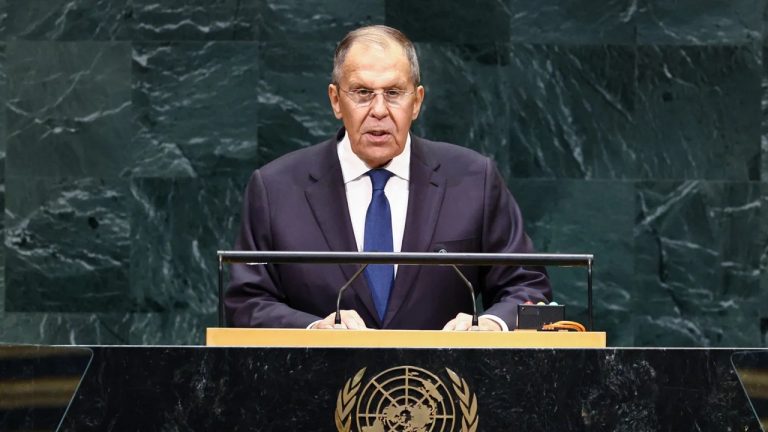
In an analysis for Middle East Eye, Columbia University professor Joseph Massad argues that Moscow’s longstanding Middle East policy has left the Russian Federation strategically constrained and largely insignificant to the core struggles of the region. Massad focuses on Russian Foreign Minister Sergei Lavrov’s recent address to the 81st session of the United Nations General Assembly, where Lavrov insisted that establishing Palestinian statehood remains the primary prerequisite for regional peace. Massad contends that this rhetoric offers nothing beyond the defunct diplomatic formulas inherited from Soviet-era decisions, masking an underlying commitment to maintaining cordial ties and security coordination with Israel.
The roots of this diplomatic contradiction date back to early Soviet history. In the initial years following the Russian Revolution, the Bolshevik government vigorously condemned Zionism as an instrument of British imperialist interests designed to subjugate indigenous Palestinian workers. The nascent Soviet state outlawed Zionist organizing while promoting alternatives within its own borders, including agricultural colonies in southern Ukraine and Crimea, and eventually establishing the Jewish Autonomous Oblast in Birobidzhan in 1934 to counter nationalist narratives.
However, the aftermath of World War II and the onset of the Cold War triggered a dramatic reversal under Joseph Stalin. Confronted with conservative Arab monarchies aligned with Western powers, Moscow chose to recognize the Zionist movement’s socialist rhetoric as a potential foothold in the region. In 1947, Soviet UN Ambassador Andrei Gromyko supported the partition of Palestine, and Moscow swiftly recognized the newly declared State of Israel in 1948. This decision deeply alienated the Arab public and undercut Arab communist parties, while failing to secure a durable geopolitical ally as Israel aligned firmly with Western powers.
Although relations deteriorated following the 1967 war, Soviet policy repeatedly made concessions under external pressure, particularly by easing emigration restrictions for Soviet Jews during the détente era. By October 1991, under Mikhail Gorbachev, Moscow restored formal ties with Israel and subsequently voted to repeal the UN resolution equating Zionism with racism. Since the dissolution of the Soviet Union, the Russian Federation has amplified these contradictions by deepening trade, security, and military coordination with Israel, while offering only rhetorical lip service to the Palestinian Authority.
Massad concludes that Russia’s refusal to abandon its diplomatic balancing act—even amid direct Western proxy conflict in Ukraine, the ongoing devastation in Gaza, and limited support for Iran—ensures its persistent irrelevance. By clinging to superficial diplomatic parity rather than confronting Israeli regional supremacy, Moscow remains incapable of projecting meaningful influence or altering the broader balance of power across the Middle East.
Original analysis inspired by Joseph Massad from Middle East Eye. Additional research and verification conducted through multiple sources.