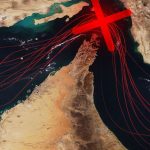
The war’s most immediate and consequential miscalculation involves the Strait of Hormuz. Iran is forcing oil tankers onto a new route through a narrow passage controlled by its Revolutionary Guard, with some ships charged millions of dollars to transit — a system shipping industry experts have dubbed “the Tehran toll booth,” suggesting Iran remains firmly in control of the critical waterway despite intense strikes.
Before the bombing campaign began, around 110 ships passed through the strait every day. Since then, that number has plummeted to fewer than 10, according to Lloyd’s List Intelligence. The economic math for Tehran is striking. At a reported fee of $2 million per tanker, that translates to roughly $600 million a month from oil tankers alone — and if LNG shipments are included, that figure could rise above $800 million a month, equivalent to 15-20% of Iran’s entire monthly oil export revenue in 2024.
Iran is simultaneously monetizing both sides of the conflict. China has been engaging in direct diplomacy with Tehran to secure safe passage for Chinese-flagged vessels, with over 11 million barrels of Iranian crude continuing to flow eastward in the conflict’s first weeks alone, paid for in renminbi through China’s Cross-Border International Payment System. Iran’s new toll system charges approximately $1 per barrel in yuan or stablecoins — a financial architecture deliberately engineered to bypass the dollar-based Western financial system. Iran has now formally added “recognition of Iran’s sovereignty over the Strait of Hormuz” to its five conditions for ending the war — a demand that didn’t even exist before the bombs fell.
In his first purported address as Iran’s new supreme leader, Mojtaba Khamenei said the leverage of blocking the waterway “must continue to be used.” That is not the statement of a regime on the verge of capitulation.
Moscow’s Windfall, Beijing’s Patience
The war has handed Russia the kind of financial rescue package that no amount of domestic policy could have delivered. Before the Iran crisis, Russia’s energy revenues were in freefall, with oil export earnings having fallen below $10 billion in February, forcing the Kremlin to prepare 10% cuts to all non-security spending. The oil price surge reversed that entirely. According to the KSE Institute, Russia could receive between $45 billion and $151 billion in additional budget revenues in 2026, depending on the conflict’s duration, accounting for energy export volumes and the narrowing of the discount on Russian crude.
Brent crude surged toward $120 a barrel, and this windfall has rescued the Russian war budget, providing the Kremlin with capital to sustain its military operations in Europe. In other words, a war ostensibly aimed at strengthening American deterrence has directly subsidized the country fighting a war against a US-backed partner. Russian support for Iran is driven not by alliance obligations but by a broader strategy of imposing costs on the United States — with intelligence and technical assistance increasing the effectiveness of Iranian attacks on US and allied assets, which Moscow views as retaliation for years of American support to Ukraine.
China’s position is more nuanced but no less advantageous. Observing US naval operations in the Gulf in real time — carrier movements, missile intercept patterns, logistics flows — is itself strategically valuable for China as it thinks through scenarios involving the Strait of Taiwan. The more the US deploys and reveals its operational playbook in the Gulf, the better calibrated Beijing’s own planning becomes. Russia trades its hydrocarbons for Chinese capital, technology, and diplomatic cover, while China’s 2026-2030 development blueprint reflects renewed momentum for projects such as the Power of Siberia 2 pipeline, underscoring Beijing’s desire to insulate its economy from Middle Eastern volatility.
The Hardliner Premium
Beyond the financial ledger, the war has reshuffled Iran’s internal power balance in ways that make any durable settlement harder to reach. Trump stated his desire for Iran’s “unconditional surrender” and the emergence of “acceptable leaders” — yet if US-Israeli operations do not accomplish these objectives, Russia and China will seek to capitalize on America’s latest entanglement in the region.
The succession tells the story plainly. Ali Khamenei — who famously issued a fatwa against nuclear weapons — was killed on the opening night of the war. His replacement, Mojtaba Khamenei, has deepened ties with the Revolutionary Guards and hardened Iran’s negotiating position. The more consequential effect is strategic: the war is accelerating the consolidation of the Russia-China partnership, reversing a half-century of American grand strategy aimed at preventing a durable alignment between Moscow and Beijing.
Up to 30% of internationally traded fertilizers normally transit the Strait of Hormuz, and unlike oil, the fertilizer sector has no internationally coordinated strategic reserves, making supply disruptions harder to manage. In early March, Middle East granular urea prices rose nearly 20% compared to late February levels. The costs are spreading into food systems, not just fuel markets.
The US may currently possess military dominance, but Russia and China are effectively winning the “risk war” — by encouraging a prolonged state of conflict, they are systematically lowering Western stability scores and waiting for the cumulative economic and political pressure to force a strategic retreat. Whether Trump’s deadline extensions and ceasefire signals translate into genuine diplomacy, or simply buy time for all sides to recalibrate, the war’s early returns suggest that the party doing the bombing is not the only one cashing in.
Original analysis inspired by Fareed Zakaria from Foreign Policy. Additional research and verification conducted through multiple sources.