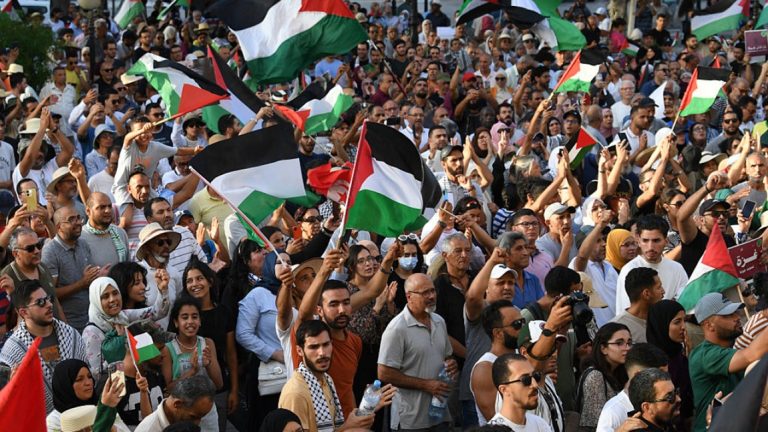
More than 300 Arab academics, writers, artists, and activists have joined a manifesto rejecting normalisation with Israel and calling for Palestinian and broader Arab self determination. Their declaration represents one side of a widening regional divide. Arab governments continue to pursue security, trade, and diplomatic arrangements that involve Israel, while large sections of the public remain deeply hostile to those relationships. That gap is becoming one of the main constraints on Israel’s attempt to secure lasting regional integration.
The disagreement is not simply ideological. Arab Barometer found that support for normalisation failed to exceed 13 percent in any of the seven Arab societies it surveyed after the Gaza war began. In Morocco, support fell from 31 percent to 13 percent, even though Rabat has retained official relations with Israel. The Arab Opinion Index similarly recorded that 87 percent of respondents opposed recognition of Israel, while 80 percent considered Palestine a collective Arab cause.
Governments and publics are moving differently
The Abraham Accords demonstrated how far official diplomacy could move even without broad public enthusiasm. The agreements established new relationships between Israel and the United Arab Emirates, Bahrain, Morocco, and Sudan, adding to the older peace treaties with Egypt and Jordan. Economic opportunities, security cooperation, technology, investment, and stronger ties with Washington helped give participating governments reasons to maintain those relationships.
But the Gaza war changed the political environment around expansion. Arab Barometer researchers concluded that public anger had constrained governments that still saw strategic benefits in closer relations with Israel. Saudi normalisation, once regarded as the next major step, became substantially harder to pursue without movement on Palestinian statehood.
Lebanon illustrates how easily security diplomacy can also become politically explosive. Beirut and Israel signed a US mediated framework in June that links Israeli withdrawal from parts of southern Lebanon with Lebanese efforts to disarm Hezbollah and extend state authority. The agreement is not a peace treaty or full normalisation arrangement, despite critics presenting it as part of a broader normalisation process. Its implementation remains contested, with Hezbollah opposing disarmament before an Israeli withdrawal.
Regional integration still has powerful incentives
Opposition to normalisation also confronts an economic strategy that reaches beyond diplomatic recognition. The India Middle East Europe Economic Corridor was formally outlined by India, the United States, Saudi Arabia, the United Arab Emirates, the European Union, and other partners as a network connecting Asian, Gulf, and European markets. Israel’s geographic position made it an important possible link between Gulf infrastructure and Mediterranean trade routes.
For supporters of regional integration, such projects promise investment, transport links, energy connections, and reduced barriers between economies. For critics, they risk allowing economic cooperation to advance while the Palestinian conflict remains unresolved. That disagreement explains why normalisation has survived institutionally while struggling to acquire popular legitimacy.
The manifesto published by Arab intellectuals pushes this criticism much further, describing normalisation as part of a wider system of Western domination and rejecting diplomatic compromise with Israel altogether. That position does not represent every Arab political current, and polling also shows continued support in parts of the region for a negotiated two state settlement. Arab Barometer reported that support for Palestinian statehood remains compatible with recognition of Israel’s existence among many respondents.
The larger challenge for regional diplomacy is therefore legitimacy. Governments can sign agreements because they see strategic or economic value in them, but formal relations do not automatically produce social acceptance. Unless diplomacy addresses Palestinian rights and the political consequences of the Gaza conflict, normalisation may continue to exist between states while remaining rejected by many of the people those states govern.
Original analysis inspired by Arab Collective from The New Arab. Additional research and verification conducted through multiple sources.