
By Alina Cara Beyer
Abstract
This article examines the evolution of warfare between Iran and Israel through the lens of the February–March 2026 war, in which the United States fought alongside Israel in an intensive air and missile campaign against Iran. Building on the earlier 12-Day War of 2025, the 2026 conflict demonstrates how both sides have integrated precision strikes, massed drone and missile salvos, and sophisticated information operations into a hybrid warfare model. The article focusses on three dimensions: (1) the kinetic conduct of the February–March 2026 campaign, including Israel-US strikes on Iranian missile and nuclear infrastructure and Iran’s regional missile response; (2) the deployment of controversial munitions, especially Israel’s use of white phosphorus in southern Lebanon; and (3) the narrative and disinformation battle, including Iran’s AI-driven propaganda and Israel-US efforts to frame the war as a defensive, “surgical” operation. It argues that “new warfare” in this dyad is less about revolutionary technologies than about the strategic fusion of existing tools, drones, missiles, phosphorus, and media, into a tightly integrated military-informational system that exploits legal grey zones and global attention cycles.
At the policy level, the war also suggests that future regional conflicts will not be decided by battlefield performance alone, but by the ability of states to protect strategic trade routes, manage alliance exposure in the Gulf, limit civilian harm, and retain narrative credibility in a hyper-mediated environment. Reuters has documented both Iranian attacks on Gulf states and shipping disruption in and around the Strait of Hormuz, while Human Rights Watch has reported that Israeli forces unlawfully used white phosphorus over Yohmor on 3 March 2026.
Introduction
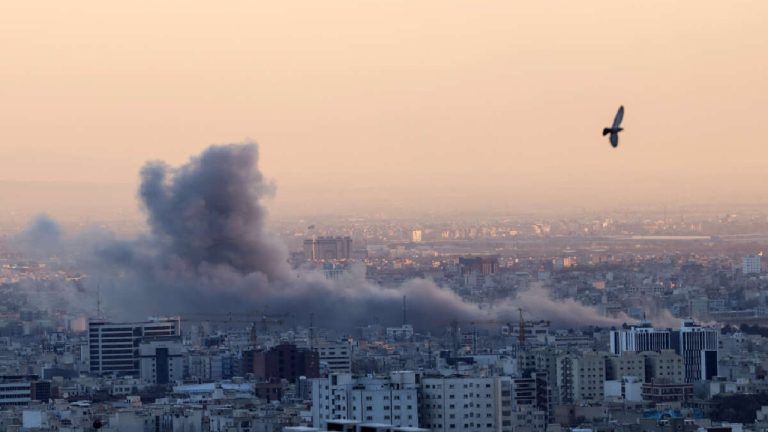
The February–March 2026 war between Iran on the one hand and the United States and Israel on the other marks a turning point in the long-running shadow conflict between Tehran and Tel Aviv. Nine months after the 12-Day War of June 2025, which saw unprecedented Iranian missile and drone attacks on Israel and a large-scale Israeli response, the 2026 conflict escalated into a far more intense, US-backed campaign aimed at degrading Iran’s missile and nuclear capabilities and, according to many observers, at reshaping the Islamic Republic’s leadership. In the first twelve hours alone, US and Israeli forces reportedly carried out nearly 900 strikes on Iranian targets, ranging from missile launch sites and air defense systems to nuclear-related facilities and command nodes.
Iran, in turn, launched waves of missiles and drones at Israel and US assets in the Gulf, struck bases in Bahrain, Qatar, Kuwait, and the UAE, and targeted shipping routes in the Strait of Hormuz. The war quickly produced significant civilian suffering inside Iran, with power outages, displacement, and mounting casualties, while also generating spillover effects in Lebanon, Iraq, Syria, and the wider region. One of the most controversial episodes occurred on 3 March 2026, when Israel used air-burst white phosphorus munitions over the southern Lebanese village of Yohmor, igniting fires in residential areas and triggering accusations of unlawful conduct under international humanitarian law.
At the same time, the conflict unfolded as a hyper-mediated event. Iranian state media and IRGC-linked outlets flooded social networks with exaggerated or fabricated claims of battlefield success, often using AI-manipulated imagery and recycled footage. Israel and the United States ran their own intensive messaging campaigns, emphasizing the precision and necessity of their strikes, while NGOs and independent journalists tried to document civilian harm and legal violations. The February–March 2026 war thus offers an ideal case to study “new warfare” in practice.
The February–March 2026 war thus offers an ideal case to study “new warfare” in practice. At the same time, it highlights a broader policy problem: contemporary regional warfare is no longer confined to bilateral deterrence between Tehran and Tel Aviv, but increasingly unfolds across allied Gulf territory, maritime chokepoints, insurance markets, and digital information ecosystems. Reuters’ reporting on Iranian strikes against Gulf states and on the resulting disruption of shipping and insurance markets underlines that the conflict’s significance extends far beyond the immediate exchange of fire.
1. Kinetic Warfare in February–March 2026
1.1 The US–Israeli Strike Wave
The opening of the 2026 war was characterized by an extraordinary tempo and density of US-Israeli air and missile strikes. On 28 February 2026, within roughly twelve hours, American and Israeli forces launched close to 900 strikes against Iranian targets. These included:
- Fixed ballistic missile sites and mobile launcher staging areas in western and central Iran.
- Integrated air defense systems around key cities and strategic facilities.
- Nuclear-related sites, including testing and research complexes previously targeted in covert sabotage operations.
- Command, control, and communications nodes used by the IRGC and conventional forces.
Operationally, this strike wave revealed a refined “decapitation and degradation” doctrine. Rather than focusing on a gradual campaign, US and Israeli planners attempted to compress as much destructive effect as possible into the opening hours: blinding Iranian radar, crippling key launch units, and severing command links. The logic was to recreate, at a larger and more overt scale, the pattern of preemptive strikes seen in 2025, when Israel had targeted Iranian missile infrastructure and leadership positions after the 12-Day War salvos—this time with far greater US participation and with fewer attempts to maintain deniability.
For Iran, the initial effect was severe: radar coverage was disrupted in several regions; air bases reported runway and hangar damage; and nuclear-related facilities experienced direct hits or operational interruptions. Yet the very intensity of the strike wave also revealed the limits of conventional dominance: despite heavy damage, Iranian forces retained sufficient capacity to launch large-scale retaliatory salvos.
1.2 Iran’s Missile and Drone Response
In the first twelve days of the war, Iran launched roughly 300 missiles at Israel—about half the volume of its 2025 12-Day War salvo, but more targeted and integrated with attacks on US regional assets. Iran also employed drones and cruise missiles against US bases in Bahrain, Qatar, Kuwait, and the UAE, and threatened shipping in the Gulf and the Strait of Hormuz.
Several features of Iran’s response point to an evolved doctrine of “asymmetric endurance” and saturation:
- Mixed salvos combined ballistic missiles, cruise missiles, and one-way attack drones, complicating interception efforts by exploiting different flight profiles, ranges, and altitudes.
- Launches originated not only from Iranian territory but also from allied territories and proxies, including elements in Iraq and Yemen, echoing but expanding the multi-front approach from 2025.
- Iranian planners clearly anticipated early losses of fixed launch sites: mobile launchers, dispersed storage facilities, and alternative command structures allowed Tehran to sustain attacks despite the initial 900-strike wave.
Militarily, Iran could not hope to match US–Israeli precision or sortie numbers. Instead, its goal was to maintain the ability to strike symbolic and strategic targets inside Israel—such as air bases, energy infrastructure, or urban peripheries—and to impose costs on US forces, while projecting resilience to domestic and regional audiences. Even when interception rates remained high, a small number of missiles that penetrated defenses and struck near major cities or bases created powerful images and psychological effects.
Interestingly, Iranian strikes appeared to target US-aligned Gulf states such as the UAE more frequently than Israel itself. This pattern reflects a strategic logic of indirect pressure. While Israel possesses one of the most sophisticated multi-layered air defense systems in the world, Gulf states host critical US infrastructure, energy assets, logistics hubs, and economically sensitive civilian targets. By striking bases and infrastructure in the Gulf, Iran can impose costs on the wider regional security architecture supporting Israel without necessarily relying on direct escalation against Israel alone. From a policy perspective, this suggests that Gulf states are no longer merely secondary arenas of spillover, but increasingly central theatres in any future Iran–Israel confrontation. Reuters has reported missile attacks on Gulf cities and analysts’ concerns that such strikes could widen the war and deepen Gulf security coordination with Washington.
1.3 Civilian Impact and Infrastructural Targeting
On the ground, the air war produced severe civilian consequences in Iran. Intensive bombing around Tehran and northern regions led to extensive power outages, disrupted transportation networks, and significant displacement. Local reports described neighborhoods partially destroyed by strikes on adjacent military or industrial targets, hospitals struggling with surges of casualties during blackouts, and residents fleeing urban centers for less exposed rural areas.
At the same time, Iran’s missile attacks on Israel and US bases often carried predictable risks to civilian populations. Missiles that fell short or were poorly targeted hit residential areas, industrial zones, and infrastructure. In one widely reported instance, a missile intended for a military facility near Haifa struck a residential building, killing several family members and damaging a nearby school. In another, an attack on a power substation caused a blackout affecting both military installations and civilian neighborhoods.
These mutual patterns underscore the core feature of the kinetic dimension in 2026: while both sides justified their targets as military, the technical properties of missiles and the urban density of regional battlefields meant that civilian harm remained structurally embedded in the conduct of operations.
1.4 Maritime Escalation: The Return of “Tanker War”
Beyond missile exchanges and air campaigns, the 2026 conflict rapidly expanded into the maritime domain, raising fears of a renewed “Tanker War” in the Persian Gulf reminiscent of the Iran–Iraq War in the 1980s. Iranian forces threatened commercial shipping in the Strait of Hormuz through a combination of missile strikes, drone surveillance, and the broader threat environment created by the Islamic Revolutionary Guard Corps Navy (IRGCN).
Although Iranian officials signaled that the Strait of Hormuz was effectively “closed,” shipping traffic never fully ceased. Instead, the situation resembled a form of selective maritime coercion rather than a uniform blockade. Several shipping companies suspended operations due to fears of sabotage, naval mines, or drone attacks, leading to sharply rising insurance premiums and temporary disruptions in global energy transport. Noor Zainab Hussain and Manya Saini reported for Reuters that war-risk premiums surged dramatically, in some cases by more than 1000 percent, as the conflict widened.
Notably, Reuters also reported that some vessels linked to major Asian energy importers, including China, were involved in talks or arrangements concerning safe passage through Hormuz. This suggests that the maritime pressure campaign may have functioned not simply as a total closure mechanism, but as a form of selective coercion shaped by geopolitical relationships and energy dependence.
Militarily, Iran possesses multiple tools for maritime harassment short of a full blockade. These may include anti-ship missiles deployed along the Iranian coast, one-way attack drones, fast attack craft capable of swarm tactics against large vessels, and the potential use or threatened use of naval mines or sabotage devices. Even isolated incidents or credible threats can have disproportionate economic effects by triggering insurance crises, rerouting, and delays in energy shipments. Reuters has also reported, however, that U.S. officials publicly cautioned that there was no confirmed evidence at one stage that Iran had mined the Strait, underscoring the need for analytical caution in assessing the exact mix of coercive tools used.
Should such attacks intensify, the United States could once again resort to naval escort missions similar to Operation Earnest Will (1987), when the US Navy protected Kuwaiti oil tankers during the Iran–Iraq War. In the context of the 2026 conflict, such convoy operations would likely involve assets of the US Fifth Fleet based in Bahrain and could significantly widen the maritime dimension of the war. Reuters reported that Donald Trump publicly stated the United States would escort vessels through Hormuz “if needed,” even as operational reporting suggested that such escort arrangements were not yet straightforward under prevailing combat conditions.
2. White Phosphorus and “Grey Zone” Weapons
2.1 The Yohmor Incident, 3 March 2026
One of the most emblematic episodes of the 2026 war occurred not in Iran or Israel proper but in southern Lebanon. On 3 March 2026, Israeli forces fired air-burst white phosphorus artillery shells over and around the village of Yohmor, a small community south of the Litani River. Human rights investigators later verified photographic and video evidence showing the characteristic cascading bursts of burning white phosphorus descending over residential areas. Human Rights Watch stated on 9 March 2026 that it had verified and geolocated visual evidence showing artillery-fired white phosphorus airburst over a residential part of Yohmor, where fires affected at least two homes and one vehicle.
In this incident:
- At least two houses and a vehicle were set on fire by burning phosphorus wedges.
- Residents described particles penetrating roofs, igniting interiors, and causing intense smoke that forced civilians to flee or seek shelter.
- Emergency responders were filmed dousing burning rooftops and trying to contain fires spreading to adjacent structures.
International humanitarian law does not categorically ban white phosphorus, which can be used for smoke screening and target marking. However, air-burst use over populated areas, where burning phosphorus spreads uncontrollably and clings to skin and tissue, is widely considered unlawful when used in airburst mode over populated areas because of the foreseeable inability to distinguish adequately between civilians and combatants and the severe incendiary effects documented by human rights monitors.
The Yohmor case did not occur in a vacuum. It formed part of a broader pattern of Israeli phosphorus use in southern Lebanon since at least late 2023, when similar attacks on border-adjacent villages were documented. The 2026 incident thus signaled not an aberration but the normalization of a tactic in which a formally “dual-use” munition is employed in ways that systematically endanger civilian populations.
2.2 Phosphorus as a Tool of Area Denial and Coercion
From a strategic perspective, Israel’s repeated white phosphorus use in southern Lebanon reflects more than tactical smoke creation. It functions as:
- Area denial: By igniting fields, orchards, and residential structures, phosphorus attacks make certain zones temporarily or even permanently uninhabitable, effectively pushing civilians away from suspected launch or infiltration areas.
- Coercive signaling: The visual and physical horror of phosphorus—burning skies, persistent fires, gruesome wounds—sends a deterrent message to Hezbollah and Iran about the price of operating near the border.
- Psychological warfare: The intense fear and media resonance surrounding phosphorus images amplify their coercive effect far beyond the immediate blast radius.
In Yohmor and similar villages, farmers lost crops and trees to fires; families abandoned homes; and residents expressed expectations that further attacks could follow any perceived escalation by Hezbollah. In this sense, white phosphorus blurs the line between artillery support and a form of forced displacement tool.
2.3 Iran’s “Grey Zone”: Conventional Munitions with Indiscriminate Effects
On the Iranian side, the 2026 war did not reveal comparable systematic use of specialized incendiary munitions over populated areas. Instead, Iran’s legal and moral exposure lies primarily in its use of conventional missiles and drones against targets in or near dense urban environments, where accuracy is limited and collateral damage is highly likely.
The key “grey zone” characteristics include:
- Use of missiles with questionable guidance accuracy against targets close to civilian infrastructure, such as power stations adjacent to residential districts or bases near cities.
- Acceptance of high miss-distance risks: Even with improved guidance, errors in targeting data or system performance produce impacts in streets, housing blocks, or industrial sites.
- Political framing of major cities as “military complexes,” rhetorically collapsing civilian and military spheres and justifying broader target sets.
In effect, while Israel pushes legal boundaries through phosphorus use that transforms nominally lawful smoke/illumination shells into de facto incendiary area weapons, Iran does so through target selection practices that leverage the destructive power of conventional munitions in urban settings. Both approaches exploit ambiguities in international law, but in distinct technical ways.
3. Information and Media Warfare in the 2026 Conflict
3.1 Iran’s Disinformation Surge
Parallel to its kinetic response, Iran engaged in an aggressive information campaign aimed at magnifying its perceived battlefield performance and undermining enemy morale. In the first days of the war, independent fact-checkers and media monitors documented a wave of Iranian state-linked or IRGC-aligned claims that turned out to be false or heavily distorted. Among them were:
- Fabricated announcements of a US radar system at Al-Udeid Air Base in Qatar being destroyed, supported by AI-manipulated satellite images showing supposed craters and damage.
- Claims that a US aircraft carrier had been seriously hit, accompanied by doctored photos and repurposed footage from unrelated naval incidents.
- Videos allegedly showing US fighter jets shot down over the Gulf, which were later traced back to older clips of Iranian training accidents or even flight simulator footage.
- Inflated casualty reports, such as assertions that “hundreds of US soldiers” had been killed in a single missile barrage, without corroboration from any independent source.
The Reuters Fact Check team documented several fabricated or AI-generated visuals circulating during the conflict, including false images purporting to show captured US troops in Iran. Such examples support the broader claim that the war’s information environment was shaped not only by exaggerated official narratives, but also by increasingly sophisticated synthetic media. Technically, these campaigns combined classic propaganda techniques—exaggeration, recycling old footage—with newer tools, including AI-generated images and deepfake-style content. The messaging targeted multiple audiences: the Iranian public, to project strength and justify sacrifices; regional publics, to present Iran as capable of bleeding the United States and Israel; and international observers, to sow doubt about Western narratives of overwhelming US–Israeli success.
3.2 Israel and the United States: Precision Narratives and Legal Framing
On the other side, Israel and the United States mounted their own intensive media campaigns. Official communications highlighted three key themes:
- Precision and professionalism: Visual materials—cockpit videos, bomb-camera footage, satellite imagery—were used to show “surgical” strikes on missile launchers, radar sites, or “terror infrastructure,” with captions emphasizing minimized collateral damage.
- Defensive necessity: Leaders framed the campaign as a forced response to Iran’s “aggression” and “unacceptable missile threats,” often linking the 2026 strikes back to the 2025 salvos and previous attacks on Israel and US regional assets.
- Legal justifications: Press conferences and statements invoked self-defense under Article 51 of the UN Charter and stressed compliance with the laws of armed conflict, even as human rights organizations raised concerns about civilian harm in Iran and the legality of certain target choices.
In practice, the precision narrative stood in tension with reports from Iranian hospitals, local authorities, and international NGOs, which pointed to significant civilian casualties and destruction of dual-use infrastructure such as power grids, bridges, and industrial facilities. The Yohmor phosphorus incident further complicated Israel’s messaging: while official spokespeople insisted that phosphorus was used in line with international law for smoke and marking purposes, images from southern Lebanon showed burning homes and injured civilians.
3.3 NGOs, Journalists, and the Counter-Narrative Ecosystem
The 2026 conflict also demonstrated the growing role of NGOs, rights groups, and independent journalists as active participants in the narrative battlespace. Organizations specializing in conflict monitoring and human rights quickly began to:
- Geolocate and verify videos from Iran and Lebanon to document strikes on civilian areas, including Yohmor and other villages where phosphorus was used.
- Cross-check claims by all sides against satellite imagery, casualty patterns, and open-source intelligence.
- Issue rapid-response reports and social media threads challenging official Israeli, US, and Iranian claims.
This created a multi-layered narrative environment where state actors (Iran, Israel, US) produced tightly framed accounts of the war, while NGOs and journalists contested these frames with evidence of legal violations and civilian harm. Third-party states and multilateral organizations selectively adopted elements of these competing narratives. The result was not a simple “truth versus lies” dynamic but a complex contest in which verified facts, partial truths, and outright fabrications coexisted and competed for attention.
4. Hybrid Warfare: The Fusion of Firepower, Phosphorus, and Narratives
4.1 From 2025 to 2026: Learning and Scaling
Comparing the 12-Day War of 2025 with the February–March 2026 conflict reveals a clear learning curve on all sides. In 2025, Iran tested massed missile and drone salvos on an unprecedented scale, while Israel stress-tested its layered air defenses and preemptive strike doctrines. US involvement was present but constrained.
By 2026, the United States and Israel integrated their operational planning to deliver a massive, synchronized strike wave at the outset, aiming for rapid degradation rather than gradual attrition. Iran refined its salvo composition, improved survivability of its launch infrastructure, and expanded its use of proxies and regional firing platforms. Both sides elevated information operations from a supporting effort to a co-equal axis of warfare, investing in real-time messaging, AI-enhanced content, and coordinated media strategies.
The Yohmor phosphorus strike and Iran’s disinformation output during the early days of the war are not side stories but central datapoints in this evolution. They show how physical violence and symbolic violence have become deeply entangled.
4.2 Weapons as Symbols, Symbols as Weapons
In this hybrid environment, weapons are not just instruments of destruction; they are semiotic devices that generate images, stories, and legal controversies:
- White phosphorus shells over Yohmor produced a cascade of visual material—night-sky flares, burning roofs, injured civilians—that fed into NGO reports, news coverage, and social media campaigns alleging war crimes and double standards.
- Iranian missiles that slipped through defenses and exploded near Israeli bases or urban peripheries were quickly turned into proof of Iranian resilience and deterrent capacity, regardless of their actual military effect.
- US–Israeli bomb-camera footage of “clean” strikes on isolated bunkers was disseminated as evidence of moral and technological superiority, even while off-camera impacts in mixed civilian-military zones told a more ambivalent story.
Conversely, symbols have become weapons. Deepfake videos of downed jets, AI-generated images of burning bases, and carefully curated clips of weeping families serve operational objectives: to sow confusion, rally supporters, pressure adversaries, and shape the global policy debate over ceasefires, sanctions, or further escalation.
4.3 Legal Grey Zones and Normative Erosion
Finally, the February–March 2026 war underscores the erosion of established norms in two linked ways:
- Operational practices in legal grey zones: Israel’s repeated use of air-burst phosphorus over populated areas in southern Lebanon exploits the fact that phosphorus is not absolutely banned, while effectively turning it into an indiscriminate incendiary weapon. Iran’s targeting of infrastructure near urban areas leans on broad interpretations of “military objectives.”
- Narrative strategies that normalize exceptional measures: By framing phosphorus as a purely “smoke and marking” tool, and high-impact strikes on dual-use infrastructure as “precision operations,” state actors gradually shift public perceptions of what is acceptable. Repeated exposure to fabricated battlefield claims dulls audiences’ ability to distinguish between real and invented atrocities.
In this sense, “new warfare” is not simply about drones, AI, or missiles; it is about the systematic use of these tools to stretch, blur, and eventually redefine the boundaries of lawful and legitimate violence.
Conclusion
The February–March 2026 war between Iran and the US-Israeli coalition crystallizes a form of hybrid warfare that has been evolving for years. On the kinetic level, the conflict fused massed missile and drone salvos, high-tempo precision strikes, and regional proxy operations into a multi-domain campaign. On the legal level, it showcased the strategic use of grey-zone munitions—most starkly white phosphorus in southern Lebanon—and target selection practices that foreseeably harm civilians. On the informational level, it saw an unprecedented flood of AI-supported disinformation, tightly choreographed state narratives, and counter-narratives by NGOs and journalists.
Three implications follow. First, analysts and policymakers must shift from narrow debates about specific weapons to broader assessments of how these tools are combined in integrated campaigns that deliberately manipulate legal ambiguities, economic vulnerabilities, and public perceptions. Second, arms control and conflict-regulation efforts will have to account not only for kinetic capabilities but also for maritime coercion and the role of AI-generated content in warfare. Third, journalists and civil society actors face the dual challenge of documenting violations in real time while resisting co-option into the narrative strategies of the parties to the conflict. The Iran–Israel dyad is thus best understood as a laboratory of new warfare: a space where hard-power and soft-power instruments are tested and refined in ways that are likely to influence future conflicts far beyond the Middle East.
Reuters, February 2026: Strait of Hormuz and Gulf Strikes
Hussain, Noor Zainab and Manya Saini, Reuters, March 2026: Maritime Insurance Premiums
International Energy Agency (IEA), March 2026: Oil Stock Release News
Reuters, March 2026: Chubb to Serve as Lead US Insurer
International Crisis Group (2026), The Expanding Israel-Iran Shadow War
Human Rights Watch (HRW), March 2026: Israel Unlawfully Using White Phosphorus
Reuters Fact Check, March 2026: AI-Generated Capture Images


