
By Maryam Raashed
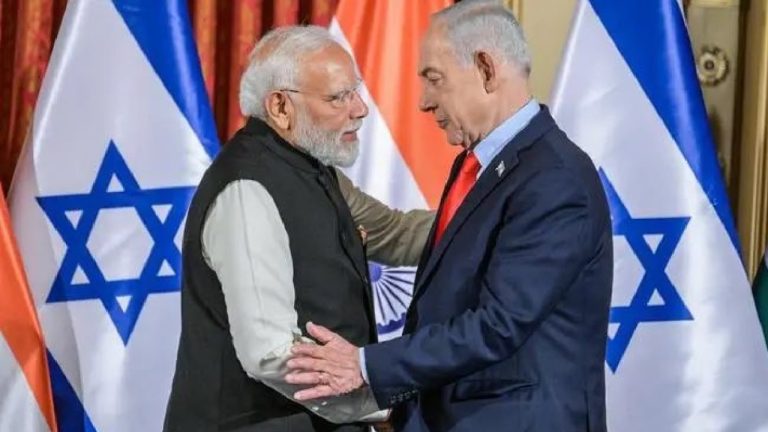
The recent visit of Indian Prime Minister Narendra Modi to Israel is perhaps one diplomatic affair that has received quite a traction, owing to a number of reasons. First, the visit not only consolidated the emerging diplomatic reset in New Delhi’s policy vis-à-vis Israel, but also depicted New Delhi’s desertion from its anti-colonial standpoint—which was once the bedrock of India’s foundational ideology, and anchored its positioning with the global South.
Second, Modi’s visit came at a time when the Israel-led humanitarian onslaught and genocide in Gaza led the Israeli Prime Minister Benjamin Netanyahu into facing immense political and diplomatic isolation; both from within Israel and the broader states and multi-lateral organisations, with Washington being an exception though. Third, the visit took place at a time when the west Asian eastern stability was about to hit a cliff as Tel Aviv and Washington were gearing up to initiate a military action against Iran. And fourth, a few days before Modi’s visit, Netanyahu voiced his ambition to form a ‘hexagon of alliance’ against the so-called Sunni and Shia axes in west Asia, while naming India to be a part of this alliance as well.
Quite naturally, the contextual backdrop of this visit painted it as New Delhi’s way of approving of Netanyahu. During Modi’s address to the Israeli Knesset—which was not attended by most opposition members of the Knesset—both leaders lauded and thanked one another for being reliable and sympathetic. Modi also expressed his deep condolences for the victims of the October 7 attack by Hamas. The meet culminated in both countries signing several agreements and joint initiatives, alongside the India-Israel strategic partnership being elevated to a ‘special strategic partnership’.
Operation Epic Fury and the Regional Shift
As the Israel-U.S.-led Operation Epic Fury commenced—throwing regional stability into free fall—Modi’s response was characterised by a condemnation of attacks on the UAE, without any mention of Iran or the assassination of the Iranian Supreme Leader, Ayatollah Khamenei. Hence, quite evidently, New Delhi has placed itself in the U.S.–Israel camp; decoupling the issue of Palestine from Israel.
In the past couple of years, New Delhi also abstained from United Nations resolutions calling for a ceasefire in Gaza. However, it could be noted that at the same time, New Delhi has nonetheless supported the two-state solution. India’s warming up with Israel is largely seen as PM Modi’s call. While formal diplomatic relations between the two states were established in 1992, since Modi’s rise to power, bilateral ties have picked up pace tremendously; most significantly in the domains of defence trade and counter-terrorism.
Defence Cooperation: From Buyer to Partner
Over the past decade, Israel has grown to become India’s largest defence supplier. The Indian military fields a wide range of Israel-origin weapons and weapon systems including:
- Missiles & Air Defence: Barak Surface-to-Air Missiles and SPICE Precision-Guided Munitions.
- Surveillance & Radar: Phalcon AWACS and EL/M series advanced naval radars.
- Tactical Gear: Unmanned aerial vehicles (UAVs), loitering munitions, and small arms.
In 2017, the Indian Airforce participated in the hosted by Israel. Furthermore, in 2024, the Indian military conducted a joint military drill with Israeli forces in New Delhi.
It is to be noted that Israel has been cooperating with New Delhi over security matters prior to Modi’s rise to power as well. For instance, Tel Aviv provided military assistance—albeit limited—to New Delhi during its military confrontations with China in 1962, as well as with Pakistan in 1965, 1971, and 1999. More interestingly, India’s Special Operations Group was established and trained with assistance from Israel. Likewise, India’s National Security Guard (NSG) receives training from Tel Aviv. Following the 1999 Kargil conflict, Israel provided New Delhi advanced military technologies for counter-insurgency purposes.
The Future of Military-Industrial Collaboration
New Delhi now seeks to transform India-Israel military cooperation from a buyer-seller model to a co-development and co-production model. Prior to Modi’s visit, Indian sources claimed that Israel had offered New Delhi the co-production of key military systems, including:
- Ice Breaker cruise missiles.
- Golden Horizon missiles (Sparrow series).
- Arbel technology for small arms.
Following the visit, both leaders committed to deepening bilateral defence and strategic ties. While agricultural cooperation and access to Israel’s labour markets also feature among Indian interests, New Delhi’s cooperation is primarily rooted in defence modernization and counter-terrorism. For Tel Aviv, India serves as a vital economic engine for its defence industry, potentially allowing Israel to scale up production by outsourcing select manufacturing processes to India.
Strategic Hedging and Regional Balancing
Despite deepening ties, New Delhi is expected to keep its relationship with Israel as transactional as possible. India will likely continue its support for the Two-State Solution to maintain a resemblance of its global south positioning and evade the ire of completely abandoning its moral position on Palestine.
New Delhi must also balance its ties with other West Asian states, particularly Saudi Arabia and Qatar, who have grown apprehensive of the emerging Israel–United Arab Emirates nexus. India’s dependence on the Gulf remains critical:
- Energy Security: Over 50% of India’s oil and 30% of its gas imports are sourced from Gulf states.
- Remittances: More than seven million Indian migrants work in the GCC, generating approximately $40 billion in annual remittances.
Conclusion
Despite Netanyahu’s announcement of a ‘hexagon of alliance’, New Delhi is expected to shy away from formal treaty obligations, relying on an approach of strategic hedging rather than comprehensive alliance commitment. India famously avoids formal alliances to preserve diplomatic flexibility.
Going forward, while New Delhi will maximize its cooperation with Israel in defence and technology, it will simultaneously navigate West Asia’s complex geopolitical landscape to protect its energy and diaspora interests. India’s Israel policy will likely remain defined by a calibrated blend of strategic partnership and calculated distance.


