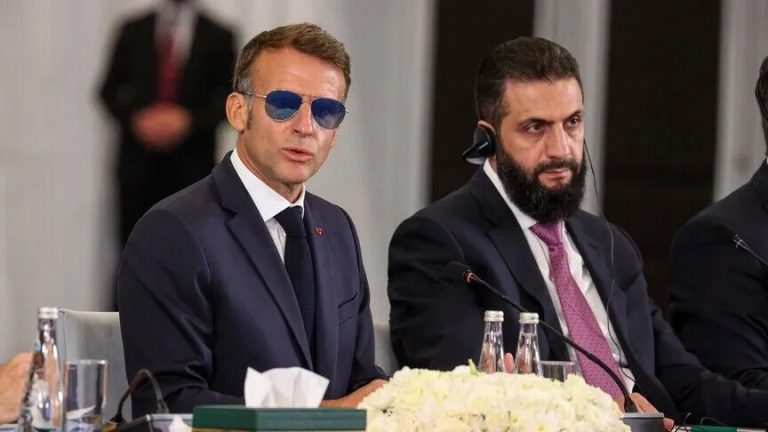
In a move that signals a seismic shift in Western policy toward the Levant, French President Emmanuel Macron’s landmark visit to Damascus marks a high-stakes bet on the future of post-Assad Syria. As the first EU head of state to visit since the regime’s fall in December 2024, Macron is attempting to turn the page on a fraught history of French colonial intervention, which often exploited sectarian divisions. This time, Paris is pursuing a strategy of pragmatic realism, positioning itself as a key partner for the new administration of President Ahmad al-Sharaa and challenging the long-standing Western consensus of isolation.
The visit was unmistakably commercial, positioning French industry at the forefront of what could be one of the largest reconstruction efforts of the 21st century. Macron was accompanied by a high-level business delegation, including the CEOs of shipping giant CMA CGM and energy major TotalEnergies. The trip yielded immediate results, with agreements to restore full diplomatic ties, develop Syrian infrastructure, and explore potential offshore energy contracts. This economic diplomacy is a clear first-mover advantage for France, which has played a key role in encouraging the EU to lift most economic sanctions that had crippled the country for over a decade.
Consolidating a Shattered State
Macron’s outreach comes as President al-Sharaa works to consolidate power and transition Syria from a pariah state into a functioning regional actor. Having led the rebel offensive that toppled the Assad dynasty, Sharaa’s government is now focused on the monumental task of rebuilding state institutions, unifying disparate armed factions, and asserting control over a fragmented country. The fragility of this transition was underscored by two explosions that rocked Damascus during Macron’s visit, wounding at least 18 people.
Despite these security challenges, the new Syrian government is projecting an image of stability and openness to international partnership. For a population exhausted by over a decade of war, the promise of centralized security and economic rehabilitation is a powerful draw. Sharaa’s administration has sought to reassure both domestic minorities and international observers of its commitment to an inclusive state, a message reinforced by symbolic gestures like the repatriation of Syrian antiquities from France.
A Challenge to the Western Consensus
France’s diplomatic gambit represents a significant break from the cautious, US-led approach that has characterized Western policy. While the EU has eased sanctions, Macron’s direct engagement is a clear signal that Paris intends to reclaim a leading role in the Levant. This proactive stance is driven by both economic and geopolitical interests. French business leaders see Syria as a potential transit hub linking Europe to the Gulf, an alternative to volatile maritime routes like the Strait of Hormuz.
Whether this pragmatic turn succeeds will depend on Sharaa’s ability to translate these diplomatic wins into genuine domestic recovery and political inclusion. His government still faces immense challenges, from extremist holdouts to deep-seated economic woes. However, Macron’s visit has undeniably altered the diplomatic landscape, forcing other Western powers to reconsider their own policies of disengagement. For now, France is betting that by helping to rebuild Syria, it can secure its own interests and foster a more stable regional order.
Original analysis inspired by Alexander Seale from Anadolu Agency. Additional research and verification conducted through multiple sources.