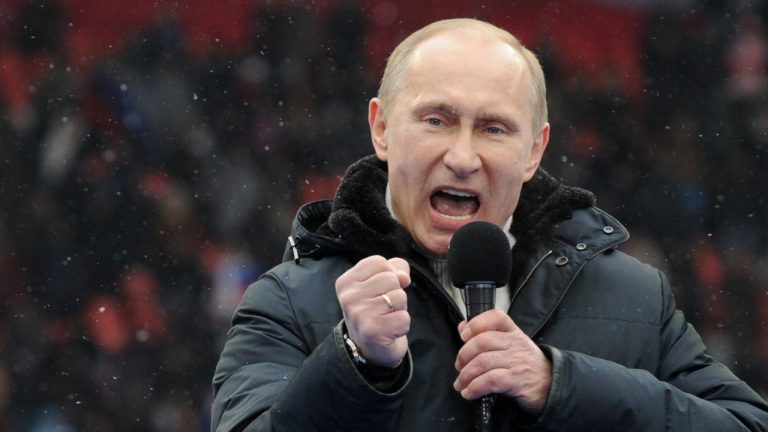
Four years after Russian tanks crossed into Ukraine, Russia controls 20% of Ukrainian territory, chipping away at its eastern frontiers in a war of attrition that has now lasted longer than the Soviet Union’s fight against Nazi Germany. On the anniversary this week, both sides made a paradoxical admission. Volodymyr Zelenskyy declared that “Putin has not achieved his goals” and “has not broken Ukrainians” — and Kremlin spokesman Dmitry Peskov concurred, telling reporters that the goals of the special military operation had not been “fully achieved yet,” so the war would continue. That strange convergence — enemies agreeing on the same failure — captures just how frozen this conflict has become.+1
The battlefield toll on both sides is approaching nearly half a million dead and 1.5 million wounded or missing, according to a staggering estimate released last month. A Latvian intelligence report revealed that drones were responsible for 70 to 80 percent of all deaths and injuries on both sides — a gruesome indicator of how warfare itself has mutated over four years. The cost of post-war reconstruction is estimated at around $588 billion over the next decade, according to a joint World Bank, EU, and UN report. Meanwhile, the Trump administration has ramped up efforts to negotiate an end to the war, setting a deadline of June 2026 for a peace agreement, with U.S.-led negotiations — beginning in Abu Dhabi and most recently ending without a breakthrough in Geneva — seeking a swift resolution that would include potential territorial concessions by Ukraine.+2
The Question No One Can Answer
The most consequential disagreement among analysts is not about the battlefield but about Putin’s mind. Sergey Radchenko, historian at the Johns Hopkins School of Advanced International Studies, frames it as a binary: either Putin wants the Donbas and will accept a ceasefire once Ukraine withdraws, or he wants political control over Ukraine itself — in which case no territorial concession will end the war. The distinction is not academic. Russia wants the entirety of Donbas, plus Zaporizhzhia and Kherson recognized as Russian — and it is not going to give up.
Nikolas Gvosdev of the Foreign Policy Research Institute offers a longer lens. Ever since Ukraine’s Orange Revolution in 2004, Putin has wanted a Kyiv government that accepts Russian interests — meaning no NATO infrastructure, no threat to Russia’s Black Sea access, and no barrier separating Ukraine from what Moscow considers a broader Russian cultural and political space. In that reading, the tactics have evolved from electoral manipulation, to seizing Crimea, to a full-scale invasion, but the underlying objective has never changed. The Kremlin is pushing for full control of Ukraine’s eastern Donetsk and Luhansk regions and a ban on Western military support for Kyiv. Ukraine says giving in would leave it vulnerable to future attack, is constitutionally impossible, and unacceptable to much of Ukrainian society.+1
Nicolai Petro of the University of Rhode Island argues Putin’s terms have been formally consistent since the start: a neutral, non-nuclear, demilitarized Ukraine outside any military alliance, with Russian control over Crimea, Donetsk, Luhansk, Kherson, and Zaporizhzhia treated as non-negotiable — even if that control need not be formally recognized by Kyiv. The gap between that framework and what any Ukrainian government could politically survive at home is, for now, unbridgeable.
The Ground Reality and the Security Gap
The battlefield arithmetic matters here. From a military perspective, the Donbas fortress belt is one of the few remaining pieces of easily defended terrain before the flatter regions of central Ukraine that lead to major cities including Kyiv — and seizing it would take Russia months, if not all of 2026 and into 2027. The high casualties and sluggish advance rate of Russian forces over four years suggest Russia would suffer another half million casualties trying to seize the region — and there is no guarantee of success, which Putin knows would heavily dent his “inevitable victory” narrative.
On the Ukrainian side, the central problem is security guarantees. Radchenko puts it plainly: Ukraine has placed too much faith in Western promises, and the West has shown no appetite to put boots on the ground against Russia. The “coalition of the willing” issued declarations of intent in Paris, including plans for a U.S.-led ceasefire monitoring mechanism and the possible deployment of multinational forces led by France and the United Kingdom. But analysts at Kyiv-based think tanks have described those guarantees as simply an attempt by the Trump administration to “sugar-coat the bitter pill” of territorial concessions. Russia has already rejected Ukrainian proposals for the deployment of European troops in Ukraine after any ceasefire deal.+3
The Deal on the Table — And Its Fatal Flaw
A framework is taking shape, but its details expose how much distance remains. The U.S. provision requires Ukraine to cede the part of Donetsk that Russia has not yet captured — roughly 2,500 square miles — while Ukraine would receive a few bits of territory near Kharkiv, about 700 square miles. Russia would gain approximately 1,800 square miles overall. The U.S. and Ukraine have reached consensus on several critical issues, but sensitive questions around territorial control in Ukraine’s eastern industrial heartland and the management of the Zaporizhzhia nuclear plant remain unresolved.
In Moscow, Putin has shown no willingness to compromise, doubling down on hardline demands for a sweeping Ukrainian withdrawal and political concessions that Kyiv and its European backers have cast as capitulation. The deeper structural problem, as Sumantra Maitra of the Center for Renewing America notes, is that Putin enjoys two durable advantages: numerical superiority on the battlefield and the knowledge that NATO will not directly enter the war. His second aim — a grand bargain with Washington that leaves Europe divided — may actually be more achievable now than at any point since February 2022, given the current U.S. preference for dealmaking with Moscow over absolute solidarity with Kyiv.+1
International law categorically prohibits the acquisition of territory by force and affirms the principle of territorial integrity. That principle, once the foundational argument for Western support of Ukraine, has been quietly set aside in the current negotiating framework. For ordinary Ukrainians, the choice is stark: either surrender a third of the country and risk enabling future aggression, or continue the war at the very limit of human and economic resources. Neither option carries a clear path to the durable peace that four years of sacrifice were supposed to produce.
The war’s fifth year begins without resolution on any of its fundamental questions — what Putin will actually accept, what security Kyiv can realistically secure, and whether a deal can be built that both sides can survive politically. Direct talks between Russian and Ukrainian negotiators in Istanbul failed to break the deadlock, and despite a flurry of diplomacy, the positions of the two countries appear still to be far apart. History has seen longer wars end in worse compromises. That is cold comfort for those living inside this one.
Original analysis inspired by Martin Di Caro from Responsible Statecraft. Additional research and verification conducted through multiple sources.