In February 2024, J.D. Vance — then a senator from Ohio — stood at the Munich Security Conference and warned that America lacked the munitions to fight simultaneously in Europe, the Middle East, and East Asia. Fourteen months later, as vice president, he is watching the war his boss launched prove that warning correct in real time. Operation Epic Fury, now in its fourth week, is consuming American firepower at a rate that will leave the military measurably weaker for years — and the countries watching most closely are not in the Middle East.
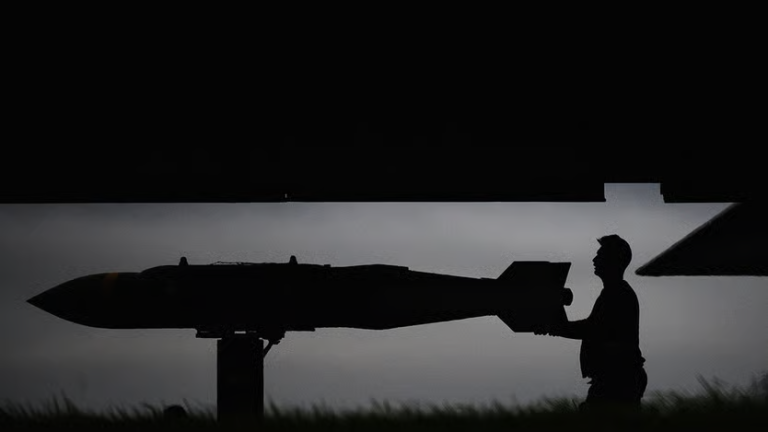
The scale of the opening campaign was extraordinary. Independent analysts at the Payne Institute of Public Policy estimate the U.S. used roughly 5,000 munitions in the first four days alone, and approximately 11,000 in the first sixteen — making Epic Fury, by their assessment, the most intensive opening air campaign in modern history, surpassing NATO’s 2011 bombing of Libya. Once Iranian air defenses were destroyed and American aircraft could fly close to their targets, the munitions picture improved: short-range JDAM-guided bombs, which can be produced quickly and in volume, now account for roughly 99% of what the Pentagon is dropping. But the opening salvo — the phase that required stand-off weapons fired from a safe distance — burned through stockpiles that cannot be replaced on any near-term timeline.
The Shortage Behind the Headlines
The most acute problem is not what is being used today but what was consumed before air superiority was established. In the first six days of the war, CSIS analysts estimated that over 1,000 expensive stand-off munitions were fired. More than 300 Tomahawk cruise missiles were likely expended in the opening strikes — yet the Pentagon had planned to buy just 57 replacements in the current fiscal year. Production capacity currently sits at around 60 Tomahawks annually, and while the Pentagon has proposed scaling that to 1,000 per year, Congress has not funded the plan.
Air defense is a parallel crisis. America fired an estimated 140 Patriot PAC-3 MSE interceptors and more than 150 THAAD interceptors in the war’s first week alone. THAAD production has seen no new deliveries since 2023, no new orders have been placed this year, and only 39 interceptors are scheduled for delivery in 2027 — under orders placed six years ago. The bottleneck is not simply money. Critical minerals including gallium, neodymium, and ammonium perchlorate are essential to missile manufacturing. Some are sourced from a single supplier. Others are controlled by China. No congressional appropriation can conjure those supply chains into existence overnight.
Replacing just the first four days’ worth of munitions would cost an estimated $20–26 billion. That figure, striking as it is, understates the problem — because the constraint is industrial capacity, not dollars. America cannot simply buy its way out of a stockpile deficit when the factories and supply chains to refill it don’t yet exist at the required scale.
The Navy Is Running on Fumes
The strain on naval forces tells a different story but arrives at the same conclusion. The USS Gerald R. Ford has now been at sea for close to 270 days. By mid-April it will break the record for the longest carrier deployment since the Vietnam War. The ship suffered a 30-hour fire earlier this month, leaving more than 600 sailors without bunks. The USS Abraham Lincoln is also deployed; the USS George H.W. Bush is reportedly en route.
As one former Pentagon official now at the Atlantic Council put it, extended high-tempo operations are “like driving a car at 200 miles per hour for months, without an oil change.” The maintenance backlog this creates will produce periodic carrier gaps — windows when America cannot deploy a carrier in critical regions — for an estimated two to three years after the conflict ends. Personnel exhaustion compounds the mechanical problem: long deployments drive family stress and elevate suicide risk among service members, and those human costs do not appear on any procurement budget.
What China Is Learning
There are genuine military gains from the campaign — combat experience, large-scale testing of AI-enabled targeting systems, and the debut of cheaper drone systems that could eventually reduce dependence on expensive cruise missiles. Former Pentagon officials acknowledge these as real. The question is whether they outweigh the costs, and on the Pacific deterrence ledger, most analysts say they don’t.
A Marine expeditionary unit has been redirected from Japan. Parts of a THAAD battery have been pulled from South Korea. And every tactical decision about how to potentially reopen the Strait of Hormuz — including de-mining operations — is being observed and logged by Chinese military planners assessing how America might respond to a Taiwan contingency. The war in Iran was framed by the Trump administration as a demonstration of American strength. For the military commanders thinking about the Pacific, it increasingly looks like an advance disclosure of American limitations.
Original analysis inspired by The Editors from The Economist. Additional research and verification conducted through multiple sources.