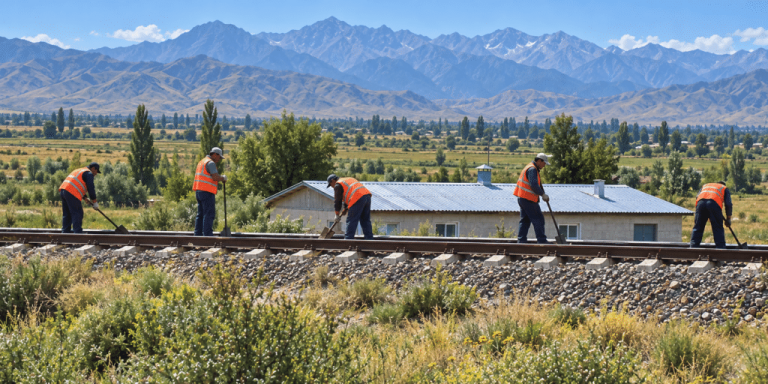
After nearly three decades of false starts and route disputes, the China, Kyrgyzstan, and Uzbekistan railway is finally moving from blueprint to construction. While grand summit declarations often portray Beijing’s engagement across Eurasia as a monolithic regional strategy, the actual execution of cross border connectivity depends on hard headed bilateral bargains. Each Central Asian capital negotiates distinct financial terms, technology transfers, and customs rules to maximize its own national return.
The financial architecture of the 4.7 billion dollar rail corridor highlights how individual states manage sovereign debt risks. Under a landmark financing pact signed in December 2025, Chinese banks allocated a 2.3 billion dollar loan over thirty five years to a joint venture in which Beijing holds fifty one percent equity and Bishkek and Tashkent hold 24.5 percent each.
In June 2026, Kyrgyz lawmakers separately approved a 304.5 million dollar loan from China’s Export Import Bank to cover their national equity stake, making future freight tariffs and terminal operations vital to paying down the debt.
Bilateral Deals Behind Multilateral Summits
This interplay between broad regional frameworks and tailored national contracts defines the wider diplomatic format between Beijing and the five Central Asian republics. When regional leaders concluded a treaty on eternal good neighborliness at the June 2025 Astana summit, only fourteen of the fifty five accompanying agreements covered regionwide rules on green minerals and road permits. The remaining forty one accords consisted of bilateral deals tailored to specific national priorities, such as BeiDou satellite integration in Kazakhstan and artificial intelligence centers in Kyrgyzstan.
Practical border management follows the same pattern of bilateral implementation.
Immediately after regional customs chiefs agreed in principle to streamline frontier checks in May 2025, Kazakh and Chinese officials inspected the Nur Zholy and Khorgos crossing to recognize shared X ray scans and expand daily truck quotas. Notably, constructing the new southern rail link required agreement among only Beijing, Bishkek, and Tashkent rather than a unanimous five state consensus, since Kazakhstan already operates established rail links with China.
With bilateral trade between China and Central Asia reaching 106.3 billion dollars in 2025, local governments face growing incentives to demand domestic mineral processing and shared data standards rather than merely exporting raw commodities. Comparing financing conditions across capitals will determine how much sovereign control and long term revenue Central Asian states retain as new Eurasian trade corridors take shape.
Original analysis inspired by ZamirbekMinbaev from TheTimesofCentralAsia. Additional research and verification conducted through multiple sources.