An investment consortium backed by the United States announced an agreement on November 25 to buy Lukoil International GmbH, threatening Kazakhstan’s plans to expand national control over major energy fields. Led by billionaire Todd Boehly’s Eldridge alongside the United States International Development Finance Corporation, Xtellus Partners, and Emirati firm Catena Investment Holding, the group seeks full ownership of the Russian giant’s foreign portfolio pending Treasury approval. Sources familiar with the negotiations told Reuters that the buyers propose exchanging roughly 10 billion dollars in Russian securities for overseas assets valued near 16 billion dollars, a process Boehly expects could take up to a year. Officials from both the consortium and the development agency told Reuters that the buyout aims to curb Russian influence over strategic energy infrastructure while securing future profits for Washington.
Astana Weighs Preemptive Rights
Lukoil’s Kazakh holdings represent roughly 6 billion dollars in value, spanning a 5 percent share in Tengizchevroil, 13.5 percent in Karachaganak, and 12.5 percent in the Caspian Pipeline Consortium that carries around 80 percent of Kazakhstan’s crude exports to Novorossiysk. Analysts at Sinopec’s research arm estimate Lukoil’s stakes at 2.48 billion dollars in Karachaganak, 2.17 billion dollars in Tengiz, and 1.38 billion dollars in the offshore Kalamkas Khazar venture, excluding the pipeline share. After Washington sanctioned Lukoil and Rosneft in October 2025 over the war in Ukraine, Kazakh officials began evaluating a domestic buyout to enlarge national company KazMunayGas. In January 2026, Energy Minister Yerlan Akkenzhenov confirmed that Astana submitted a formal petition to the Office of Foreign Assets Control invoking Kazakhstan’s statutory preemptive right to purchase domestic oil and gas stakes.
Acquiring Lukoil’s shares would raise KazMunayGas ownership in Tengiz from 20 percent to 25 percent and more than double its Karachaganak holding from 10 percent to 23.5 percent. Although the Energy Ministry stated on June 1 that authorities had not yet decided whether to exercise preemptive rights, earlier talks gave Astana room to maneuver. When Lukoil signed a prior sale agreement with American investment firm Carlyle in January, that deal explicitly excluded Kazakh assets before expiring in July and collapsing in October. Because Eldridge’s consortium targets Lukoil’s entire overseas holding company at once, uncertainty remains over whether Astana can still carve out individual domestic fields.
Stalled Caspian Fields and Regulatory Scrutiny
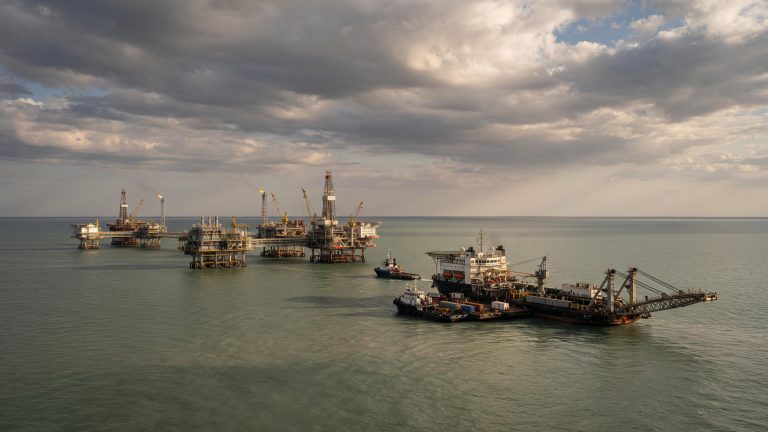
A change in ownership could nonetheless revive the stalled 6.4 billion dollar offshore development covering the Kalamkas Sea, Khazar, and Auezov fields, projected to reach peak output of 4 million metric tons annually. Whereas American regulators exempted Tengiz, Karachaganak, and the Caspian pipeline from sweeping operational bans, the equal joint venture Kalamkas Khazar Operating remained blocked under rules targeting entities at least half owned by designated firms. Banks closed all joint venture accounts by late 2025, and KazMunayGas subsequently suspended project work while postponing a final investment decision, even though chief executive Askhat Khassenov described Lukoil in October as a continuing strategic partner. Removing Lukoil from the venture could restore international financing and insurance, though the new consortium would inherit an unfinished offshore project requiring billions of dollars in fresh capital to offset declining mature western fields.
The proposed transaction also places Washington in an unusual dual role as both prospective shareholder and chief sanctions arbiter. Thomas Glynn Hanley at the Center for Strategic and International Studies outlined estimates indicating that the development finance agency could obtain a 15 percent equity stake without upfront capital, while warning that holding Lukoil’s swapped shares in a United Arab Emirates account for five years appears to conflict with Treasury rules requiring blocked accounts under American jurisdiction. Democratic Representative Gregory Meeks likewise criticized the agency’s participation as undermining economic pressure on Moscow, echoing earlier bipartisan skepticism in the Senate. With the Treasury’s negotiation license expiring on December 19 and regulators signaling continued oversight over future resales, Astana will likely need Washington’s approval even if it seeks to purchase the Kazakh stakes from Boehly’s group later.
Original analysis inspired by Askar Kubaizhanov from The Times of Central Asia.
Additional research and verification conducted through multiple sources.