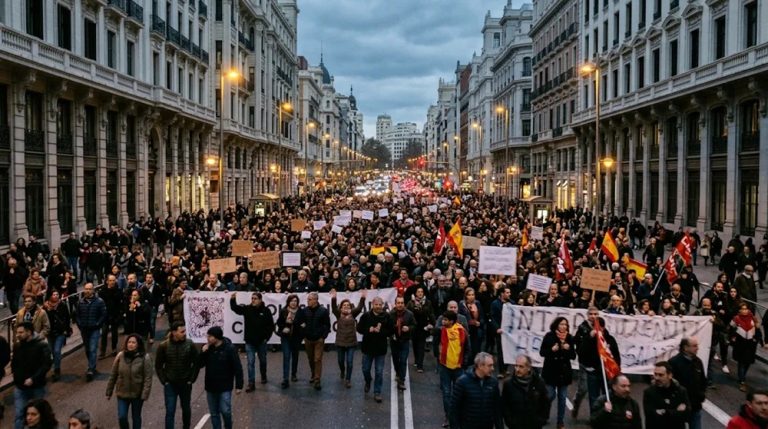
Across Western and Southern Europe, millions of workers, students, and pensioners have poured into city squares this autumn to challenge austerity, stagnant wages, and unaffordable housing. On November 11, Spanish unions staged the country’s first general strike in fourteen years, drawing roughly 120,000 demonstrators in Madrid alone after weeks of similar unrest in France and Belgium. Governments have responded by condemning isolated property damage as chaos and pledging to restore public order. That official framing obscures a deeper reality in which decades of eroding social protections have pushed ordinary households to a breaking point.
The Quiet Cost of Economic Inequality
Long before protesters erected street barricades in Paris, Brussels, or Madrid, material hardship had settled into daily European life. Official figures from Eurostat showed that 92.7 million people across the European Union, representing 20.9 percent of the population, lived at risk of poverty or social exclusion in 2025. Overcrowded classrooms, underfunded hospitals, and soaring rents have turned basic dignity into a luxury for families whose paychecks fail to keep pace with food and energy bills. Across the broader OECD area, more than 2.6 million people experience homelessness, including over 1.4 million inside the European Union where speculative properties sit vacant.
At the top of the economic ladder, wealth concentration has accelerated sharply. Research by Oxfam revealed that the combined fortunes of European Union billionaires surged by €405 billion during the first half of 2025 alone, reaching €2.3 trillion. Meanwhile, ordinary residents shoulder more than 80 percent of total tax revenue through payroll, income, and consumption levies while net wealth taxes contribute just 0.4 percent. Extreme summer heatwaves also expose class divides, with EuroMOMO recording 14,260 excess deaths across 24 European nations in late June, predominantly among elderly residents lacking adequate cooling and support.
Spending Choices and Foreign Complicity
Public frustration has sharpened as European capitals plead fiscal scarcity for schools and housing while finding vast sums for militarization and border enforcement. In March 2025, the European Commission proposed its ReArm Europe plan, later branded Readiness 2030, aiming to mobilize up to €800 billion for defense spending by 2030. Simultaneously, the Council of the European Union adopted new return regulations allowing member states to establish migrant detention hubs in countries outside the bloc, expanding deportation powers rather than addressing structural poverty.
Foreign policy contradictions have further alienated younger demonstrators across European campuses. Despite three years of devastating war in Gaza, European Union trade in goods with Israel totaled €43.3 billion in 2025 under the existing Association Agreement. Earlier this year, independent United Nations experts urged Brussels to suspend those trade privileges immediately over human rights obligations. For many protesters, domestic austerity and external impunity stem from the same political choices.
Reframing Public Order and Dissent
History offers repeated examples of authorities labeling popular resistance as disorder while ignoring the structural harm that provoked it. From nineteenth century anticolonial uprisings to modern labor strikes, entrenched systems rarely acknowledge the daily toll inflicted by evictions, wage suppression, or aggressive policing. Street mobilizations disrupt routine comfort and force institutions to defend their priorities in public view. Until European leaders confront the economic and political inequities driving millions into the streets, policing the symptoms will not restore lasting calm.
Original analysis inspired by Tamam Abusalama from The New Arab.
Additional research and verification conducted through multiple sources.