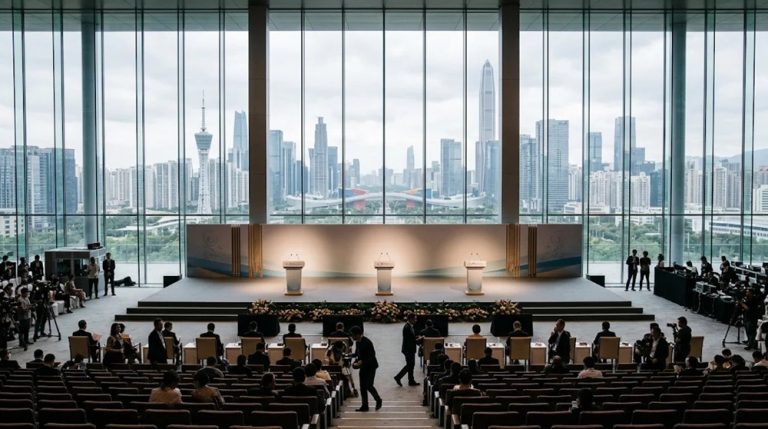
As Chinese President Xi Jinping hosts Donald Trump and Vladimir Putin in Shenzhen alongside the Asia Pacific Economic Cooperation summit, comparisons to the 1945 Yalta conference miss the true balance of power. Unlike Franklin Roosevelt, Winston Churchill, and Joseph Stalin carving up the postwar order as rough equals, the Shenzhen gathering places Xi at the center as the host with the fewest concessions to seek. Both Washington and Beijing have framed the trilateral talks as an effort to promote strategic stability and world peace, yet the optics favor Beijing. By stepping onto this stage just days after midterm setbacks at home, Trump risks trading democratic leadership for hollow political theater.
Asymmetric Leverage Among the Three Powers
For Putin, simply standing beside the American and Chinese presidents delivers an immediate diplomatic triumph that masks severe domestic weakness. Russia has diverted roughly 40 percent of its economic output toward its war in Ukraine, while absorbing nearly half a million military casualties with no decisive breakthrough in sight. Earlier this week, Ukrainian forces struck the main road arch of the Kerch Bridge into Crimea, severing a vital supply artery to occupied territory. Ahead of the trilateral, Putin promoted a new Eurasian security framework at the business forum, seeking great power legitimacy that his battered military cannot secure on the battlefield.
Xi enters the summit with clear domestic objectives and tight control over the diplomatic choreography. Hosting both leaders on Chinese soil bolsters his stature ahead of next year’s Communist Party Congress, where he is expected to secure an unprecedented fourth term. Analysts at the Atlantic Council note that Beijing is working relentlessly to script the event and prevent unscripted remarks from embarrassing its leader. Meanwhile, China faces little incentive to accommodate Trump on nuclear arms control, dismissing trilateral limits as unrealistic while rapidly expanding its own warhead stockpile.
Weak Hands on Trade, Chips, and Ukraine
Trump arrives in Shenzhen holding a remarkably weak negotiating hand on both economic and security fronts. Efforts to press Beijing on critical minerals run into the same leverage that forced Washington to retreat from tariff threats during talks in South Korea a year ago. At the same time, the recent resignation of Nvidia chief executive Jensen Huang over alleged Chinese intelligence ties has exposed fierce divisions inside the administration over advanced semiconductor exports. Reports indicate that Commerce Secretary Howard Lutnick repeatedly stalled tighter chip restrictions, leaving the White House vulnerable if Xi threatens to choke off mineral supplies once again.
For Kyiv, the summit carries acute danger that Trump could pursue a settlement granting Moscow territory it failed to conquer by force. Ukrainian officials pointedly noted that their recent bridge attack bypassed Elon Musk’s Starlink network, which Kyiv accuses Washington of throttling to apply diplomatic pressure. President Volodymyr Zelenskyy has expressed alarm that major powers might negotiate Ukraine’s future behind closed doors without European or Ukrainian participation. Even with Democrats winning control of Congress in the midterms, Kyiv doubts substantial new American funding will materialize, leaving European allies to carry the burden.
Allies Look Elsewhere for Security
Absent from the Shenzhen table, European and Asian democracies are drawing sobering conclusions from this display of power politics. European capitals already confront Russian hybrid warfare on their eastern flank alongside looming trade friction with Beijing and open hostility from Washington. Across the Indo Pacific, partners from Tokyo to Taipei fear that Washington could trade away regional deterrence in pursuit of bilateral deals with Beijing. Rather than cementing a new three power directorate, the Shenzhen spectacle is accelerating efforts by middle powers to strengthen regional alliances and defend international law on their own.
Original analysis inspired by Bronwen Maddox from Chatham House.
Additional research and verification conducted through multiple sources.