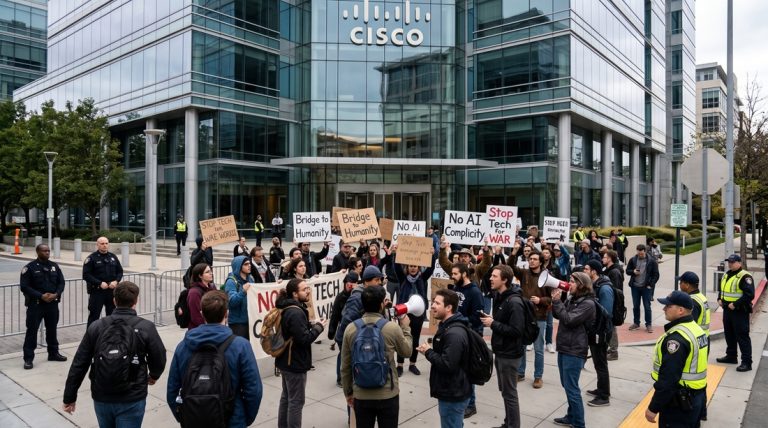
Public scrutiny of technology companies supplying the Israeli military has largely centered on cloud computing giants like Google and Amazon. Yet a cache of internal corporate records obtained by investigative journalists shows that networking conglomerate Cisco worked aggressively behind the scenes to rescue and expand its contracts with Israeli military intelligence throughout the Gaza war. As the Palestinian death toll surpassed seventy thousand and international bodies investigated war crimes, company executives mobilized engineering teams to fix network crashes for the Israeli Ministry of Defense and billed the intervention internally as a major commercial triumph.
Salvaging Military Intelligence Networks
Roughly one year into the Gaza offensive, digital infrastructure upgrades inside the Israeli intelligence apparatus triggered severe multi hour system blackouts and debugging failures. Fearing that the Israeli military intelligence directorate would cancel contracts worth roughly sixty seven million dollars over three years, Cisco leadership activated emergency technical teams. Company engineers traveled under heavy security to work on site with a secretive military unit known as Sapir, which was tasked with relocating Israeli intelligence servers underground after October 2023.
After stabilizing the hardware and restoring data access for military operations between 2024 and summer 2025, corporate presentations celebrated the repair effort for reversing negative client sentiment. Internal records also reveal that dozens of new military deals were pursued in 2026 across the Israeli air force, navy, and intelligence branches, many involving artificial intelligence capabilities. Executives at Splunk, a data analytics subsidiary owned by Cisco, simultaneously pitched their services to join Project Nimbus, the controversial cloud contract linking the Israeli government with Silicon Valley providers.
Internal Dissent and Civil Rights Violations
This commercial expansion unfolded alongside fierce internal protests from employees who warned that corporate networking hardware was facilitating mass atrocities in Gaza. Current and former staff members organized under the banner Bridge to Humanity argued that providing routers, servers, and analytical software to military intelligence made the firm indistinguishable from traditional weapons manufacturers. Earlier this year, the United States Equal Employment Opportunity Commission found reasonable cause to believe that Cisco tolerated a hostile work environment that violated the civil rights of Palestinian, Arab, and Muslim staff following October 2023.
Digital rights advocates at 7amleh note that cloud software contracts cannot function without the physical server infrastructure and routing hardware maintained by firms like Cisco. Shareholders are preparing to vote this month on a formal resolution demanding an independent human rights assessment of all military sales. Until technology conglomerates face binding legal accountability for wartime contracting, internal ethics pledges will remain subordinate to defense revenue.
Original analysis inspired by Alice Speri from The Guardian. Additional research and verification conducted through multiple sources.