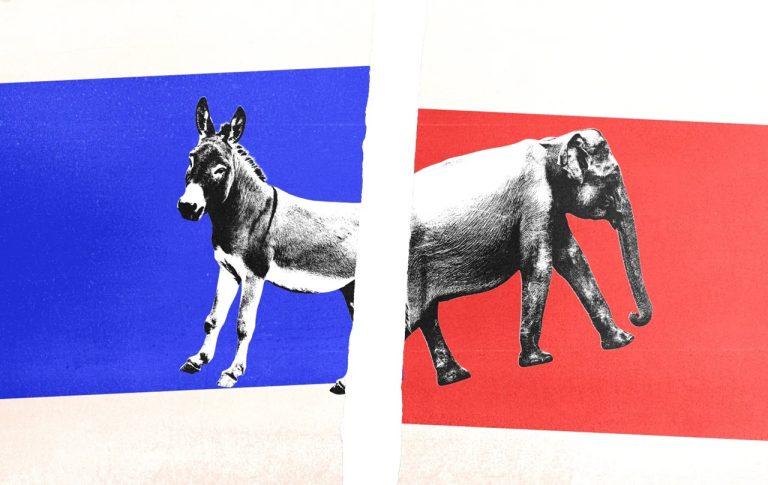
American politics has treated a third party as a wasted vote for two centuries. Ralph Nader in 2000, Ross Perot in 1992, and Jill Stein in 2016 all showed the usual ending: a splinter bid that helped elect someone else. That record still matters. It no longer looks like a law of nature. The share of voters who refuse both big brands has grown large enough that a well-known outsider could, for the first time in decades, be competitive without first capturing a party.
Gallup recorded a high of 45 percent identifying as independents in 2025, with Democrats and Republicans at 27 percent each. Twenty years ago, party loyalists outnumbered independents by about two to one. A third party then had to peel away people who already wore a label. Now it can build from a pool almost as large as both parties combined, and need only a slice of the old bases. Discontent supplies the fuel. Polling averages put Donald Trump near 39 percent approval and about 59 percent disapproval. An NBC survey cited in recent coverage found only 36 percent viewing Republicans positively and 29 percent viewing Democrats positively. In the old pattern, one party’s fall lifted the other. Independents have soured on Republicans over the past 18 months without warming to Democrats. Midterms may still produce a blue wave because the president is the face of government. That is not the same as loyalty.
The duopoly is already thinner
Other democracies already ran this experiment. France’s Fifth Republic belonged to the socialists and the moderate right until Emmanuel Macron founded an upstart movement and won in 2017. The old parties have not recovered, and neither traditional camp looks able to reach next year’s runoff. Germany’s Social Democrats and Christian Democrats once took 70 to 90 percent of the vote. At the last federal election they fell under half, and recent polls put them near a third combined. In Britain, Labour and the Conservatives often cleared 90 percent together after the war. Their combined share fell to 57 percent in 2024. Earlier this year polling had them near 37 percent before Andy Burnham replaced Keir Starmer and Labour recovered some ground. Reform UK, if it climbs back toward 30 percent, could still turn a plurality into a Commons majority. Majoritarian rules slow new parties. They do not stop them once the old ones shrink.
A celebrity, not a party
The United States will not copy Europe’s path. Greens and Libertarians are unlikely to win a string of House seats, because a vote that cannot carry a district feels wasted, and ballot rules are written by the parties already in office. The plausible break is a rich or famous person running for president outside both tents, then pulling a few senators or representatives along. Trump showed the model by seizing a party. A successor, blocked by his remaining base inside the Republican tent, may attack from outside.
The wish for that option is widespread. The result may not be. Independents do not share a program. A winner is more likely to mix hard cultural views with isolationism than to offer a calm middle. And a celebrity with little governing past can treat the office as a stage. The day of the third-party candidate is closer than the smart money admits. Many who want it may not like who walks through the door.
Original analysis inspired by Yascha Mounk from The Dispatch. Additional research and verification conducted through multiple sources.