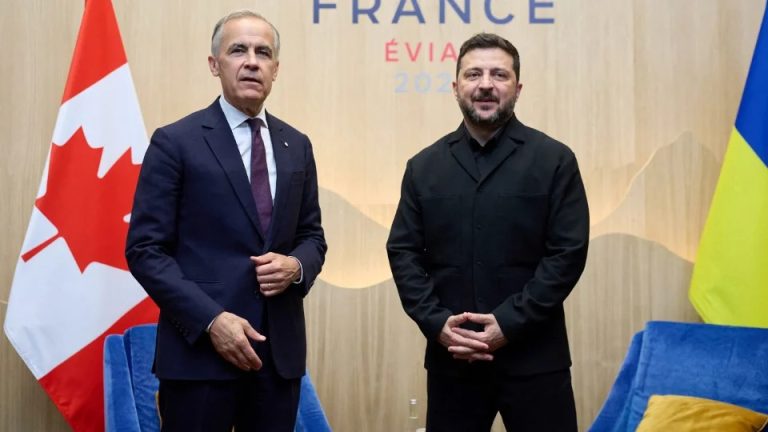
Canada has long cultivated an image as a global champion of human rights and international law, but its divergent responses to the wars in Ukraine and Gaza reveal a significant policy paradox. While Ottawa has acted with moral clarity and immense material support for Ukraine, its approach to Israel’s actions in Gaza has been far more restrained. This contrast suggests a two-track foreign policy, where the application of international norms appears to depend heavily on geopolitical alignments.
Following Russia’s 2022 invasion, Canada’s response was swift and robust. The government immediately condemned the aggression, imposed sweeping sanctions on thousands of Russian individuals and entities, and committed nearly $22 billion in total assistance to Ukraine. This included billions in military aid and the training of tens of thousands of Ukrainian soldiers. Within months, Canada’s House of Commons unanimously declared that Russia was committing genocide, a position Prime Minister Mark Carney later reinforced by stating, “Ukraine’s fight is our fight.”
The response to the war in Gaza, however, has followed a different script. Initially, Ottawa emphasized Israel’s right to self-defense, even as UN experts and human rights groups raised alarms about potential war crimes. Despite the catastrophic humanitarian situation, with famine conditions confirmed in parts of the territory, Canada refrained from taking concrete punitive measures against Israel. It was only after significant domestic and international pressure that the government’s tone began to shift, culminating in the decision to recognize a Palestinian state in September 2025, conditional on reforms.
A Calculated Selectivity in Applying Norms
This policy divergence can be understood through the lens of two distinct international frameworks. For geopolitical rivals like Russia, Canada invokes the “liberal international order,” a system that espouses universal human rights and principles like the Responsibility to Protect (R2P). Canada was a key architect of the R2P doctrine, which obligates the international community to intervene when a state fails to protect its population from mass atrocities. This principle was central to its narrative on Ukraine.
For allies like Israel, however, Ottawa appears to default to a more flexible “rules-based order.” This framework allows for a selective application of norms, ensuring that strategic partners are not meaningfully constrained. While Canadian officials called on Israel to respect international law, these calls were not backed by the consequential actions seen in the case of Russia. This selective approach extends to historical narratives; Ottawa readily frames Russia’s invasion within a history of imperialism but is reluctant to acknowledge the context of Israeli settler-colonialism, a reality detailed in reports by organizations like Amnesty International.
This perceived double standard has not gone unnoticed, prompting criticism that it damages Canada’s moral standing on the world stage. A recent poll shows that nearly half of Canadians believe Israel is committing genocide in Gaza, indicating a disconnect between public opinion and official policy. By pursuing one policy for its adversaries and another for its friends, Canada risks undermining the very international norms it claims to champion, suggesting its moral positions are often a matter of geopolitical convenience rather than universal principle.
Original analysis inspired by Jeremy Wildeman and Joseph Bouchard from Middle East Eye. Additional research and verification conducted through multiple sources.
By ThinkTanksMonitor