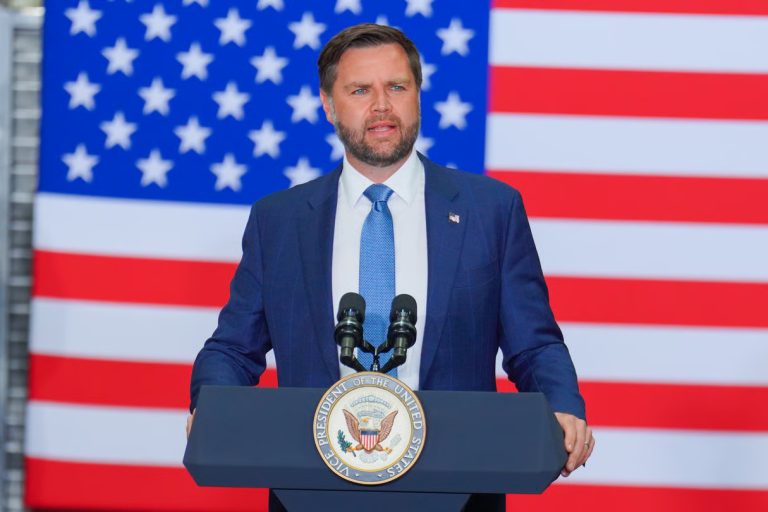
For more than 25 years, unwavering support for Israel functioned as something close to a litmus test in Republican politics. Candidates competed to outdo each other on the subject. Criticism from the right was rare, reputationally costly, and politically suicidal. That era is not fully over — but it is visibly ending, and the person doing the most to accelerate its departure is the frontrunner for the 2028 Republican presidential nomination.
Republicans on Capitol Hill are split over Vice President Vance’s rebuke of Israeli officials who criticized the memorandum of understanding between the US and Iran, highlighting the broader debate on the right about foreign entanglements and the US’s relationship with Israel. What made Vance’s comments remarkable was not their content alone, but their source. As the Republican base sours on the Iran war and Netanyahu’s adventurism in the Middle East, the vice president has changed his rhetoric on Israel, positioning himself as the voice of a new MAGA foreign policy. One Trump administration official put it simply: “He sees the writing on the wall. He’s trying to save his political future.”
What Vance Actually Said — and Why It Matters
The immediate trigger was blunt enough. The deal drew sharp criticism from some Israeli officials, including National Security Minister Itamar Ben-Gvir, who argued Israel is not a party in the deal and is not constrained by its calls for a ceasefire. Vance fired back by saying in a press briefing that if he were a member of the Israeli Cabinet, he “might not be attacking the only powerful ally” that the country has left anywhere “in the entire world.”
The comments drew pushback from conservatives, with Fox News host Brian Kilmeade saying he was “shocked” by the vice president’s criticism of Israel, adding “I wish he would be that tough with Iran.” Former GOP House Speaker Newt Gingrich similarly questioned the administration’s criticism of Israeli leaders, writing on social media: “Why is Israel getting blamed for trying to protect its citizens from Hezbollah attacks? Iran funds and arms Hezbollah, encourages them to kill Israelis in Israel and then blames Israel for defending its own citizens. We should be focusing our anger on the Iranian dictatorship not on a democracy fighting to protect its citizens.”
Vance’s and Trump’s narrative has exposed a widening rift within the GOP’s foreign-policy establishment. While Vance describes a Tehran that is prepared to “change its ways” and “stop trying to fund terrorism all over the Middle East,” Senator Lindsey Graham has cautioned that the United States must “understand who we are dealing with” — a sentiment Vance addressed directly by urging the senator “not to believe the hardliner propaganda in Iran.”
What the exchange reveals is that Vance is doing something deliberate, not reactive. He has become the administration’s face of the Iran deal, taking part in numerous media interviews to sell the deal, which coincided with his book tour this week, and he led the US delegation to Islamabad to negotiate with the Iranians and is set to remain Trump’s point person in talks on a broader nuclear deal. He is not just defending a policy. He is building a foreign policy brand.
The Numbers Behind the Shift
Vance is not manufacturing a trend. He is reading one. The polling data on Republican attitudes toward Israel has moved significantly and rapidly. More Republicans and Republican leaners have a favorable than unfavorable view of Israel, but the share of Republicans with a negative view has ticked up since last year, driven by those under 50. Today, 57% of Republicans ages 18 to 49 have an unfavorable opinion of Israel, up from 50% last year.
In a primary between two Republicans, 52% of Republican voters — and 59% of Republicans under 45 — would prefer a nominee who supports prioritizing lower prices for Americans over funding Israel. Just 23% of Republicans under 45 and 31% of Republicans overall prefer a nominee who supports unconditional funding for Israel.
Republicans differ sharply by age. Republicans 50 and older are about twice as likely as those under 50 to have confidence in Netanyahu — 58% versus 30%. That generational gap is significant because it maps almost perfectly onto the electorate Vance would need to win a 2028 primary against an older-generation, traditionally hawkish Republican challenger.
The broader public picture is equally stark. For the first time in Gallup’s annual measurement since 2001, Americans’ sympathies no longer lie more with the Israelis than the Palestinians. Among those aged 18 to 34, 53% say they sympathize more with the Palestinians, marking the first time a majority of this age group has expressed this view. Meanwhile, 23% of young adults say they sympathize more with the Israelis, a record low for the age group.
The AIPAC Question and the Party’s Fault Lines
The debate on the right is not happening in a vacuum. Groups affiliated with AIPAC spent tens of millions of dollars in primary campaigns, and the spending became a political flashpoint. AIPAC is a leading lobby group that endorses — and puts money behind — pro-Israel candidates, and for decades the group has spent money on politics, trying to shape US policy toward Israel and the views of everyone from members of Congress to the president himself. On the populist right, that financial presence has become a talking point that crosses from legitimate policy debate into territory that is sometimes less easily distinguished from ethnic grievance.
Vance himself has tried to draw that distinction, saying both the “obsession to blame Israel” and the conflation of US and Israeli interests are wrong. “My reaction is that Israel’s opinions matter, but fundamentally they are separate. But you’re right, there are certainly people who take every frustration with the Trump administration, every policy disagreement becomes because of Israel, and that is absolutely wrong. I think that is one of those things that can bleed into some very dark places.”
That is a careful line to walk. The Republican Party still contains a substantial majority that supports Israel. The only position on US-Israel relations to receive majority support from young voters was Chuck Schumer’s — that “Israel is a democracy and the safe haven of the Jewish people, but they have a moral obligation to ensure humanitarian treatment of Palestinian civilians” — with a notable 55% of Republicans agreeing. That is not the language of abandonment. It is the language of conditionality, which is very different from where the GOP stood a decade ago.
A 2028 Calculation in Real Time
The Democratic side of this story is also shifting fast. Eight in ten Democrats and Democratic-leaning independents currently have an unfavorable view of Israel, up from 69% last year and 53% in 2022. Several Democratic primaries are now hinging on a candidate’s position, with the anti-Israel candidate often having the upper hand. That means the Israel question is becoming an organizing issue on both sides, which makes 2028 an election in which the traditional bipartisan consensus on the US-Israel relationship could, for the first time in a generation, genuinely break down.
Vance is positioning himself to benefit from that breakdown on the Republican side. Whether he succeeds depends on whether the older, more traditionally hawkish base of the GOP — white evangelical Protestants, Fox News viewers, older suburban conservatives — remains large enough to nominate someone who outflanks him on Israel from the right. The data suggests that base is shrinking faster than it expected.
Original analysis inspired by David M. Drucker from Bloomberg Opinion. Additional research and verification conducted through multiple sources.