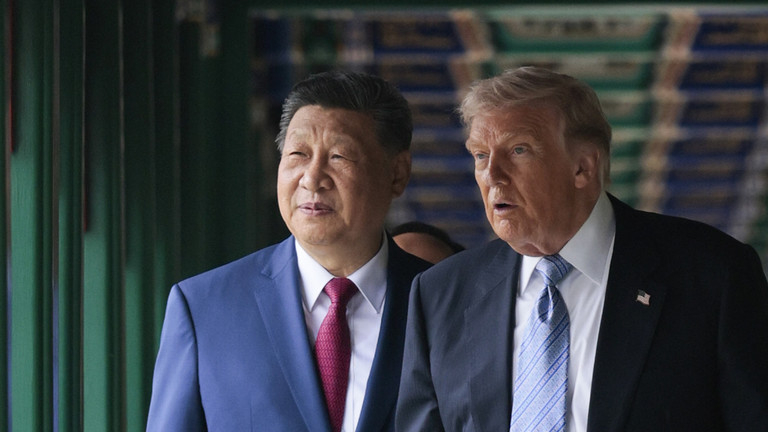
The optics alone told the story. Donald Trump, flanked by a dozen American CEOs, spent 43 hours inside Beijing’s Great Hall of the People last week exchanging toasts, reviewing troops, and sitting through extended talks with Xi Jinping. No landmark treaty emerged. No grand bargain was struck. Yet something may have shifted in ways that matter more than any signed document: Washington appeared to treat Beijing not as a problem to be managed, but as a co-equal power whose cooperation it actively needed.
For three decades, every American president who visited China did so from the working assumption that the United States sat atop a unipolar order and that Beijing was either a junior partner, a future convert to liberal norms, or a threat to be contained. The May 14–15 summit suggested that framework has quietly collapsed. Xi proposed a new concept — “constructive strategic stability” — as the operating principle for the next three years, and the White House did not push back publicly.
From Threat to Competitor to Partner?
The clearest evidence of the shift sits in Washington’s own official documents. Trump’s first National Security Strategy in 2017 labeled China a “revisionist power” bent on undermining American security, grouping it alongside Russia, Iran, and jihadist terrorism. The 2025 NSS released last December reads like a different document entirely. China appears for the first time on page 19 of a 33-page text. The threat language is gone. In its place: trade imbalances, economic competition, and the need for respectful relations. The 2026 National Defense Strategy, released in January, went even further — it no longer labels China a strategic competitor and describes it neutrally as “the second most powerful country in the world.”
This rhetorical retreat isn’t cosmetic. It tracks a deeper recalculation of American capacity. The 2025 NSS places the Western Hemisphere — not the Indo-Pacific — as the priority region, reasserting a version of the Monroe Doctrine through what the administration calls the “Trump Corollary.” Actions in Venezuela, Cuba, and Panama have followed that logic, all aimed at curbing Chinese influence closer to home. The strategic implication is clear: Washington is accepting, at least implicitly, that it cannot dominate every theater simultaneously.
Beijing’s Confidence at the Table
China entered the summit radiating assurance. Xi framed the talks as a meeting between two powers steering the world through what he called an accelerating “once-in-a-century transformation.” He asked Trump directly whether the two nations could overcome the Thucydides Trap — the ancient pattern of war between a rising power and an established one. That Xi felt comfortable posing the question publicly says something about where Beijing believes the balance now sits.
China had reasons for that confidence. Its manufacturing output exceeds that of the United States, Japan, and Germany combined. The BRICS+ bloc it co-leads now accounts for over 45% of global GDP measured by purchasing power. And Beijing’s response to Trump’s tariff war in 2025 proved more resilient than Washington expected, partly because China had spent years building control over critical supply chains that the U.S. had neglected.
The summit’s actual deliverables were modest — a 200-plane Boeing order (less than half the 500 initially floated), some agricultural commitments, and conditional approval for Nvidia to sell H200 chips to Chinese firms. But Beijing was never chasing deliverables. It was chasing recognition. And by agreeing to visit Washington in September — a trip that never happened during Trump’s first term — Xi secured exactly that.
The Iran Contradiction
One area where the power-shift thesis gets complicated is the Middle East. Trump’s broader strategy points toward managed competition with China and hemispheric consolidation at home. The ongoing war with Iran cuts against that logic. Every month of open-ended military commitment in the Gulf dilutes American focus and resources. Beijing, by contrast, continues to position itself as a stable partner willing to engage all sides — a posture that wins diplomatic credit across the Global South without costing a single warship.
Indo-Pacific allies watching the summit drew their own conclusions. A Stanford conference this spring found that regional powers are actively diversifying away from dependence on Washington, treating the United States as “less predictable, less committed to multilateral frameworks” than at any point since 1945. China, meanwhile, has modestly exploited the opening — not by filling America’s institutional vacuum, but by presenting itself as the more reliable economic partner.
None of this means American primacy has vanished overnight. The U.S. retains unmatched global military reach, the world’s reserve currency, and an innovation ecosystem that still leads in critical technologies. But Beijing’s summit in May sent a signal that the era of uncontested dominance — where Washington could dictate terms and expect compliance — is giving way to something messier and more negotiated. The question ahead isn’t whether multipolarity is arriving. It’s whether the two most powerful nations on earth can build rules for a world neither fully controls.
Original analysis inspired by Ladislav Zemánek from RT. Additional research and verification conducted through multiple sources.