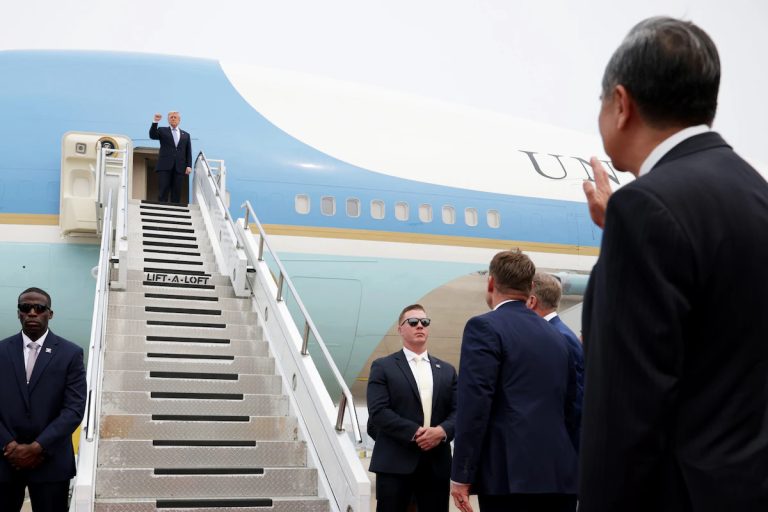
Donald Trump returned from Beijing last week calling a $14 billion weapons package for Taiwan “a very good negotiating chip.” He told Fox News the sale was being held “in abeyance” and that its fate “depends on China.” On Capitol Hill, the reaction was swift and bipartisan: treating defensive weapons as trade leverage against the very power those weapons are meant to deter is not strategy. It is an invitation to miscalculation.
The package in question — which includes missiles, air defense interceptors, and anti-drone systems — has been stuck in the State Department for months. Reporting indicates the White House instructed agencies not to push the sale forward ahead of Trump’s meeting with Xi Jinping, effectively freezing the process to protect the diplomatic atmosphere in Beijing. The delay quickly drew attention on Capitol Hill, where Taiwan enjoys strong bipartisan support and lawmakers had been pressing the administration to move ahead with the package Congress approved in January.
Taiwan Did What Washington Asked
The bitter irony is that Taipei did exactly what Trump demanded. On May 8, Taiwan’s legislature passed a $25 billion supplementary defense budget — running from 2026 to 2033 — ending months of painful debate between the ruling DPP and the opposition-controlled parliament. The final figure was a significant compromise, falling well below President Lai Ching-te’s initial $40 billion proposal but far above the opposition’s preferred $11 billion.
That money is earmarked largely for American-made hardware. Roughly $11 billion will cover HIMARS rocket systems, Javelin anti-tank missiles, howitzers, and loitering munitions from a December 2025 sale. The remaining funds are set aside for the still-pending second package. Taiwan’s defense spending has risen to an estimated 3.3% of GDP in 2026, and Lai has publicly committed to reaching 5% by 2030 — a target that would make Taiwan one of the most heavily armed democracies in the world relative to its size.
Punishing a partner that steps up after years of American complaints about insufficient spending sends a toxic signal. House Democrats had urged Trump ahead of the summit to approve the delayed package before meeting Xi, warning that delays could weaken deterrence of Chinese aggression in the Taiwan Strait. Representative Gregory Meeks argued that Xi has “leverage over the president” but not “over the United States Congress and the American people,” adding that Congress had already acted on the package and “the president is the one that’s holding it up.”
The Deterrence Clock Is Ticking
Deterrence delayed is deterrence degraded. The weapons Taiwan needs — mobile launchers, short-range air defenses, counter-drone platforms, precision munitions — are systems that must be in place before a crisis begins. Once Chinese ships, aircraft, and cyber units are in motion, the delivery window slams shut. The entire logic of arming Taiwan rests on making Xi Jinping conclude that the cost of forcibly taking the island exceeds any conceivable benefit.
The military pressure from Beijing is neither theoretical nor distant. The December 2025 “Justice Mission” drills brought together the PLA Navy, Air Force, Rocket Force, and other branches to rehearse a full maritime blockade of Taiwan — covering a larger area than any exercise since 2022. For the first time, 11 PLA Navy vessels and eight China Coast Guard ships entered Taiwan’s contiguous zone in significant numbers. These exercises are designed not just to prepare for conflict but to demoralize Taiwan’s population — to create the impression that resistance would be pointless.
The munitions question makes the delay even more dangerous. A May 2026 CSIS report found that the U.S. military lacks sufficient munitions and industrial readiness for a prolonged war with China, with stockpiles of long-range missiles and air defense interceptors already low before the Iran war and further depleted during that conflict. Replenishment timelines for critical systems stretch to four years or more. The Heritage Foundation has documented that the U.S. fields fewer than 250 operational Long-Range Anti-Ship Missiles against a requirement exceeding 1,000.
In that environment, every month of delay in delivering weapons to Taipei compounds the risk. If American stockpiles are thinning and production timelines are measured in years, the systems already approved for Taiwan are not bargaining chips — they are urgent necessities.
What Trump Should Do Instead
Hard bargaining with Taipei is fair game. Washington can and should push for faster coastal defense improvements, greater investment in indigenous drone production, expanded civil resilience programs, and long-term liquefied natural gas purchases that would help Taiwan withstand a blockade. Those demands are reasonable — allies should never expect the U.S. to do more for their defense than they are willing to do themselves.
But the bargaining should happen with Taipei, not with Beijing over Taipei’s head. Trump has had an ongoing dialogue with Xi about Taiwan, and his decision to openly discuss arms sales with the Chinese leader deepened concerns that future packages could be jeopardized. If strengthening Taiwan’s defense can be suspended whenever Beijing objects, Xi has every reason to object louder — more military exercises, more economic threats, more rare-earth pressure, more private trade assurances that may never materialize.
Congress has a role here. Lawmakers should press the administration to approve the pending package, accelerate delivery timelines, and explain any further delay publicly. Trade talks with China are welcome. But weapons Taiwan has agreed to buy — and appropriated billions to fund — are the architecture of peace, not currency for a deal.
Original analysis inspired by Craig Singleton from The Washington Post. Additional research and verification conducted through multiple sources.