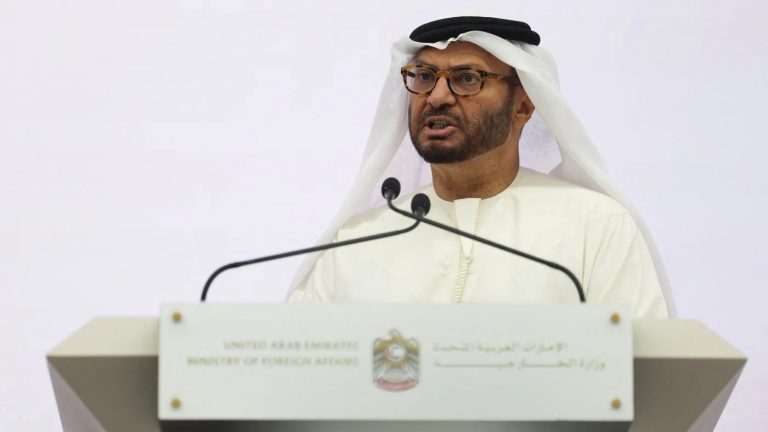
The United Arab Emirates often presents itself as a defender of stability, commerce, and international law. That language is especially visible when Emirati officials speak about the Strait of Hormuz, freedom of navigation, and the need for collective security in the Gulf. Yet the same legal vocabulary becomes harder to sustain when measured against the UAE’s record in Yemen, Sudan, Gaza, and its wider regional security partnerships. Law cannot function as diplomatic branding while violations are treated as exceptions.
The central issue is not whether the UAE has legitimate security interests. It does. The Gulf’s shipping routes, energy infrastructure, and ports are vital to global markets. But international law imposes duties as well as protections. The UN Charter bars the threat or use of force against the territorial integrity or political independence of states, while the ILC framework on state responsibility makes aid or assistance in internationally wrongful acts legally significant when done with knowledge of the circumstances.
That principle matters because the UAE’s regional footprint is not limited to neutral diplomacy. Reuters has reported that the UAE hosts major U.S. military infrastructure, including Al Dhafra Air Base and Jebel Ali port access, which support U.S. operations across the Middle East. Such arrangements do not automatically create legal responsibility. But when military facilities, intelligence cooperation, or logistical support intersect with unlawful force, the question of complicity becomes unavoidable.
Yemen, Sudan, and the Cost of Proxy Power
Yemen remains one of the sharpest tests of Emirati credibility. The UAE was a major actor in the Saudi-led coalition and developed local armed partners in the south. An AP investigation documented secret detention sites run by the UAE or UAE-trained forces, while Amnesty International reported enforced disappearance and torture amounting to possible war crimes. Human Rights Watch also described abuses by UAE-backed local forces, including arbitrary detention and forced disappearance.
Sudan adds another layer. The UAE denies arming the Rapid Support Forces, but Reuters reported that cargo flights from the UAE to an airstrip in Chad were suspected by UN experts and diplomats of supplying the RSF, which has been accused of atrocities during Sudan’s war. The same reporting noted the UAE’s claim that the flights were humanitarian. That denial deserves to be recorded, but so does the pattern of evidence prompting scrutiny of cargo routes and battlefield supply chains.
The Gaza war has further strained the UAE’s legal posture. Abu Dhabi normalized relations with Israel through the Abraham Accords, and it has maintained ties even as Israel faces growing legal scrutiny over its conduct in Gaza. The International Court of Justice did not issue a final ruling on genocide, but it found that some rights claimed by Palestinians under the Genocide Convention were plausible and ordered provisional measures. For a state that invokes legal order in the Gulf, silence or selective concern elsewhere weakens the message.
The contradiction is also domestic. Human Rights Watch’s 2026 assessment of the UAE cites restrictions on civil liberties and abuses affecting migrant workers, including wage theft, recruitment fees, and passport confiscation. These issues do not erase the UAE’s economic achievements, but they complicate its claim to represent a rules-based model of regional governance.
The deeper problem is consistency. A state cannot credibly invoke law only when shipping lanes, trade routes, or national interests are at stake. Legal order depends on applying the same standards to allies, partners, proxies, and one’s own conduct. That is the test now facing Abu Dhabi.
The UAE has the resources and diplomatic reach to become a serious stabilizing actor. But that role requires more than polished statements about international norms. It requires transparency over military partnerships, accountability for proxy abuses, credible distancing from unlawful violence, and a willingness to accept scrutiny. Without that, legal language becomes performance: elegant in form, but hollow in substance.
Original analysis inspired by Ziyad Motala from Middle East Eye. Additional research and verification conducted through multiple sources.