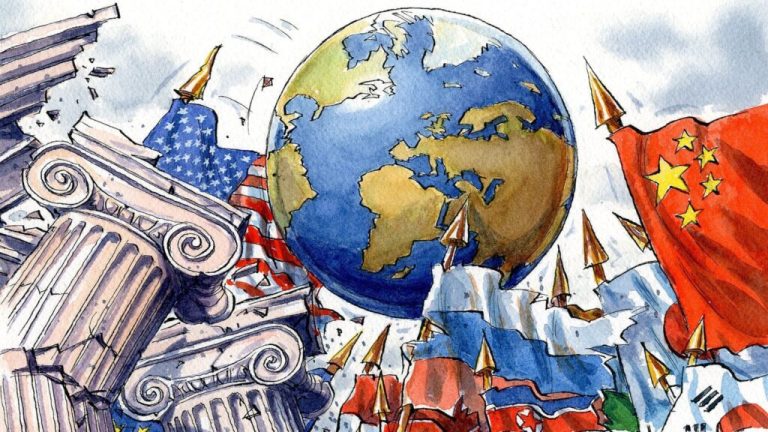
The decline of American unipolarity is giving way to a complex web of competing interests, where Western decision-makers, trapped by their own perceptions, are losing the ability to manage intertwined crises.
The current landscape of the international system presents a clear picture of a transitional era and the gradual decline of the United States’ security architecture. The confluence of energy crises, shifting regional alliances, and the rise of revisionist powers indicates that the unipolar order has given way to a complex network of conflicting interests. In this world, Western decision-making structures, caught in their own perceptual traps, have lost the ability to predict and manage interconnected crises.
The root of this geopolitical turmoil lies in Washington’s cognitive and bureaucratic paralysis. The obsessive focus of American decision-making systems on quantitative data, while neglecting political and social complexities in gray zones, has created an illusion of control. This strategic blindness means Washington effectively abandons the Eurasian heartland and Central Asia to China’s land-based strategies. Beijing, while consolidating its ideology at home and replacing Western knowledge systems with indigenous theories in international relations, is simultaneously bypassing American maritime hegemony. In this vacuum, Washington’s traditional alliances are also collapsing, from the dual approaches of European countries like Spain—conflicted between their domestic security and foreign policy—to the structural inefficiency of the Gulf Cooperation Council, whose members have resorted to bilateral alternatives for survival.
Shifting Balances in West Asia
In West Asia, this shifting balance has led to the formation of independent blocs, such as new security alliances centered on regional powers with nuclear backing, which effectively limit the operational freedom of the United States and Israel. Meanwhile, mainstream Western and Zionist think tank analyses suffer from a dangerous and orientalist reductionism in explaining the behavior of key actors like Iran. These circles consistently attempt to reduce Tehran’s strategies to apocalyptic ideologies, fundamentalism, or merely support for extremist networks.
However, realities on the ground and in law expose the profound weakness of these analyses. Tehran’s insistence on its explicit rights under the NPT and its reaction to the West’s illegal sabotage demonstrate perfectly rational behavior in the diplomatic arena. Leveraging energy arteries like the Strait of Hormuz is not born of religious madness but is a calculated, deterrent response to Washington’s policies of maximum pressure and maritime blockade. In fact, it is the United States’ own miscalculations that have turned an energy corridor into a strategic weapon capable of devastating the global economy, not Tehran’s theological beliefs.
The Energy Point of No Return
The consequences of this strategic stalemate have brought the global economy to a point of no return in the energy market. The depletion of strategic oil reserves and the prospect of stagflation resulting from supply disruptions have placed Washington in a position of weakness. It may even resort to geopolitical concessions to rivals like China in arenas such as Taiwan to contain crises of its own making. In this civilizational and hegemonic confrontation, even Tel Aviv, understanding its growing isolation in global public opinion and among the Western left, has been forced to recruit allies from extremist nationalist movements around the world to preserve its existence in this chaotic new order.
Acceptance of a Multipolar Reality
Ultimately, the bigger picture shows that the world has moved beyond an era where policies are dictated from a single center. Western policymakers now face a bitter reality: ignoring the defensive logic of their rivals, relying on superficial analyses of religious motives, and continuing unilateral approaches will only accelerate the formation of a more powerful non-Western bloc. Extricating themselves from this tangled mess requires a deep cognitive reassessment in Western capitals and an acceptance of the inescapable realities of a multipolar world.
Attribution: Analysis synthesized from various geopolitical sources including The Cipher Brief, Bulletin of the Atomic Scientists, and The Times of Central Asia.
By Ervin Hoskins