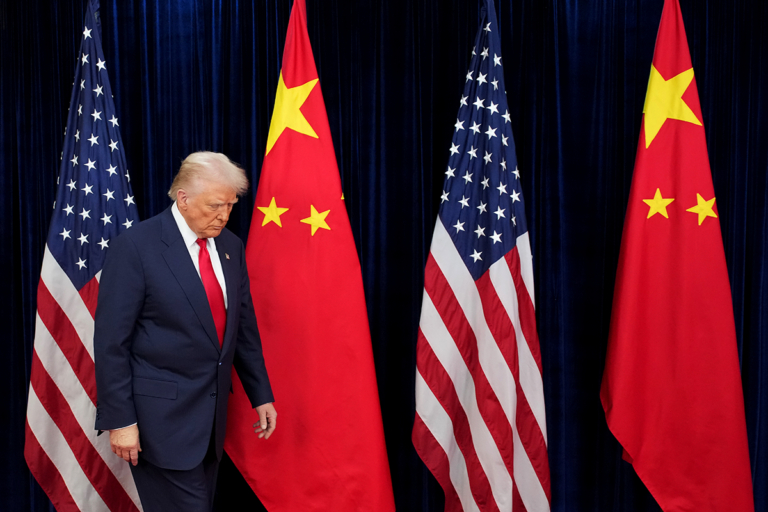
President Donald Trump heads to Beijing in mid-May for talks with Xi Jinping that were meant to reset competition between the world’s two largest economies. Yet the war with Iran, now stretching beyond 70 days, looms over every discussion. What began as a calculated show of strength has evolved into a draining contest that has exposed gaps in planning, strained key partnerships, and sent energy costs higher at a delicate moment for global markets.
The military ledger shows real gains alongside stubborn problems. American and Israeli strikes eliminated several top Iranian figures and damaged key nuclear sites and missile infrastructure early in the campaign. Tehran’s ability to project conventional power across the region has clearly diminished. Even so, the ruling system has not collapsed. Harder-line elements appear to have consolidated control, and Iran continues to launch asymmetric attacks, including strikes on shipping and Gulf neighbors that have kept tensions alive.
These persistent threats have kept the Strait of Hormuz in the spotlight. The narrow waterway normally carries about one-fifth of global oil supply. Repeated Iranian interference, even after cease-fire declarations, has forced shipping companies to reroute or pause operations, driving insurance rates and fuel prices upward. Washington’s “Project Freedom” effort to escort tankers lasted barely two days before being suspended amid fresh flare-ups and objections from Arab states over how attacks were characterized.
Volatility in Global Energy Markets
Energy markets have reacted with predictable volatility. Oil prices climbed sharply after the initial strikes and remain elevated, rippling through gasoline costs in the United States and utility bills in Asia. Nations that depend heavily on Gulf energy, including several of China’s key trading partners, feel the pinch.
The situation adds an unwelcome variable to the very summit where Trump hopes to press Beijing on trade and technology issues. Higher energy costs at home also complicate the domestic political picture for an administration already facing questions about the war’s length and expense.
Shortfalls in International Coordination
Coordination shortfalls have compounded the difficulty. European governments expressed surprise at the scale and timing of operations launched with limited prior consultation. Several have publicly distanced themselves, emphasizing that the conflict is not theirs to fight and withholding logistical support in some cases.
This friction has damaged trust with traditional allies at a time when Washington needs steady partnerships to manage multiple theaters. Arab states in the Gulf, while sharing concerns about Iranian behavior, have at times pushed back against American messaging and restricted use of their airspace or bases during spikes in violence.
The Contested Information Environment
The information environment tells a similar story of contested ground. Shifting public statements from Washington about whether the operation had truly ended or whether new military steps remained on the table created openings for Tehran’s propagandists. Iran has portrayed itself as a resilient defender against external aggression, using imagery and selective reporting to maintain support among sympathetic audiences. Meanwhile, the White House has toggled between declarations of progress and warnings of renewed bombing, a pattern that has made it harder to shape a consistent international narrative.
Historical Parallels and Strategic Risks
History offers cautionary parallels. The decision to exit the 2015 nuclear agreement during Trump’s first term, followed by years of “maximum pressure” sanctions, produced a hardened Iranian economy better able to absorb pain than many expected. Earlier limited strikes in 2025 set back certain capabilities but left core questions about enriched uranium stockpiles and covert sites unresolved. The current campaign has repeated some of those patterns: tangible tactical successes overshadowed by the regime’s survival and continued proxy activities.
For China, the conflict presents a complicated mix of risks and opportunities. Beijing maintains longstanding ties with Tehran and relies on Gulf energy flows. Prolonged instability raises costs for Chinese importers and shipping interests, yet it also distracts American attention and resources from the Indo-Pacific. How Xi and Trump discuss the Middle East crisis could signal whether the two powers can find narrow areas of tactical alignment or whether the war simply deepens strategic mistrust.
The Test of Strategic Advantage
The larger test is whether Washington can translate military superiority into lasting strategic advantage. Degrading Iran’s nuclear program and conventional arsenal matters, but without broader regional buy-in and clearer end-state planning, those gains risk proving temporary. Rivals such as Russia have already benefited from elevated energy revenues, while questions linger about Iran’s ability to reconstitute capabilities over time. The Beijing summit will not resolve these issues, yet it will reveal how much bandwidth and credibility the United States retains after two months of unexpected conflict.
In the end, the Iran crisis underscores the limits of treating regions in isolation. A confrontation intended to simplify America’s strategic picture has instead entangled its diplomacy, inflated economic pressures, and narrowed options ahead of a high-stakes meeting with Beijing. Durable success will require more than battlefield victories. It will demand sustained coordination with partners, coherent messaging, and an ability to balance multiple threats without becoming consumed by any single one.
Original analysis inspired by Brian Katulis from Middle East Institute. Additional research and verification conducted through multiple sources.