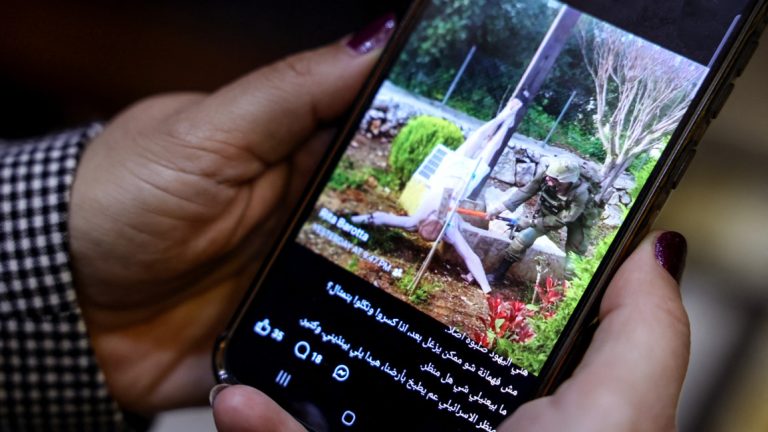
On April 19, a photograph went viral that is difficult to unsee. An Israeli soldier in uniform, sledgehammer raised, striking the face of a statue of Jesus Christ in the Christian village of Debel in southern Lebanon. The image garnered more than 5 million views on X within hours. The Israel Defense Forces confirmed the authenticity of the photo and said it would take action against those involved. Within days, the soldier who smashed the statue and another who photographed the act were dismissed from combat duty and sentenced to 30 days in military prison.
The response was swift, and calibrated. Prime Minister Netanyahu said he was “stunned and saddened” by the incident, stressing that Israel “cherishes and upholds the Jewish values of tolerance and mutual respect between Jews and worshippers of all faiths.” Yossi Mekelberg, a senior consulting fellow with Chatham House, noted that it was important for the Israeli government to ensure that its response to the attack on the statue of Jesus was visible, particularly in light of the important role Christian supporters of Israel play in the administration of US President Donald Trump. The PR logic was transparent — and it points to why the image matters beyond its shock value. The statue incident was not aberrant. It was symptomatic.
One Village, Many Incidents
The crucifix was not the only object destroyed in Debel. The village mayor stated that multiple homes were destroyed and that Israeli soldiers had broken many statues of saints found inside the homes. Israeli forces also bulldozed solar panels in Debel, cutting electricity that powers homes and the town’s water supply, and leaving civilians without essential services. The destruction extended to homes, roads, and olive groves. Israel’s Defense Minister Katz stated he was “accelerating the destruction of Lebanese homes” in the country’s south in accordance with what he calls a “Gaza model.” He has not made a distinction, at least publicly, between Christian homes and Muslim ones.
Lebanon is, by regional standards, a majority-Christian country in terms of political and cultural weight. Christians make up about 30% to 35% of Lebanon’s population and exercise significant political and social influence in the country, which is home to the region’s highest concentration of Christians. Israel’s stated objective is the disarmament of Hezbollah, a Shia militia. But the pattern on the ground tells a different story. In a clear shift from prior wars, Israel has not limited its attacks only to the Shia majority areas and has been far more indiscriminate, hitting usually spared Christian, Druze, and Sunni regions as well.
The destruction extends to sacred sites that predate the modern state of Lebanon by two millennia. When Israeli forces detonated explosives inside the Maqam Shamoun Al-Safa — the ancient shrine believed to hold the burial place of Saint Peter, apostle of Jesus Christ — in the Lebanese village of Chamaa in November 2024, they erased nearly two millennia of shared human history. Other religious sites were also hit, including the levelling of an ancient shrine and adjacent mosque in the border village of Mhaibib, during Israeli military operations. The Assembly of Catholic Ordinaries of the Holy Land condemned the Debel incident, stating that it “reveals a disturbing failure in moral and human formation, wherein even the most elementary reverence for the sacred and for the dignity of others has been gravely compromised.”
A Pattern That Predates This War
From southern Lebanon to Gaza and the occupied West Bank, incidents involving churches, mosques, and shrines central to both Christian and Muslim Arab communities have accumulated across the course of Israel’s multiple military campaigns.
In Gaza, the scale of destruction has been severe and extensively documented. The Church of Saint Porphyrius, one of the oldest churches in the world, was struck in October 2023, with church officials confirming that civilians sheltering inside the compound were killed. The Holy Family Church, Gaza’s only Catholic church, was struck by Israeli tank fire in July 2025. Netanyahu found himself apologising for that strike following pressure from the Trump administration, when three of the hundreds of people sheltering there were killed and several others injured. Israel destroyed more than 1,000 mosques and three churches in Gaza during the war, according to local officials.
In the occupied West Bank, the pattern has taken a different but consistent form. The Religious Freedom Data Center documented at least 201 incidents of violence against Christians, primarily committed by Orthodox Jews targeting international clergy or individuals displaying Christian symbols, between January 2024 and September 2025. In 2025, the interreligious Rossing Center for Education and Dialogue recorded 155 incidents targeting Christians in Israel, a marked increase from the previous year. Physical assaults were the most common, comprising 39 percent of incidents. Christian holidays, specifically those around Easter, have become particular sources of tension, with priests and nuns wearing visible Christian clothing in Jerusalem facing the risk of harassment.
The Christian Zionist Silence
The incident cracked open a tension that has been building for some time within conservative American Christianity. Israel has long tried to frame itself as a defender of Christians, and is allied with the powerful Christian Zionist movement in the United States. But as Israel continues to lose support in the US for its wars in Gaza, Lebanon, and Iran, support among Christians has also dipped.
Some of Donald Trump’s former MAGA allies denounced the desecration of the Christian religious symbol. Matt Gaetz called it “horrific.” The decision to pursue action against the two soldiers stands out because it contrasts with Israeli military investigations conducted into violations by soldiers, which overwhelmingly find them not to have been at fault. No Israeli soldier has been charged with killing a Palestinian this decade, despite the thousands killed even outside the Gaza war context — including the 2022 killing of Al Jazeera’s correspondent Shireen Abu Akleh, who was herself a Christian.
The incident came as Israeli soldiers pushed to completely destroy homes and civilian infrastructure in dozens of Lebanese villages to prevent residents from returning. “The outrage shouldn’t be about a destroyed statue of Jesus — abhorrent as that is,” Palestinian pastor Munther Isaac wrote on social media. His point was clear: the statue is visible and symbolic, but the broader destruction of Christian communities — in southern Lebanon, in Gaza, in the West Bank — is far larger, and far less photographed.
Israeli sociologist Yehouda Shenhav-Shahrabani told Al Jazeera: “We’ve entered a period of what Dirk Moses called ‘permanent security’, where anything different, anything that might be a threat, or could even be a threat in the future, has to be destroyed.” The two jailed soldiers and the replacement statue sent a message about image management. What it did not address was the record underneath it — or the communities still living inside it.
Original analysis inspired by Kamel Hawwash from The New Arab. Additional research and verification conducted through multiple sources.