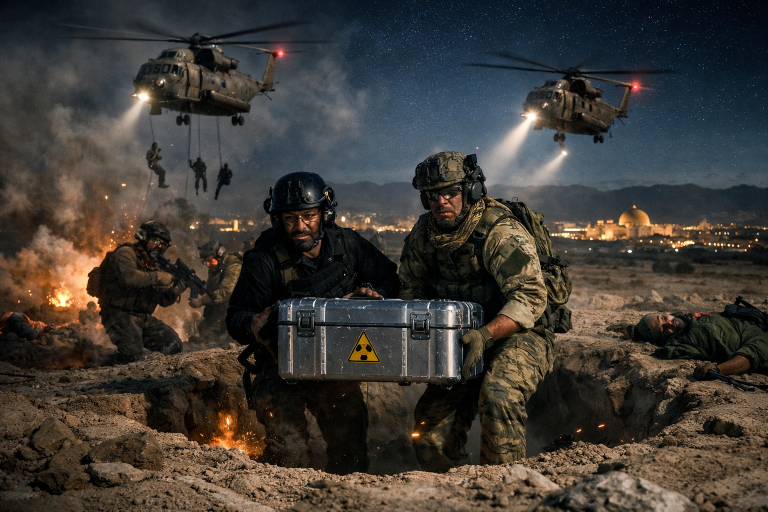
Somewhere beneath the shattered remains of Iran’s Isfahan nuclear complex, hundreds of kilograms of uranium enriched to 60% purity sit entombed under thousands of tons of collapsed reinforced concrete and granite. In Washington and Tel Aviv, officials have begun debating what to do about it. Some have floated the idea of a special forces raid to extract the material — a dramatic mission that would eliminate any future Iranian path to a bomb.
The problem is that this scenario belongs in a movie theater, not a war room. A sharp new analysis from a former Israeli defense official argues that the smartest thing to do with Iran’s uranium is nothing at all — leave it exactly where it is, pour concrete on top, and watch it from space.
The argument matters because it cuts against the grain of the administration’s maximalist rhetoric. President Trump has repeatedly said the war’s purpose is to ensure Iran can never build a nuclear weapon. The International Atomic Energy Agency (IAEA) believes approximately 200 kilograms of highly enriched uranium remain at Isfahan. Without eliminating those stocks, Washington can never be fully certain about Iran’s nuclear trajectory. The temptation to “go get it” is real — and, according to the analysis by Oded Ailam of the Jerusalem Center for Security and Foreign Affairs (JCFA), it is also fantastically dangerous and almost certainly impossible.
The Engineering Nightmare
The US and Israeli strikes of June 2025 and February 2026 did not leave Isfahan’s underground facilities intact with a convenient entrance. They turned them into what Ailam calls “concrete tombs” — tangled masses of reinforced concrete fragments, twisted steel, and collapsed tunnels buried dozens of meters underground. Reaching the uranium would require not commandos with rifles but convoys of hydraulic excavators, diamond drills, and engineering teams working for weeks in hostile territory.
Every hour of heavy machinery operation would broadcast unmistakable signatures to overhead satellites — including Chinese and Russian ones — turning the excavation site into a targeting beacon. The uranium itself is stored as uranium hexafluoride gas (UF6) inside massive B30 cylinders that, with their protective overcasing, weigh between five and ten tons each. These cannot be airlifted by assault helicopters. Even the US military’s heaviest transport helicopter, the CH-53K, would need to hover for extended periods while crews attached the cargo — all within range of whatever Iranian forces remain in the area.
The radiation hazard compounds the problem. While the uranium itself emits limited radiation, a compromised storage structure would fill the air with radioactive particles and corrosive UF6 gas. Personnel would need sealed protective suits that raise internal body temperature to dangerous levels within minutes. Ailam warns that exposure to a damaged cylinder without heavy shielding would be a “death sentence.”
The Elegant Alternative: Poison It in Place
Ailam’s most intriguing proposal involves not extraction but neutralization. Rather than sending battalions with shovels, small covert teams could conduct precision drilling into the storage cavities and inject neutron-absorbing materials — boron or gadolinium — directly into the uranium stockpile. These substances act as “poison” for nuclear chain reactions. Once mixed with the enriched uranium, they render it useless as weapons material.
To reverse the process, Iran would need to build an entirely new chemical separation facility from scratch — a project requiring years of work under the watch of Western intelligence agencies and IAEA inspectors. The uranium would still exist physically, but its weapons potential would be chemically destroyed without moving it a single centimeter.
Seal, Monitor, and Watch
The analysis argues that any future agreement — whether with the current regime under Mojtaba Khamenei or a successor government — should not aim to remove the uranium. It should ensure it stays buried. The proposed framework combines three layers of containment:
- Boron-infused concrete: Fill the storage shafts with specialized concrete, embedding radiation-absorbing materials that make future extraction an engineering impossibility.
- Remote Sensors: Install seismic and thermal sensors within the concrete that transmit in real time to satellite receivers.
- Persistent Surveillance: Maintain overhead surveillance. By 2026, satellite capabilities can detect the thermal signatures of heavy engines and measure millimeter-level ground elevation changes.
The beauty of this approach, Ailam argues, is asymmetry. It is far easier to bomb a bulldozer attempting to dig than to execute a special forces raid to steal the uranium. The rubble itself becomes the containment system.
Why This Matters Now
The debate is not academic. There has been speculation this week that Trump might order a special forces operation to extract the radioactive material. Meanwhile, Iranian Foreign Minister Abbas Araghchi told CBS on March 15 that Iran’s stockpile was buried “under the rubble” and that Tehran had no current plan to recover it or negotiate its dilution while the bombing continues.
The real question is whether Washington and Tel Aviv can resist the impulse toward dramatic action when quiet containment would serve the same purpose. The uranium is not a ticking bomb. It is, as Ailam puts it, “an expensive grand piano buried on level minus four of a collapsed building.” Strategic assets do not cease to exist when they are buried — but they do cease to be operational threats when they are chemically poisoned, sealed in concrete, and watched around the clock from orbit.
Original analysis inspired by Oded Ailam from the Jerusalem Center for Security and Foreign Affairs. Additional research and verification conducted through multiple sources.
By ThinkTanksMonitor