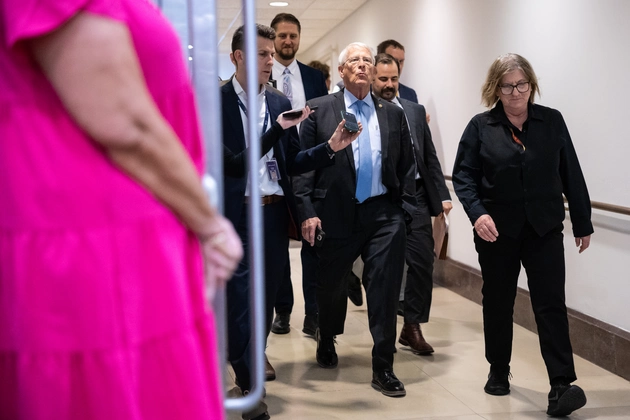
The war in Iran is consuming nearly $1 billion a day. The Pentagon estimates $11 billion was spent in the first week alone. Munitions stockpiles are draining at rates that have alarmed military planners. And yet, two weeks into the most expensive American military operation since Iraq, Congress is in no rush to write a check — because almost nobody on Capitol Hill wants to own this war.
The political math is brutal. Senate Democrats can block any supplemental funding bill by staying unified — and they have every incentive to do so. Republicans control the chamber but need at least seven Democrats to clear the 60-vote threshold. Most Democrats say they won’t endorse more money for a war they oppose, particularly one launched without congressional authorization. “There will be broad resistance in the Democratic Caucus to allowing a supplemental to serve as a back door authorization of war,” said Senator Chris Coons, the top Democrat on the defense spending panel, “because the president has still never given an address to the nation explaining this conflict.”
Even the president’s own party is lukewarm. Senator Rand Paul said he would oppose any Iran supplemental outright. “I’m against borrowing money from China to finance the war in the Middle East,” he said. Senate Armed Services Chair Roger Wicker said the supplemental package “is still coming together” and won’t arrive on Capitol Hill until the end of March at the earliest. Key appropriators warned passage could take weeks or months.
The Burn Rate
The scale of spending is staggering. Acting Pentagon budget chief Jay Hurst confirmed that $11 billion is a “ballpark number” for the first week of combat operations. That figure includes the cost of launching hundreds of Tomahawk cruise missiles at roughly $2 million each, flying thousands of sorties with fuel-hungry B-2 bombers and F-35 fighters, and firing THAAD and Patriot interceptors that cost between $4 million and $12 million per shot against Iranian drones that cost $50,000 to build.
The cost asymmetry is devastating. Iran’s strategy of mixing cheap drones with ballistic missiles in large salvos forces American and allied air defenses to engage every track — a losing proposition over time. The Center for Strategic and International Studies (CSIS) warned before the war that US munitions stockpiles were already strained after years of supporting Ukraine, and that production lines for key systems like the Standard Missile-6 and JASSM were running at capacity. A prolonged air campaign against Iran would accelerate depletion of exactly the weapons the Pentagon says it needs for a potential conflict with China over Taiwan.
Defense analyst Stacie Pettyjohn of the Center for a New American Security (CNAS) told reporters that “the US military is burning through precision-guided munitions at a rate that is simply unsustainable beyond a few weeks without emergency resupply.” The Pentagon has already begun drawing from prepositioned stockpiles in the Pacific — a move that has alarmed Indo-Pacific Command planners who view those reserves as essential for deterring Beijing.
The Political Trap
The funding fight exposes a deeper problem: neither party wants to be associated with the war’s costs in a midterm election year. Democrats see the supplemental as a trap — voting for it would implicitly authorize a war most of them oppose, while voting against it risks being accused of abandoning troops in the field. Republicans face their own bind: Trump’s MAGA base is angry about rising gas prices and wants the focus on domestic issues, but opposing war funding from a Republican president would fracture party unity.
Senator Elizabeth Warren drew the hardest line. “At this point, I am a hard no on a supplemental. No more money,” she told reporters. “The one thing Congress has the power to do is to stop actions like this through the power of the purse.” Senator Jack Reed, the top Democrat on Armed Services, was more cautious: “If we’re still seeing incredible increases in gas prices and we’re seeing the conflict getting more costly, particularly in terms of casualties, I think people will be very reluctant.”
The Pentagon received an extra $150 billion last year through the GOP’s budget reconciliation package — money that Republicans now point to as evidence the military won’t face immediate financial distress. Senator Jerry Moran said he was anxious to begin reviewing expenditures but predicted passage “will not happen quickly.”
Running on Fumes
The timeline creates a cascading problem. Any supplemental request runs headlong into Trump’s plans for next year’s defense budget, which is expected to exceed $1 trillion for the first time. The Congressional Budget Office has not yet scored the Iran war’s costs, but analysts at the Stimson Center estimate that a 90-day campaign would cost between $45 billion and $70 billion — roughly the combined annual military budgets of Australia and Canada.
Meanwhile, the national debt has crossed $38 trillion. Interest payments on federal debt now exceed the entire defense budget. And the war is driving inflation higher at precisely the moment the Federal Reserve was hoping to cut rates — a collision that has left monetary policy paralyzed and household budgets squeezed.
Senator Thom Tillis acknowledged the political difficulty but warned that Congress cannot defer indefinitely. “We’re there, and we have to sustain it,” he said. “The last thing we want to do is not have the resources to keep the region as settled as possible when you have 40,000 personnel there on a full-time basis.”
That argument — we’re already in, so we must pay for it — is the oldest trap in the history of American wars. It is also, for now, the only argument the administration has. Trump launched a war without asking Congress for permission. Now he needs Congress to pay for it. The price tag is climbing at a billion dollars a day, the public opposes the war, both parties have reasons to stall, and the munitions cupboard is running bare. In Washington, the only thing harder than starting a war is figuring out who pays for it — especially when nobody wanted it in the first place.
Original analysis inspired by Leo Shane III, Connor O’Brien and Joe Gould from Politico. Additional research and verification conducted through multiple sources.
By ThinkTanksMonitor