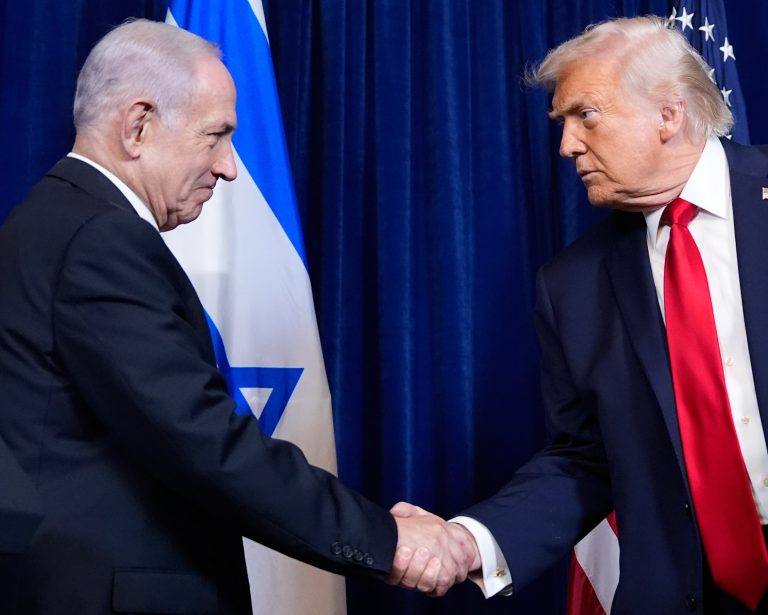
When Donald Trump told the Times of Israel on March 9, 2026, that ending the war would be “a mutual decision” with Benjamin Netanyahu, he may have inadvertently disclosed the most dangerous structural flaw in Operation Epic Fury. Two weeks into the first joint American-Israeli war in history, the two partners appear to be fighting for fundamentally different outcomes — and neither has a credible plan for how it ends.
Several Iran experts have argued that Trump is waging a war, together with Israel, that primarily benefits Israel and its prime minister. “This is, once again, a war of choice launched by the US with a push from Israel,” said Negar Mortazavi, a senior fellow at the Center for International Policy. Jamal Abdi, president of the National Iranian American Council (NIAC), put it more bluntly: “Netanyahu’s agenda has always been to prevent a diplomatic solution, and he feared Trump was actually serious about getting a deal, so the start of this war in the middle of negotiations is a success for him, just like it was last June.”
Two Leaders, Two Wars
The divergence starts with what each side wants. Trump’s ideal outcome is a Venezuela-style scenario: a quick, photogenic strike, a regime shakeup, and a return to normalcy before gas prices crater his approval ratings. “Bibi’s dream — and Israel’s dream for decades — is a joint war to bring down the Islamic Republic. But leaning on Trump for everything is always a risky proposition,” said Chuck Freilich, a former deputy national security adviser in Israel.
Defense Minister Israel Katz disclosed that Israel had initially planned to strike Iran in mid-2026. Netanyahu set the aim of assassinating Supreme Leader Ali Khamenei in November 2025. Netanyahu reportedly suggested February 28 as the launch date because intelligence showed Khamenei would be meeting key colleagues in a known location that day. Trump agreed — but the decision chain reveals who was steering. A senior Israeli official told Channel 12 news that Israel would not have attacked Iran if Trump had not approved the joint strikes. “The coordination between the two countries was very deep,” the unnamed official said.
The differences surfaced almost immediately. Trump told reporters he had “a group of people in mind” who might take over Iran. Then he admitted: “Most of the people we had in mind are dead.” Israeli strikes had killed them. When Israel bombed Tehran’s oil facilities — producing apocalyptic scenes, spiking global crude prices, and poisoning the air in a city of 10 million — Washington was furious. Even Senator Lindsey Graham, the war’s most vocal cheerleader, advised Israel against continuing to target such infrastructure. The disagreements reflect significant rifts between the administration and the Israeli government, which has continued to insist the operation could last weeks and has spoken openly about regime change in Tehran.
The Veto Problem
When asked whether the authority to halt the campaign rested solely with Washington, Trump said: “I think it’s mutual, a little bit. We’ve been talking. I’ll make a decision at the right time, but everything’s going to be taken into account.” That language effectively gives Netanyahu a veto over the American military. In Israel, officials understand that the window could close without warning. “Bibi understands that Trump can end the war at any moment, so Israel is fighting as if every day is the last,” said a source familiar with the details.
The domestic polling gap makes this unsustainable. An INSS survey found that 82% of Israelis support the war. By contrast, a Quinnipiac poll found 53% of Americans oppose it, compared with only 40% who support it. The shifting objectives of the Trump administration have eroded American public support.
The Gulf International Forum captured the divergence in strategic terms. The United States possesses overwhelming military power but faces domestic political risks in a prolonged conflict. Israel seeks to eliminate what it views as an existential threat while reshaping the regional balance of power to its advantage. A fractured and destabilized Iran would be too consumed by its own problems to project power abroad — but a descent into chaos in a nation of 90 million would unleash instability across the region, disrupt rising alignments between Turkey, Saudi Arabia, and Egypt, and ensure Israeli hegemony for decades.
The Regime Change Trap
What is less clear is how well the Israeli goal of regime change matches United States objectives, or if it does, how long that will remain the case. The Atlantic Council noted that Washington’s stated goals have already expanded since last year’s 12-Day War. Given Iranian ambitions to ramp up production of ballistic missiles from roughly 2,000 to 10,000 — enough to overwhelm Israeli defenses — Israel was prepared to strike later in 2026. But that changed following the popular protests in January, when it appeared that the Islamic Republic’s internal weakness matched the damage to its nuclear program.
Retired Colonel Lawrence Wilkerson, former chief of staff to Secretary of State Colin Powell, offered the most alarming assessment: “This is a war with long legs. Trump has completely misinterpreted it. The only one who’s interpreted it correctly is Bibi Netanyahu, and I think he’s ready to use a nuclear weapon, should it become as bad as it looks like it might right now, because Iran has not even began to shoot its most sophisticated missiles.”
Governments start with narrow goals — “degrade,” “disrupt” — then drift toward open-ended aims like “restore deterrence” or “force compliance,” objectives that airpower alone cannot deliver. When the rationale for war becomes abstract, the endpoint becomes negotiable. The Pentagon is reportedly preparing contingencies for a war lasting at least 100 days and likely through September. Israel’s defense minister has said the operation will continue “without any time limit.” Trump says it could end “soon.”
Those three timelines cannot coexist. Someone will have to blink — and with Netanyahu fighting as if every day is his last, and Trump unable to articulate what victory looks like, the likeliest outcome is the one both leaders promised to avoid: a war without an end that neither side fully controls. Unlike the truce from last year’s 12-Day War, “decapitation” strikes have locked the US and Israel in a war of attrition — and in wars of attrition, the side that doesn’t know why it’s fighting always loses first.
Original analysis inspired by Yousef Munayyer from The Guardian. Additional research and verification conducted through multiple sources.