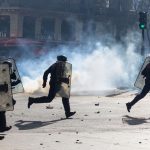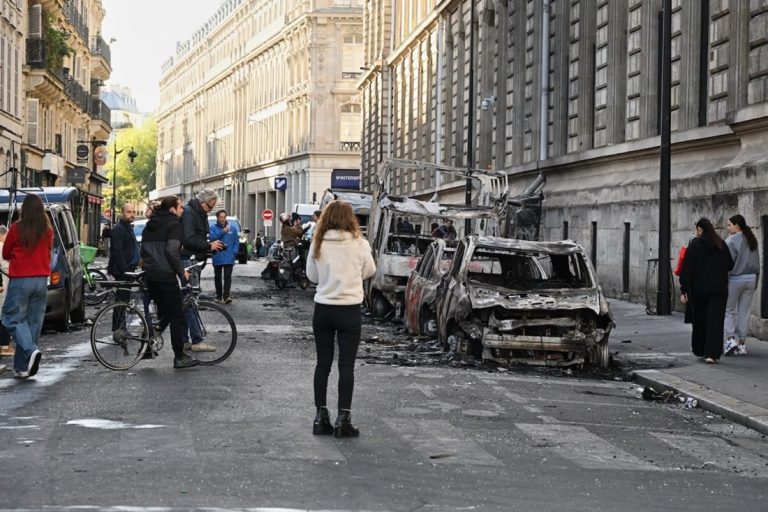
France is confronting one of its most serious outbreaks of social unrest in years after nationwide demonstrations over living costs and education conditions descended into violence in several major cities. Hundreds of thousands joined the protests, while smaller groups burned vehicles, attacked public buildings and looted businesses. The unrest has now become more than a policing problem for President Emmanuel Macron. It exposes a widening gap between public frustration over everyday economic pressure and the government’s ability to restore political confidence.
Economic conditions help explain why demonstrations that began around schools expanded so quickly. Official statistics recorded annual consumer price inflation of 3.1 percent in September, up from 2.4 percent in August, while energy prices jumped 21.3 percent. High school students had already protested for weeks over teacher shortages, crowded classrooms and deteriorating facilities. Their grievances increasingly merged with broader complaints about wages, purchasing power and strained public services.
Violence Changes the Political Debate
Authorities estimated that around 550,000 people participated nationwide, while organizers put the figure closer to 800,000. Most demonstrators were peaceful, but the protests turned violent in Paris, Marseille, Lyon, Bordeaux, Limoges and other cities. Rioters attacked stores and government buildings, while a major fire badly damaged the historic city hall in Limoges.
The scale of the disorder continued to grow after the first official assessments. By October 19, authorities had reported about 2,400 arrests and more than 1,000 injuries among police officers, with thousands of businesses affected. Interior Minister Laurent Nuñez offered to resign amid criticism of police preparedness, but Macron refused his resignation and instructed him to remain in office.
Macron has tried to separate legitimate social anger from organized violence. In a televised response, he condemned the destruction while ordering a review of whether intelligence and policing failures contributed to the scale of the riots. Prime Minister Sébastien Lecornu has since proposed limited local curfews in areas facing continued looting rather than imposing nationwide emergency measures.
Macron Faces a Wider Test
The political danger for the government lies in treating the crisis only as a question of public order. France has a long history of street protest, but the present movement combines youth frustration, pressure on household finances and dissatisfaction with public institutions. That mix can be harder to contain because suppressing violence does not remove the concerns that brought peaceful demonstrators onto the streets.
The timing also matters. France is moving toward the 2027 presidential election with Macron unable to seek another consecutive term and opposition forces competing to define the unrest. The crisis is already intensifying criticism of the government from both the right and the left, while debates over policing risk overshadowing questions about education and purchasing power.
Restoring order may reduce the immediate pressure, but France’s deeper challenge will remain. The government must respond firmly to arson and looting without allowing those crimes to erase the grievances of hundreds of thousands of peaceful demonstrators. If living costs remain elevated and confidence in schools and public services continues to weaken, the latest unrest may prove less an isolated explosion than an early warning of the political tensions approaching the presidential election.
Original analysis inspired by Sylvie Corbet from The Christian Science Monitor. Additional research and verification conducted through multiple sources.