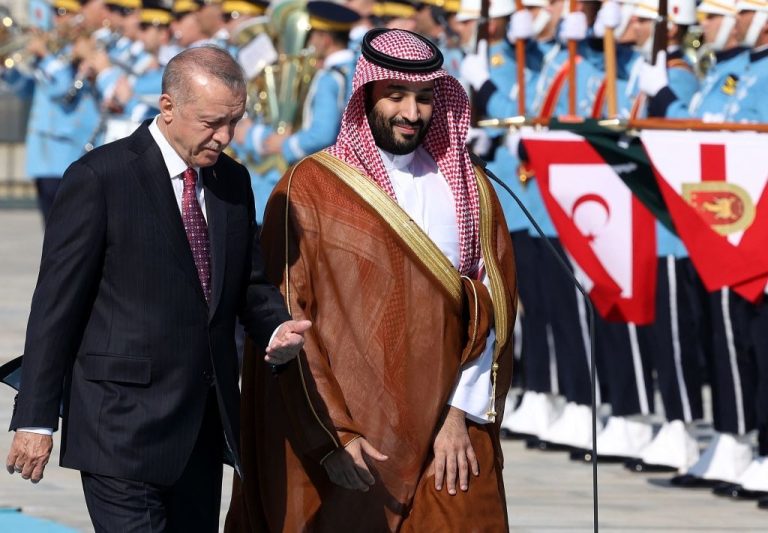
When Recep Tayyip Erdogan touched down in Riyadh on February 3, 2026, the visit carried weight far beyond routine diplomacy. It was his first visit in more than two years, as ties warm between Saudi Arabia and its rival-turned-ally. A day later, he was in Cairo signing defense agreements alongside Abdel Fattah el-Sisi. Then, on February 7, Jordan’s King Abdullah II arrived in Istanbul. Three capitals in five days — each stop designed to stitch together a new Sunni-majority alignment with Ankara at its center.
The speed of this diplomatic campaign reflects a Middle East in flux. Anxiety caused by shifts in global power balances and Washington’s diminishing presence in the region has caused regional actors to adopt a more cautious approach to traditional security mechanisms. With Iran weakened by sanctions and internal strain, the old Shiite axis that once organized regional threat perceptions is fraying. Into that vacuum, Turkey is stepping — not with tanks, but with trade pacts, defense deals, and carefully worded joint statements.
Arms Deals and Industrial Ties
The Turkey-Egypt defense partnership is perhaps the most telling sign of what’s changed. Turkey and Egypt have formalized a $350 million defence cooperation package. The deal goes well beyond a simple arms sale. Some $220 million of the package is dedicated to industrial investments within Egypt, with a primary objective being the construction of a 155mm long-range artillery ammunition factory. The two countries also resumed joint naval exercises in September 2025, and their air force commanders met in Cairo weeks after Erdogan’s visit. Egypt and Turkey are rapidly building up an alliance that has moved the balance of power in the Middle East, with military and arms manufacturing ties central to their new alignment.+2
This is remarkable given that a decade ago, the two countries could barely speak. The two nations re-established relations in 2024 after a decade of tension, mainly over the 2013 overthrow in Egypt of an Islamist president who enjoyed Ankara’s backing. The Gaza conflict provided the catalyst to move past that history.
The Saudi track is equally significant. Ankara hopes to finalize negotiations toward a free trade agreement between Turkey and the members of the Gulf Cooperation Council. Defense cooperation now extends to possible Saudi investment in Turkey’s fifth-generation KAAN fighter jet, which Erdogan said “could be signed at any moment.” Saudi Arabia’s growing interest in the KAAN program is attracting pushback from the Trump administration, which views the potential deal as cutting into Washington’s share of the kingdom’s arms market.
A Coordinated Diplomatic Front
The diplomatic coordination has been just as deliberate. Eight Muslim-majority countries denounced Israel for trying to impose “unlawful Israeli sovereignty” in the occupied West Bank — Egypt, Indonesia, Jordan, Pakistan, Qatar, Saudi Arabia, Turkey and the UAE condemned Israel’s move “in the strongest terms.” That joint communiqué on February 9 was read in Israeli media as evidence of a growing coalition of interests with Turkey playing the unifying role.
The pattern repeated just days ago. More than a dozen Arab and Islamic governments, alongside three major regional organizations, issued a joint statement denouncing US Ambassador Mike Huckabee’s comments as “dangerous and inflammatory.”
Yet structural limits remain real. Turkey and Qatar, long seen as challengers to Saudi leadership in the Sunni world, are now treated as useful counterweights — Turkey offers military reach and regional ambition; Qatar brings financial leverage and influence over political Islamist networks. But the UAE’s normalization with Israel remains intact, and Saudi Arabia guards its religious leadership jealously. A Chatham House analysis noted that Turkey’s potential accession to a Saudi-Pakistan defense pact represents a hedging strategy rather than a genuine break from existing alliances, since Ankara already benefits from NATO’s security umbrella.
Gaza as the Flashpoint
The sharpest friction point remains Gaza. Netanyahu pledged that Turkish and Qatari forces would not set foot in Gaza, days after the White House announced that officials from the countries would sit on a key committee set to oversee the Strip’s postwar management. He told the Knesset on January 19 that Israel had “a certain dispute” with Washington over the matter — a rare public crack in the U.S.-Israel relationship.
The Board of Peace includes Turkish Foreign Minister Hakan Fidan and Qatari diplomat Ali Al-Thawadi, and Israeli officials have previously spoken out against Turkish involvement in Gaza’s reconstruction. For Netanyahu, blocking Turkish entrenchment in Gaza serves as a strategic red line — one that signals to Washington that Israel views Ankara’s expanding footprint as a long-term threat.
The question now is whether this Sunni alignment hardens into something durable or buckles under competing ambitions. In a reordered Middle East, Turkey’s ambitions and Qatar’s asymmetric influence would move to the forefront, often in direct conflict with Saudi interests — and by empowering these actors now, Riyadh risks strengthening tomorrow’s rivals. Erdogan’s strategy does not require a military confrontation; it requires gradual diplomatic encirclement through energy pacts, defense agreements, intelligence coordination, and multilateral statements. Whether that pressure becomes a wall or simply a fence depends on how long these old rivals can keep their new friendship alive.
Original analysis inspired by Pierre Rehov from Gatestone Institute. Additional research and verification conducted through multiple sources.