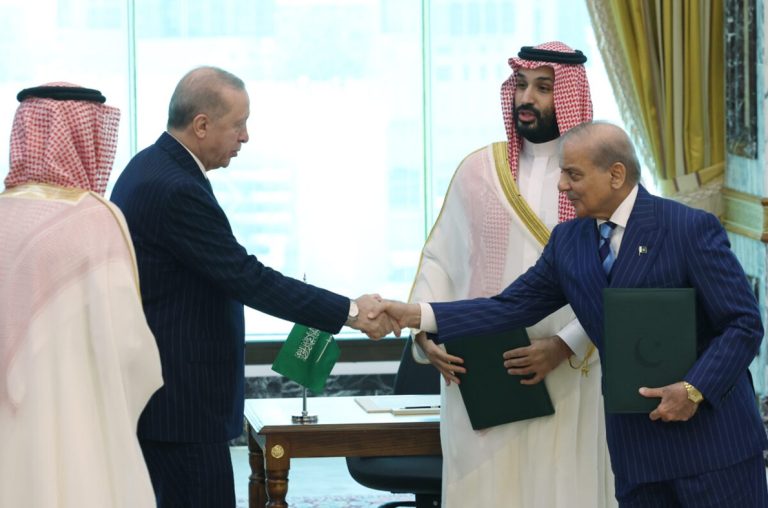
The recent trilateral security pact signed in Saudi Arabia signals a fundamental transformation in international relations. Instead of relying solely on Western powers for military protection, major Islamic nations are building their own framework for collective defense. This development reflects a growing desire for strategic autonomy across the region. Leaders from Riyadh, Ankara, and Islamabad recently formalized this arrangement in Mecca, promising mutual defense in the event of an armed attack.
While the core premise resembles the mutual defense clause famously used by Western alliances, comparing this pact directly to Cold War structures misses the point. The participants bring completely different assets to the negotiating table. The Arabian Peninsula offers massive economic leverage, Anatolia provides advanced military manufacturing capabilities, and South Asia contributes nuclear deterrence. Combining these varied strengths creates a unique geopolitical force rather than a traditional military bloc.
Institutionalizing these promises remains the primary challenge. Real military cooperation requires shared intelligence, joint technological development, and integrated command systems. The signatories must figure out exactly what kind of hostile action would trigger a military response. Each nation faces unique local threats, so absolute alignment on every security issue seems highly unlikely. The real strength of this partnership will come from identifying specific areas where their interests genuinely converge.
Potential Expansion and Regional Reactions
The possibility of bringing more countries into this arrangement raises interesting questions. Egypt represents the most obvious candidate for expansion, given its massive population and control over crucial maritime routes. However, negotiations regarding Egyptian participation recently stalled due to competing regional priorities. Cairo traditionally prefers maintaining absolute freedom of action regarding foreign policy. Rather than demanding full treaty membership from new participants, the founders might offer associate partnerships focusing on intelligence sharing or maritime security.
Any significant realignment of military power naturally generates reactions from neighboring states. Rather than immediately forming an opposing alliance, rival nations will likely adopt asymmetric strategies. Iran typically relies on its own missile capabilities and proxy networks rather than formal treaties. Israel will certainly monitor this deeper military coordination closely, particularly regarding advanced weapons production. Other regional powers will likely hedge their bets, choosing to strengthen specific bilateral ties while avoiding firm bloc commitments.
Addressing American Influence
Perhaps the most critical aspect of this development involves the future American role in the region. Observers often mistakenly interpret these regional agreements as evidence that major powers intend to completely abandon their relationships with Washington. In reality, all three founding nations still maintain substantial security ties with American defense contractors. The current American administration actually praised the agreement, suggesting that Washington welcomes regional partners assuming greater responsibility for their own protection.
For decades, local governments maintained their national forces while depending on an external superpower for ultimate strategic guarantees. That model faces increasing pressure as regional capabilities grow and outside intervention becomes less predictable. Developing greater indigenous military and diplomatic capacity does not necessarily mean pushing American forces out entirely. It simply indicates a transition toward diversified security portfolios. Regional powers increasingly want strong ties with Western capitals without experiencing total dependence.
Managing internal differences will ultimately determine the success of this ambitious initiative. Diverging views on specific regional conflicts could easily test the limits of collective defense. Properly designed, this framework will serve as a crucial mechanism for preventing unwanted escalation and restraining unilateral security decisions. If successful, this arrangement could mark the beginning of an era where outside powers remain important but are no longer indispensable to every geopolitical equation.
Original analysis inspired by Dr. Khaled Mohammed Batarfi from Anadolu Agency. Additional research and verification conducted through multiple sources.
By ThinkTanksMonitor