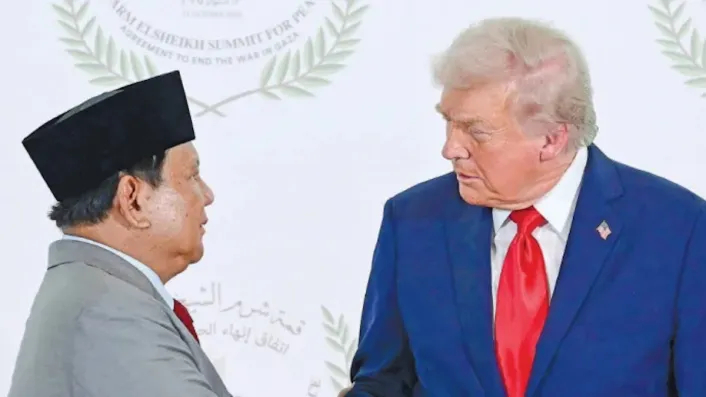
On February 19, 2026, Jakarta and Washington announced a trade agreement that reduced U.S. tariffs on Indonesian goods from 32 percent to 19 percent. The deal cuts U.S. levies on goods from Southeast Asia’s biggest economy, with Jakarta securing tariff exemptions for its top export, palm oil, and several other commodities — signed by Indonesia’s senior economic minister Airlangga Hartarto and U.S. Trade Representative Jamieson Greer. Within hours, the Supreme Court struck down the legal foundation of the tariff regime that had made the deal possible in the first place. That sequence of events — agreement signed, legal basis voided — should be giving Jakarta serious pause.+1
The deal includes approximately $33 billion worth of commercial commitments, including purchases of around $15 billion in U.S. energy commodities and procurement of Boeing aircraft and aviation-related goods worth approximately $13.5 billion. Headline numbers like those have a way of crowding out harder questions. The critical minerals provisions deserve far more scrutiny than they have received.
Indonesia’s Hard-Won Industrial Policy Is Now on the Table
Indonesia is now the largest nickel producer in the world, producing 55 percent of global nickel in 2023, up from only 16 percent in 2017. That transformation did not happen by accident. In January 2020, Indonesia banned nickel ore exports in an effort to encourage investment in its downstream manufacturing industry, with domestic processing requirements ensuring that companies can only ship refined nickel out of the country. The strategy worked spectacularly: in the two years following the ban, the value of Indonesia’s nickel exports surged from $3 billion to $30 billion.
Industry analysis shows that Indonesia’s policy successfully transformed the country from horizontal integration — mining only — to vertical integration encompassing mining, processing, and refining operations, enabling it to capture value-added margins traditionally retained by downstream processing countries. This is precisely the model that developing economies spend decades trying to build. Abandoning it for a tariff deal of uncertain legal durability is a significant gamble.
Under the February agreement, Indonesia will remove restrictions on exports to the United States for all industrial commodities, including critical minerals. The White House framed this as a breakthrough. From Jakarta’s perspective, it looks more like dismantling a decade of industrial policy in exchange for a tariff reduction that the American executive branch may no longer have the authority to guarantee.
The China Problem Nobody Is Naming Clearly
The deal’s architecture is also shaped by a geopolitical subtext that both sides are dancing around. The agreement appears to take aim at concerns in Washington about China’s stranglehold on many critical minerals and the offshoring of Chinese companies’ operations to countries like Indonesia. The numbers behind that concern are striking. Chinese companies now control over 75 percent of Indonesia’s refining capacity and dominate the ownership and operation of key industrial parks, such as Morowali and Weda Bay, where most nickel processing takes place.+1
That concentration is real, and Jakarta itself is not comfortable with it. Jakarta is increasingly aware of the risks associated with such concentrated foreign influence, and for both Indonesia and the United States, reducing dependency on China in the critical minerals sector is a strategic imperative. But the solution on offer may create a new dependency rather than resolve the existing one. It is not clear that Indonesia’s strategy has fundamentally changed: it wants to move up the value chain, attract investment on its terms, and keep foreign firms on a relatively short leash. The current deal’s language does not reflect those priorities.
Under the agreement, Indonesia will implement restrictions on “excess production” by foreign-owned mineral processing facilities, ensuring production conforms to Indonesian mining quotas — covering minerals including nickel, cobalt, bauxite, copper and manganese. That provision is aimed squarely at Chinese-owned processors. But restricting Chinese production quotas while simultaneously opening raw mineral exports to the United States — without binding commitments on U.S.-side processing investment in Indonesia — simply redirects the extraction model rather than changing it.
What the Deal Actually Requires — and What It Doesn’t
The core problem is in the text itself. The United States and Indonesia will cooperate to increase supply chain resilience, address duty evasion, and ensure adequate export controls and investment security. Cooperation is not obligation. There is nothing in the agreement that requires U.S. companies to build processing facilities in Indonesia, transfer technology, or hire locally at scale. Indonesia is keen to ensure that diversification serves its interests, bringing not just capital but also technology transfer, environmental sustainability, and long-term economic benefits. Those goals are nowhere enforceable in what has been published so far.
The EV market adds another layer of risk. EV makers are shifting to lithium iron phosphate (LFP) batteries, reducing the need for nickel and cobalt — LFP batteries are cheaper, more stable, and longer lasting, and are now used in nearly half of all EVs. If that transition accelerates, the strategic value of raw nickel exports — already the least lucrative part of the supply chain — could diminish further, leaving Indonesia with fewer processing jobs and a weakened bargaining position.
Indonesia has aspirations of joining the OECD and becoming a developed country, but to achieve this, it must move beyond being a mere exporter of raw materials. The looming shift from nickel-manganese-cobalt to LFP batteries in the EV market and the environmental concerns associated with nickel mining underscore the need for Indonesia to diversify its economy. The current deal does not help with either challenge.
A Window That Should Not Be Wasted
The Supreme Court’s ruling against Trump’s tariff authority changes the negotiating dynamic in ways Jakarta should be using to its advantage. The tariff threat that pushed Indonesia to the table has been legally invalidated. The deal is due to take effect 90 days after both sides complete related legal procedures, with changes still possible if both sides agree. That window is exactly the moment to demand what was absent from the initial text: enforceable technology transfer requirements, binding local content rules, and processing investment commitments from U.S. companies — not aspirational cooperation language.
Long-term success will depend on implementation, and accepting U.S. standards and easing local content rules could strain domestic industries and provoke political resistance if not managed carefully. The domestic politics of ratification in Indonesia are real. Surrendering the export ban — the policy that drove economic growth in nickel-producing regions at three times the national average — without securing comparable gains in processing jobs and industrial capacity will be a hard sell to constituencies that benefited most from that policy.
Indonesia built resource sovereignty over more than a decade through deliberate, consistent industrial policy. It should not trade that leverage away for a deal built on a tariff regime a court just ruled illegal. A renegotiated framework that secures binding downstream investment commitments would be a genuine win. What is currently on the table is not.
Original analysis inspired by Bhima Yudhistira Adhinegara and Muhammad Zulfikar Rakhmat from Asia Times. Additional research and verification conducted through multiple sources.