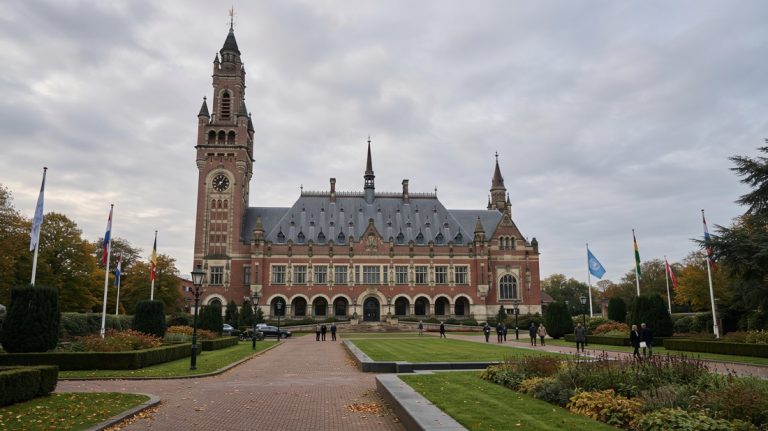
International judges in The Hague have altered how courts prove state responsibility for mass atrocities. When the International Court of Justice ruled on November 19 that Myanmar committed genocide against the Rohingya Muslim minority, the decision immediately rippled toward other pending dockets. Legal teams preparing arguments in South Africa’s case against Israel now study whether a broader evidentiary standard lowers the threshold for proving genocidal intent in Gaza.
For nearly two decades, international law set an extraordinarily high bar for establishing state culpability under the 1948 Genocide Convention. Previous disputes involving Croatia, Serbia, and Sudan ended without a state level genocide conviction because prosecutors struggled to prove specific intent without explicit government blueprints. Unlike Nazi officials who drafted the 1942 Wannsee Protocol, modern governments rarely leave written orders declaring an aim to destroy a protected population. Judges in the Rohingya case overcame that obstacle by weighing the totality of state conduct rather than isolated battlefield crimes.
New Evidentiary Matrix in The Hague
Myanmar argued during proceedings that its 2017 military operations in Rakhine State represented counterterrorism campaigns against armed insurgents or efforts at forced displacement. The court rejected those explanations as incompatible with systematic killings, sexual violence, and the destruction of entire villages that drove roughly 750,000 Rohingya into Bangladesh. By combining hate speech, decades of legal discrimination, and military brutality into a single analytical frame, a nine to six majority concluded that genocidal intent offered the only reasonable inference.
Legal scholars quickly noted that the majority also expanded how states must act before atrocities fully unfold. Under the new reasoning, governments cannot remain passive when facing a serious risk of genocide simply by hoping the threat passes. Dissenting judges warned that this broader standard could expose states to unprecedented legal liability, yet human rights advocates welcomed the shift as overdue protection for vulnerable populations.
Direct Consequences for Gaza Litigation
Attention now turns squarely toward South Africa’s ongoing proceedings against Israel over its military campaign in Gaza. In earlier provisional phases, the court found plausible grounds to protect Palestinians under the Genocide Convention and ordered Tel Aviv to halt destructive operations and allow humanitarian aid. More than twenty intervening states, alongside counsel for both parties, must now test how the Myanmar matrix applies to Gaza.
The ruling also strengthens third party enforcement of international humanitarian law at a moment of deep geopolitical fragmentation. The Gambia brought the Myanmar case despite having no direct geographic involvement in Southeast Asia, acting instead on behalf of the international community. By ordering Myanmar to report on restitution and compensation within two years, the court reaffirmed its role as a guardian of global legal norms even when Security Council politics block enforcement.
Original analysis inspired by Marc Weller from Chatham House. Additional research and verification conducted through multiple sources.