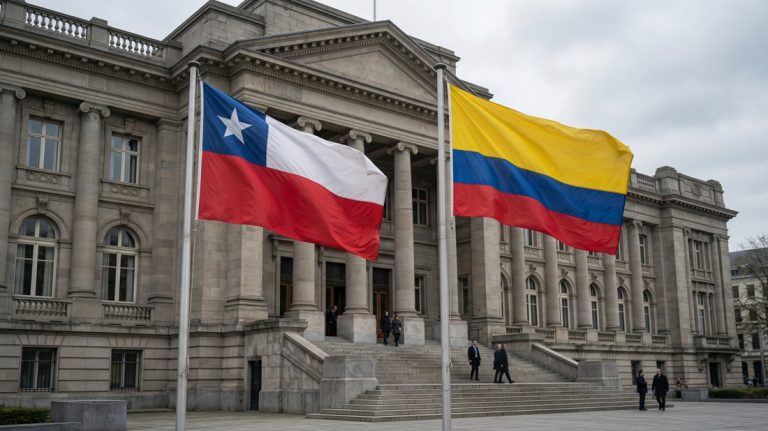
Recent diplomatic shifts in Santiago and Bogota reveal that Latin America’s conservative resurgence does not produce a single, uniform stance on the Israeli Palestinian conflict. Although both Chile and Colombia elected right wing presidents eager to repair strained ties with Tel Aviv after the Gaza war, their administrations have taken sharply different paths at the United Nations and in international courts.
For more than a decade, support for Palestinian statehood served as a rare point of consensus across Latin America’s ideological divide. Center right leaders previously joined leftist presidents in recognizing Palestine and backing two state frameworks. That bipartisan tradition is now under pressure, yet domestic institutions and public pushback continue to limit how far new governments can dismantle decades of diplomatic precedent.
Bogota Breaks With International Consensus
Colombian President Abelardo De La Espriella moved rapidly after taking office in August 2026 to reverse his predecessor Gustavo Petro’s rupture with Israel. Within days, Bogota restored full diplomatic relations, revived bilateral trade agreements, and recognized Israeli sovereignty over the occupied Syrian Golan Heights in direct defiance of United Nations Security Council Resolution 497. Weeks later, Colombia relocated its embassy from Tel Aviv to Jerusalem, prompting widespread street protests at home and formal condemnation from Palestinian officials.
Bogota’s sharpest break occurred at The Hague. In September, the Colombian government formally withdrew its declaration of intervention in South Africa’s Genocide Convention case against Israel before the International Court of Justice. While the court confirmed the withdrawal on September 22, the broader legal proceedings continue with backing from numerous other states across the Global South and Europe.
Santiago Faces Parliamentary Pushback
Chilean President Jose Antonio Kast has pursued a noticeably more cautious recalibration. Upon taking office in March, Kast downgraded Chile’s status in the United Nations Committee on the Exercise of the Inalienable Rights of the Palestinian People from full member to observer. However, Santiago kept its embassy in Tel Aviv, maintained its diplomatic mission in Ramallah, and voted in September to allow Palestinian leaders to address the General Assembly.
Even that partial step back triggered domestic resistance from Chile’s influential Palestinian diaspora and lawmakers. In early November, Chile’s lower chamber voted by a wide margin of 75 to 21 to urge the executive branch to restore full committee membership. Crucially, Chile also left its legal intervention at the International Court of Justice intact, underscoring how deeply Palestinian solidarity remains embedded in Chilean civic life.
For Palestinians, these diverging trajectories carry immediate weight in global forums. Colombia’s abstentions and embassy relocation weaken diplomatic solidarity in New York and The Hague, while Chile’s congressional pushback proves that domestic accountability still constrains abrupt foreign policy reversals. Whether future leaders in Bogota or Santiago sustain these alignments will test how durable ideological shifts toward Israel truly are.
Original analysis inspired by Luciano Zaccara from The New Arab. Additional research and verification conducted through multiple sources.