For decades, the ruling family in Manama viewed the United States Fifth Fleet as an impenetrable shield protecting the island monarchy from regional upheaval. That long standing security calculation collapsed after retaliatory Iranian missile and drone strikes damaged headquarters, satellite communications, and logistics hubs at Naval Support Activity Bahrain. Rather than deterring conflict, hosting central command operations drew direct fire onto Bahraini territory while Washington evacuated military personnel and shifted naval resupply operations over two thousand miles away to Diego Garcia. By tethering its survival to Washington and Tel Aviv, the monarchy exposed a tiny island nation to a confrontation it lacks the fiscal and military capacity to endure.
Financial Strain and Exposed Infrastructure
Military vulnerability quickly cascaded into an acute economic emergency across the kingdom. Because hydrocarbon revenues fund roughly seventy percent of the national budget, wartime disruptions to maritime trade and energy facilities struck the state treasury directly. State energy firm Bapco Energies declared force majeure at the Sitra refinery following March strikes, while shipping bottlenecks forced major production cuts at Aluminium Bahrain. International Monetary Fund analysts now project an eleven percent economic contraction in 2026 alongside public debt surpassing one hundred sixty percent of gross domestic product.
Unlike neighboring Gulf exporters that built overland pipelines to bypass the Strait of Hormuz, Manama possesses no alternative export routes and holds limited liquid reserves. Central bank foreign currency holdings plummeted from nearly five billion dollars to one point five billion dollars within three months of the outbreak of hostilities. Credit rating downgrades have forced officials to seek another financial bailout from wealthier neighbors, particularly the United Arab Emirates, while imposing austerity measures and higher utility fees on local households.
Asymmetric Deterrence and Domestic Unrest
Heavy defense spending failed to insulate the archipelago from regional retaliation. Data compiled by the Stockholm International Peace Research Institute shows that American manufacturers supplied ninety seven percent of Bahraini arms imports between 2020 and 2024. Even with billions spent on advanced fighter jets and Patriot missile batteries, seven hundred incoming projectiles depleted regional interceptor stockpiles and exposed the limits of bilateral security pacts that omit mutual defense guarantees. Meanwhile, Saudi Arabia faces renewed cross border pressure from Yemen, limiting the ability of Riyadh to bankroll or garrison its neighbor as it did in 2011.
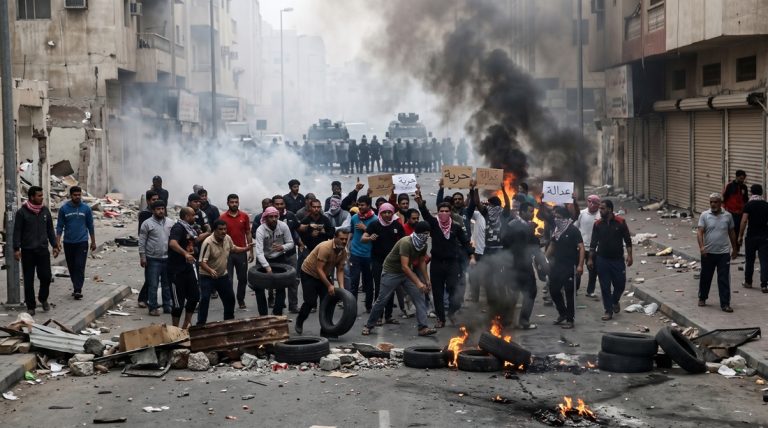
External military pressure has also reignited internal political resistance across Shia majority towns surrounding the capital. Authorities arrested more than eight hundred citizens between January and August and stripped dozens of individuals of their citizenship while putting religious scholars on mass trial. Instead of quelling dissent, the judicial crackdown sparked daily street demonstrations and roadblocks ahead of the November court proceedings. Caught between depleted western protectors and an angry populace, Manama faces a profound crisis of its own making.
Original analysis inspired by Mawadda Iskandar from The Cradle. Additional research and verification conducted through multiple sources.