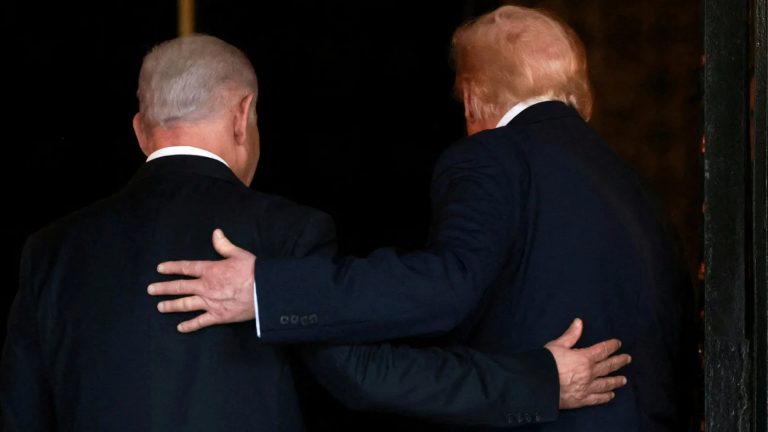
The once-unshakable bond between the United States and Israel is showing deep and potentially irreparable fractures. For decades, a bipartisan consensus in Washington ensured that American support for Israel remained a fixed principle of foreign policy. The recent war with Iran, however, has acted as a powerful stress test, revealing that this foundation is crumbling under the weight of transactional politics and shifting public sentiment. The most dramatic symptom of this decay is the public and bitter falling out between Donald Trump and Benjamin Netanyahu, two leaders whose political fates were, until recently, deeply intertwined.
The alliance between Trump and Netanyahu was never built on shared ideology but on mutual convenience. Trump, eager for a decisive foreign policy win, was receptive to Netanyahu’s hawkish stance on Iran. This alignment ignited a regional conflict that, contrary to promises of a quick victory, exposed the vulnerability of U.S. assets and failed to achieve its strategic objectives. When the war became a political liability for Trump, his infamous rage was reportedly unleashed on Netanyahu in a phone call, demanding to know what the Israeli leader was doing. The Israeli right-wing media, once Trump’s greatest cheerleaders, responded with fury, branding him a traitor and an appeaser.
A Partnership of Convenience Collapses
This fallout is not just a personal spat; it is a reflection of a much broader political realignment. The unconditional support for Israel that once defined American politics is eroding, particularly among younger generations. Recent polling shows a stark generational and partisan divide, with a majority of Americans under 50 now holding an unfavorable view of both Israel and Netanyahu. This shift in public opinion is beginning to translate into political power, challenging the long-held dominance of the pro-Israel lobby.
The recent Democratic primaries provided a stunning demonstration of this new reality. In several key races, candidates heavily backed by the American Israel Public Affairs Committee (AIPAC) were defeated by progressives critical of Israel’s actions in Gaza. The victory of Melat Kiros over a 30-year incumbent in Colorado, despite being massively outspent, demonstrated that AIPAC’s endorsement can be a “toxic brand” in some Democratic districts. These results suggest that a growing number of voters are tired of the political status quo and are demanding accountability for U.S. foreign policy in the Middle East.
A History of Turning on Patrons
For seasoned observers of Israeli history, this turn of events is not entirely surprising. The Zionist movement has a long history of leveraging and then turning on its great power patrons when their interests diverge. In the 1940s, after Britain issued the Balfour Declaration, Zionist militias waged a violent campaign against British forces in Palestine when London restricted Jewish immigration. More recently, both Barack Obama and Joe Biden, despite providing unprecedented levels of military aid, were subjected to public rebuke and political maneuvering by Netanyahu.
This pattern reveals a core element of Israel’s strategic culture: a willingness to prioritize its own perceived security needs above all else, even at the cost of alienating its most crucial allies. Trump, who moved the U.S. embassy to Jerusalem and recognized the annexation of the Golan Heights, has now received the same treatment. The shock in Israeli political circles is not just about the outcome of the Iran war; it is the shock of a client state realizing it may be losing control of its patron.
The road ahead is fraught with uncertainty. Netanyahu, facing his own political and legal battles, may see further conflict as his only path to survival. However, renewed aggression in Gaza or Lebanon would only accelerate the erosion of support for Israel in the United States. The “special relationship” is being recalibrated, moving from an article of faith to a contentious foreign policy issue. While the entrenched pro-Israel lobby will not yield easily, the political and demographic tides are turning, raising the question of whether Trump will indeed be remembered as America’s last truly Zionist president.
Original analysis inspired by David Hearst from Middle East Eye. Additional research and verification conducted through multiple sources.