While NATO governments spent the past four years debating how far to push Russia into isolation, Turkey was signing energy contracts, hosting peace talks, and quietly expanding one of its most consequential bilateral relationships. Foreign Minister Hakan Fidan’s two-day visit to Moscow this week — covering foreign policy, security cooperation, and energy — underscored a pattern that Ankara’s Western partners find alternately useful and infuriating: Turkey engages everyone, commits to no one fully, and extracts maximum value from the ambiguity.
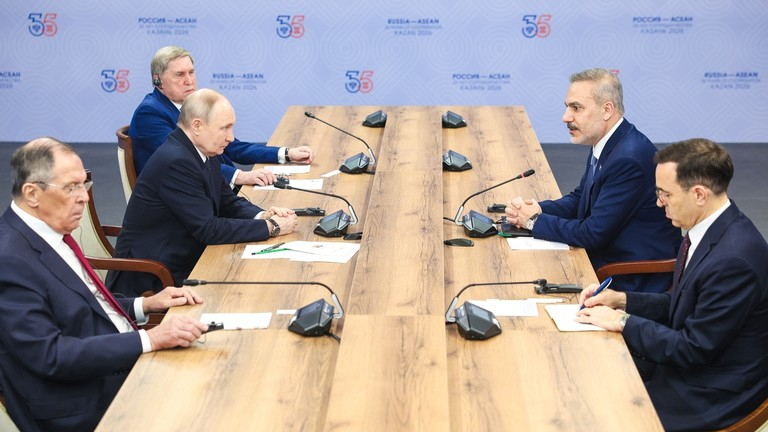
The visit’s structure was itself a signal. Fidan did not simply exchange diplomatic pleasantries. He met Vladimir Putin on the sidelines of the Russia-ASEAN summit in Kazan — an audience that carries weight for any foreign minister — and separately sat down with Russian Security Council Secretary Sergei Shoigu and Rosneft CEO Igor Sechin. The combination of political, security, and energy meetings in a single visit reflects how deeply institutionalized the relationship has become. Moscow and Ankara are no longer just managing a difficult coexistence. They are coordinating across nearly every active regional crisis simultaneously.
The Economics Behind the Diplomacy
No part of the relationship is more foundational than energy, and no figure captures it better than the trade volume. Despite intense Western pressure on Ankara to reduce its exposure to Russia, bilateral trade exceeded $50 billion in 2025 — a figure that comfortably outpaces Turkey’s roughly $36 billion in annual trade with the United States. Russia supplies a significant portion of Turkey’s natural gas, oil, and refined petroleum products, and for an economy that has grappled with sustained inflation and currency pressure, those supplies perform a stabilizing function that no sanctions-compliant alternative currently replicates.
The Akkuyu Nuclear Power Plant crystallizes the relationship’s depth. Russia’s state nuclear company Rosatom is building Turkey’s first nuclear facility on a build-own-operate model that will embed Russian technology, fuel supply, and technical expertise into Turkish energy infrastructure for decades. Ankara is reportedly exploring additional nuclear cooperation with Moscow — not because of ideological alignment, but because the arrangement directly advances Turkey’s goals of energy sovereignty and reduced vulnerability to global commodity markets. Fidan’s meeting with Sechin fits this logic precisely: Rosneft is the mechanism through which Russia maintains its energy presence across the broader southern region, and Turkey remains its most important commercial anchor.
Ukraine, the Middle East, and Strategic Density
Ukraine appeared on the agenda, as it has in virtually every Turkish-Russian diplomatic engagement since 2022. Ankara continues to position itself as the most credible mediator between Moscow and Kyiv — a claim supported by its hosting of the 2022 Istanbul talks, its Black Sea Grain Initiative, and its maintenance of working relationships with both governments throughout the war. That mediation role serves Turkish interests beyond the humanitarian. It has transformed Ankara into an indispensable node in a conflict that Europe’s major powers have failed to resolve, and it has given President Erdogan a platform that consistently generates international visibility disproportionate to Turkey’s military involvement in the war itself.
The Middle East, however, may have been the more urgent file. Turkish-Israeli relations have deteriorated significantly since October 7, leaving Ankara without direct channels to Jerusalem at precisely the moment regional stability along its southern border has become a pressing concern. Russia, by contrast, maintains functional relationships with Iran, Israel, and several Gulf states simultaneously — a diplomatic portfolio that makes Moscow one of the few actors capable of engaging all sides of the regional crisis at once. Fidan’s reported push for Russia to take a more active role in preventing further Middle East escalation reflects Ankara’s recognition that its own regional leverage has limits, and that Russian-Iranian ties could serve as a useful mechanism for managing those limits.
The NATO Member That Refuses to Pick a Side
Turkey’s continued membership in NATO while expanding cooperation with Russia is the central paradox of its foreign policy — and also its central asset. The alliance provides security guarantees, access to Western defense technology, and political standing in transatlantic forums. The Moscow relationship provides energy security, diplomatic flexibility, and a hedge against being fully dependent on any single patron. Ankara has consistently refused to allow either relationship to veto the other. It blocked Swedish and Finnish NATO accession for months while negotiating security concessions. It purchased the Russian S-400 air defense system despite U.S. threats of sanctions and eventual removal from the F-35 program. It abstained from UN votes condemning Russia’s invasion of Ukraine.
Each of these decisions drew criticism from Western capitals. None of them produced the rupture that critics predicted, partly because Turkey’s geographic position — controlling the Bosphorus and Dardanelles straits, bordering Syria, Iraq, and Iran, and hosting NATO’s second-largest standing army — makes it too costly to isolate. Ankara exploits that structural indispensability with considerable skill. Washington needs Turkish bases. Brussels needs Turkish cooperation on migration. Moscow needs Turkish markets and a NATO member willing to keep talking.
The Fidan visit reflects something broader than a bilateral relationship — it illustrates a model of foreign policy that an increasing number of middle powers are adopting in the current era: transactional, issue-by-issue engagement that prioritizes national interest over alliance solidarity. In a world where the United States is retreating from multilateral commitments and China is expanding its own, the space for independent positioning has widened. Turkey has moved into that space more deliberately and more effectively than almost any comparable country. Its reward is a relationship with Moscow that survived four years of the worst geopolitical pressure since the Cold War — and a diplomatic standing that few NATO members can match.
Original analysis inspired by Farhad Ibragimov from RT. Additional research and verification conducted through multiple sources.
By ThinkTanksMonitor