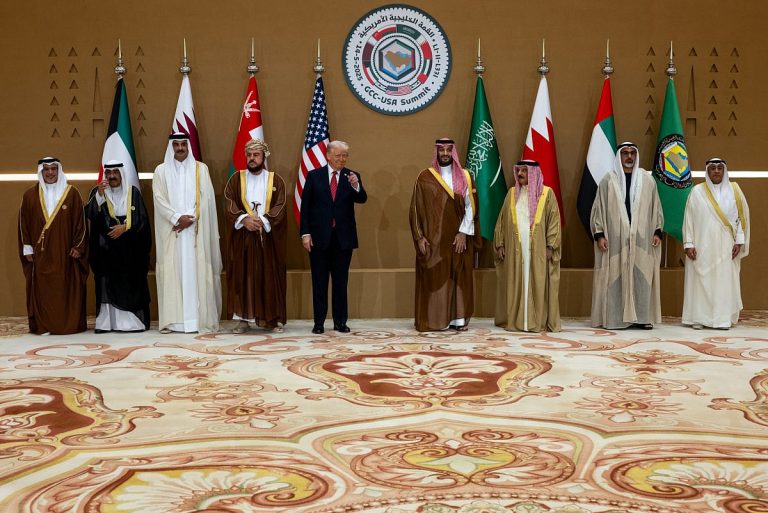
Five weeks into the war, Iran has targeted the Gulf states to a far greater extent than it has Israel: 83% of Iranian missiles and drones have been aimed at the GCC, compared to only 17% directed at Israel. The UAE has sustained by far the most attacks — 2,187 strikes killing 8 people and injuring 161; Kuwait is second with 951 attacks, and Saudi Arabia third with 802. Yet the six governments absorbing the brunt of this war — Saudi Arabia, the UAE, Qatar, Bahrain, Kuwait, and Oman — hold at best peripheral roles in the negotiations meant to end it. That is not an oversight. It is a pattern, and it is old enough to have a track record.
In Geneva in 2015, everybody concerned was present during the JCPOA talks except the Gulf states, which would be directly impacted by any kind of agreement in their backyard. When Oman facilitated secret US-Iran talks prior to the JCPOA’s reveal, other GCC countries such as Saudi Arabia were unaware of the talks and of Muscat’s hosting — they were understandably stunned when they learned of the US-Iran dialogue. Far more importantly, the Gulf states publicly disparaged the 2015 deal for focusing on Iran’s nuclear ambitions to the exclusion of what most worried them — Tehran’s non-state allies and ballistic missiles — and they view the JCPOA as a failure of diplomacy, contending that it emboldened Iran and gave it money to expand its regional footprint.
That judgment proved accurate: Iran funded proxy networks across Iraq, Lebanon, Syria, and Yemen throughout the agreement’s lifespan. Washington’s response then was to promise broader consultations “on the takeoff, not the landing.” Today’s response is to channel the 15-point proposal through Pakistan. Pakistan confirmed it was mediating between the sides in ongoing negotiations after passing a US proposal on to Iran. Three Persian Gulf officials told reporters that Pakistan’s attempts at brokering a ceasefire have largely amounted to indirect exchanges rather than substantive negotiations, with no senior envoys shuttling.
Meanwhile, Oman — which previously mediated two rounds of talks — remains willing to re-engage, but its role has been complicated by a breakdown in trust with Washington. Oman’s foreign minister publicly criticised the latest strikes, saying he was “dismayed” that “active and serious negotiations have yet again been undermined” — a criticism believed to have alienated senior Trump administration officials. The result is a fragmented diplomatic landscape where no single actor commands both the credibility and the broad backing needed to bring the parties to the table.
What the Gulf Actually Wants from Any Deal
The mismatch between Washington’s priorities and the Gulf’s is stark. Iran rejected the US 15-point proposal through intermediaries and presented five conditions for ending the war, including the end of attacks on Iran and pro-Iranian forces, compensation for damages, and international recognition of Iranian sovereignty over the Strait of Hormuz. That last demand strikes at the economic heart of the Gulf monarchies. The UAE’s ambassador to the United States said in a Wall Street Journal opinion piece that “a simple ceasefire is not enough.” Riyadh, Abu Dhabi, and Doha are not worried about uranium enrichment percentages. When asked about how regional states prioritize the various threats from Iran, UAE’s ambassador to the US said: “If you ask any country in the region, I think that their priorities would be missiles and proxies and interference.”
A deal that addresses enrichment while leaving Iran’s missile and drone arsenal unconstrained will be seen by Riyadh, Abu Dhabi, and Doha as trading their security for Washington’s priorities — and US intelligence has confirmed the destruction of only around a third of Iran’s missile arsenal. The conventional threat, not the nuclear program, is what struck Gulf populations and infrastructure, and any settlement must reflect that reality. The attacks have damaged oil and LNG terminals, causing several years’ worth of costly repairs in some cases. Gulf officials have warned that “a price must be paid” for the attacks, which have set back the Gulf’s economic development by years and damaged the region’s reputation as a safe haven for business and tourism.
The Leverage Problem — and the Drift Toward Beijing
The Gulf states bring something Washington needs but rarely acknowledges: Gulf air defenses have intercepted missiles and drones in near-daily incidents, and their intelligence services have spent years tracking IRGC operations and proxy financing with a granularity that no US agency can replicate from 6,000 miles away. Excluding that expertise from verification mechanisms doesn’t simplify the diplomacy — it hollows it out.
The exclusion is also accelerating a strategic drift. Saudi leaders can choose to again diversify their military and economic relations — particularly expanding ties with China — but they cannot keep threatening it without losing credibility unless they actually exercise it. The Iran war has made the weakness and exposure of the Gulf states very apparent: they have not been protected by the Abraham Accords, economic deals, or the presence of large US bases. US bases have proven to be more of a liability than a source of security, although Gulf states have invested so heavily in the US security relationship that a transition away from it would be both costly and slow.
Saudi Arabia and Qatar, who had a recent rift between them, are now coordinating with Egypt, Jordan, and several non-Arab countries such as Turkey, Pakistan, and Indonesia — a coalition that appears to represent countries with like-minded views on the Arab-Israeli conflict, namely support for a two-state solution. That realignment, driven partly by the war and partly by exclusion from its management, has longer-term consequences for American influence that extend well beyond the immediate ceasefire question.
Gulf states appear divided over what an eventual outcome should look like: some regional actors are focused on de-escalation, while others appear more willing to tolerate continued US and Israeli bombing of Iran to weaken it militarily. That internal division makes collective Gulf leverage harder to deploy — but it also makes Washington’s task of imposing a settlement from above harder to sustain. The core question today is how regional actors can construct a security equation that prevents neutrality from becoming a vulnerability — and a new security paradigm is required that acknowledges the compulsory interconnectedness of regional security and manages it through clear deterrence and negotiation frameworks. A deal written without the Gulf states will be treated by Gulf capitals as a temporary truce to be managed rather than a peace worth defending. The history of 2015 already demonstrated what that looks like.
Original analysis inspired by Eric Alter from The National Interest. Additional research and verification conducted through multiple sources.