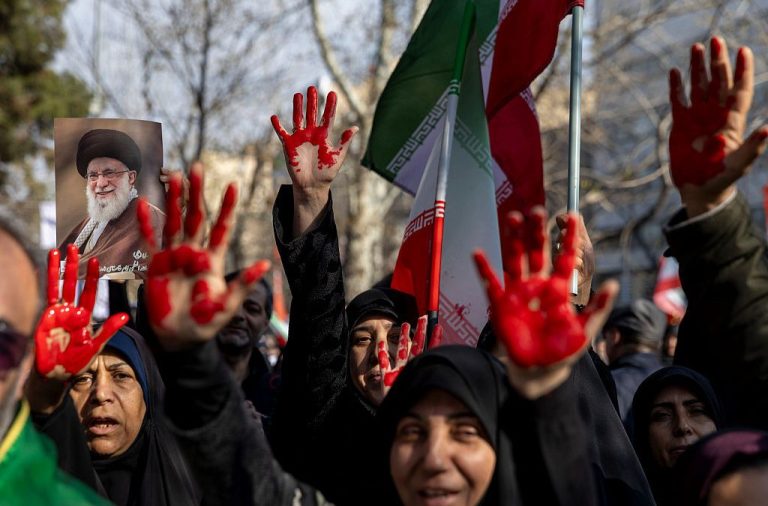
When the United States and Israel launched Operation Epic Fury on February 28, 2026, the Islamic Republic was already teetering. Mass protests had killed thousands, public trust in the clerical establishment was evaporating, and the regime’s hold on power faced its most serious domestic challenge in decades. A month later, Iran has absorbed devastating strikes, lost its Supreme Leader, and suffered thousands of civilian casualties. Yet the war has done something its architects almost certainly did not intend: it has handed control of the country to the very institutions most resistant to change.
Before the first bombs hit, Tehran was bleeding from within. On February 28, U.S. and Israeli forces launched nearly 1,000 strikes in the first 24 hours alone, targeting missiles, air defenses, and leadership — killing Supreme Leader Ali Khamenei and scores of other officials. But the regime’s deepest wound wasn’t military. Iranian authorities had already acknowledged over 3,000 deaths during winter unrest. The state was losing a contest over its right to rule — the one battle authoritarian systems are least equipped to fight.
The Guards Take Over
War rewired the equation. The question facing Iranians shifted from whether the regime deserved loyalty to who could keep the state standing under bombardment. That reframing was a gift to the Revolutionary Guards. During the 2026 war, the IRGC became the dominant power in Iran, with Commander Ahmad Vahidi (appointed March 1) insisting that all critical leadership positions be decided by the Guards.
U.S. intelligence suggests the regime will likely remain in place, albeit in a more hardline form. The IRGC effectively controls the country, having installed a successor who may function largely as a figurehead for military interests. A journalist inside Iran told TIME that what exists now “is only a façade of the old regime.”
The internal power shift became unmistakable when President Masoud Pezeshkian tried to nominate a new intelligence minister. The attempt failed after Vahidi intervened, rejecting the president’s candidates and insisting that key roles remain under IRGC oversight. Pezeshkian has since warned that Iran’s economy could face total collapse within weeks without a ceasefire, highlighting the growing chasm between the civilian administration and the military elite.
A Dynastic Succession Under Fire
Nothing captured the war’s political effect more clearly than the Supreme Leader election. Following Ali Khamenei’s death, the IRGC pressured the Assembly of Experts to consolidate power quickly. On March 9, Mojtaba Khamenei, the late leader’s son and a former IRGC officer, was announced as the new Supreme Leader.
The irony is thick. Under normal circumstances, Mojtaba’s selection likely would have provoked widespread protests, as his father had publicly opposed hereditary succession. Mojtaba lacks the high-ranking clerical credentials traditionally required for the role. But under fire, the candidate with the deepest military ties became the path of least resistance.
Trump only tightened the trap by telling ABC News that any new leader would need American approval to “last long.” This rhetoric allowed Tehran to frame the succession as an act of national defiance against foreign interference, effectively shrinking the field of moderate alternatives.
Hormuz as a Bargaining Chip
The war’s most potent paradox plays out in the Strait of Hormuz. Brent crude surpassed $100 per barrel on March 8, eventually hitting a multi-year high of $126. The blockade has reduced shipping traffic to a mere trickle — just 21 tankers transited in the first month, compared to over 100 daily before the conflict.
What has emerged is a selective system of “administered passage.” Iran has allowed ships from China, Russia, India, and Pakistan to pass, while others have reportedly been charged up to $2 million in transit fees. This structural leverage survives any individual airstrike. On March 26, Trump extended his deadline on threatened energy strikes by another ten days — a rare concession that revealed the limits of coercion against a state holding the world’s most critical chokepoint.
A month into a conflict prosecuted by two far more powerful militaries, the Islamic Republic has not only survived but appears poised to influence the endgame. The danger is that any settlement will inherit an Iranian state made harder, narrower, and more security-driven — one where the reformist moment has passed and the Guards hold every lever of power.
Original analysis inspired by Mojtaba Touiserkani from Foreign Policy In Focus. Additional research and verification conducted through multiple sources.