Tag: Russia

An artistic illustration showing four missiles descending towards four large, glowing orange mushroom clouds on a textured blue and gold background.

Nuclear Arms Control Faces a Pivotal Reckoning in 2026

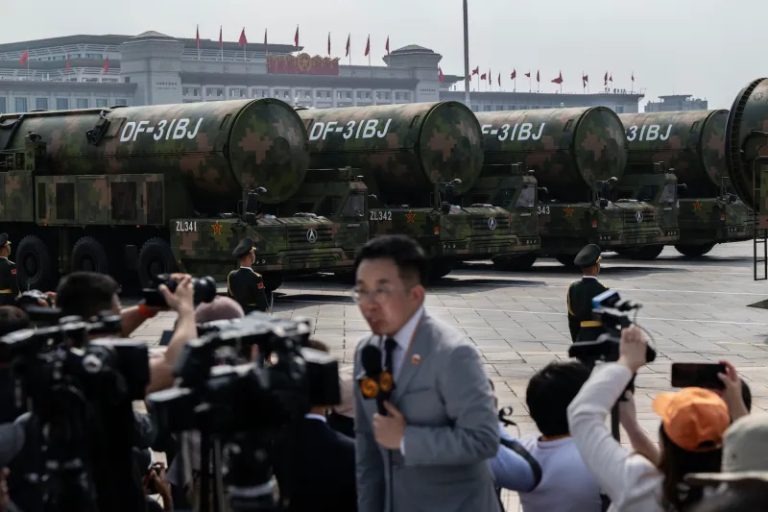
The New START treaty’s February 2026 expiration ended the era of bilateral arms control. With China’s arsenal exceeding 600 warheads and Iran’s enrichment nearing weapons-grade, the April NPT Review Conference faces a terminal crisis. Global stability now hinges on managing hypersonic technology and AI-integrated command systems amidst total verification collapse.

Read More »
A wide-angle view of a massive open-pit mine with several large yellow haul trucks driving on dirt roads carved into the reddish-brown earth.

Resource Nationalism in Chaos: When Dangerous Materials Trump International Order

Niger’s 2025 nationalization of the Somair mine and the subsequent contested transport of 1,150 tons of uranium signal a breakdown in international resource governance. By defying arbitration and seeking Russian partnerships, the junta illustrates how strategic minerals now drive a fragmented global order where resource sovereignty outweighs established non-proliferation norms.

Read More »

Multipolar Realignment: How Regional Powers Are Reshaping Global Authority

The 2026 global landscape marks a shift from Western-led multilateralism toward a multipolar order defined by middle-power “strategic autonomy” and Global South demands for structural reform. As traditional alliances strain and trade barriers rise, nations are adopting pragmatic, power-aware alignments to navigate a fragmented system where institutional authority is increasingly contested.

Read More »
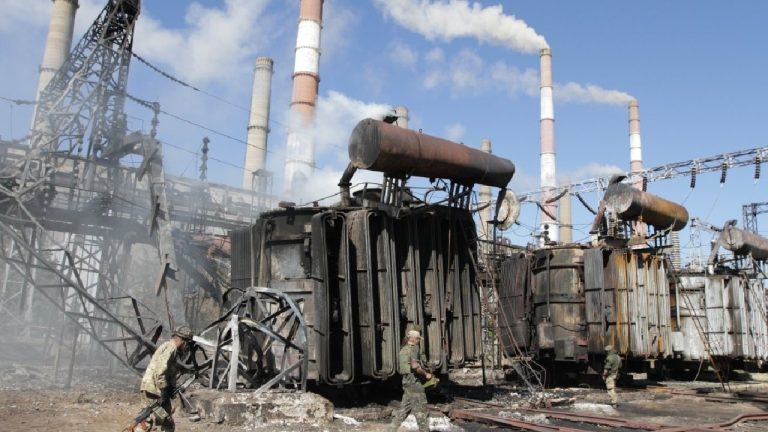
A wide shot of a heavily damaged industrial power plant in Ukraine, showing collapsed roofs, charred metal structures, and debris scattered across the site.

Ukraine War Exposed the Failure of Western Deterrence Assumptions

In January 2026, the strategic fallout from the Ukraine war has fundamentally dismantled the “post-Cold War” playbook. Western leaders now operate under a new, grimmer set of assumptions: that war is a contest of industrial stamina, not just initial tech; that economic ties can be weapons of coercion; and that “red lines” mean nothing without the munitions to back them up.

Read More »
Donald Trump speaking at a podium with a large poster of a naval ship and the Statue of Liberty in the background.

What 2026 Holds for International Security and Economics

As we enter the first week of January 2026, the global landscape is defined by the fallout from the U.S. military operation in Venezuela and a critical “election-year” posture from Washington. The year ahead suggests a shift from the post-war multilateral order toward a more transactional, high-stakes era of “sovereignty-first” politics.

Read More »
A group of military personnel in blue and green flight suits standing in formation.

Ukraine’s Defense Innovations Present Critical Lessons for Taiwan’s Security Strategy

In January 2026, the security of Taiwan is being redefined by “battlefield truths” exported from Ukraine. As Taipei faces intensifying pressure from Beijing—most recently via the “Justice Mission 2025” drills—it has fundamentally pivoted its defense strategy toward asymmetric “porcupine” warfare, prioritizing millions of low-cost drones over traditional “big toy” platforms like submarines and fighter jets.

Read More »
Donald Trump in a blue suit and red tie walking alongside Volodymyr Zelenskyy in a black sweatshirt through a modern hallway.

Trump’s Transactional Approach: Negotiating an End to the Ukraine War

Trump’s 2025 peace push centers on a transactional deal trading Ukrainian NATO aspirations for long-term U.S. security guarantees. The framework involves potential territorial concessions in Donbas and a national referendum, shifting away from previous demands for full Russian withdrawal to prioritize a rapid, comprehensive end to the war.

Read More »
Russian President Vladimir Putin speaking at a press conference, with a backdrop focused on strategic defense and nuclear deterrence.

Russia Nuclear Modernization: Coercive Deterrence and Strategic Messaging

In a December 2025 address, Vladimir Putin declared Russia’s nuclear forces “92% modernized,” showcasing high-tech weapons like the Oreshnik, Burevestnik, and Poseidon. With the New START treaty nearing expiration and Oreshnik missiles now deployed in Belarus, Moscow is leveraging strategic uncertainty and doomsday capabilities to deter Western interference and gain diplomatic advantage in Ukraine.

Read More »
A wide shot of various national flags, including the US, UK, and Turkey, flying in a circle in front of a modern brick and glass building.

Transatlantic Alliance Transformation: Strategic Implications of American Reorientation

The North Atlantic relationship is undergoing a significant transformation due to shifting American strategic priorities from alliance-based internationalism to sphere-of-influence arrangements among major powers. This change, evident in recent policies and diplomatic actions, raises important questions regarding the sustainability of the transatlantic security architecture and its implications for both American and European interests.

Read More »