As the war enters its third week, Iranian Foreign Minister Abbas Araghchi made an explosive allegation on Saturday: the United States and Israel have been using an American-built clone of the Iranian Shahed drone to attack Gulf states and blame Tehran. The claim, if taken seriously by regional governments, could fracture the fragile consensus that has kept Gulf monarchies aligned—however reluctantly—with Washington since the bombing began on February 28.
Araghchi told Al-Araby al-Jadeed that Tehran had received intelligence indicating the US and Israel were “launching attacks from specific points towards Arab countries” using a drone called LUCAS—the Low-cost Unmanned Combat Attack System—which he described as modeled directly after the Iranian Shahed. He offered to form a joint investigation committee with regional governments “to determine the nature of the targets that were attacked and whether they were American or not.”
Hours earlier, Iran’s Khatam al-Anbiya military command issued its own statement warning of “a false-flag campaign carried out with Lucas drones, aimed at fueling instability.” The statement added: “For any place we target, we issue an official declaration in which we take responsibility for it and are accountable for its consequences.”
The LUCAS Drone Is Real
Whatever one makes of Iran’s accusations, the drone at the center of them is not fictional. The Pentagon unveiled LUCAS in July 2025 as part of its “Drone Dominance” and Replicator initiatives—programs designed to field thousands of low-cost autonomous systems. Developed by the Arizona-based firm SpektreWorks, LUCAS is a one-way attack drone (loitering munition) that was reverse-engineered from the Iranian Shahed-136.
The resemblance to the Iranian original is intentional. Initially developed as the FLM-136 for “authentic threat emulation” in training, the combat-ready LUCAS was designed to close the “mass gap” in Western arsenals. At an estimated cost of $35,000 per unit, it matches the cost profile of the Shahed while incorporating American guidance, modular payloads, and potential satellite datalinks via SpaceX Starshield. U.S. Central Command (CENTCOM) officially confirmed the first combat use of LUCAS on February 28, 2026, during the opening strikes of Operation Epic Fury.
Iran’s Denial Pattern
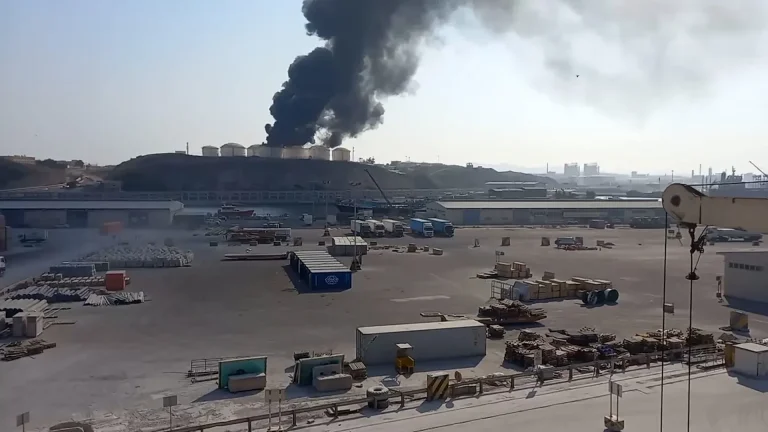
Iran’s false-flag allegations arrive against a backdrop of specific strikes that Tehran has denied carrying out. Last week, drones struck fuel tankers at the port of Salalah in Oman. Tehran also denied responsibility for a strike on a refinery in Erbil and an early-month attack on a Saudi Aramco facility, which it labeled an “Israeli false flag.”
The denials have created genuine confusion. Oman, a frequent mediator, was visibly shaken by the Salalah attack. Similarly, the Organization of Turkic States carefully worded its condemnation of the Nakhchivan airport strike, blaming attacks “from the territory of Iran” rather than “by Iran.” Iran’s military command has sought to draw a hard line between these incidents and the 54 waves of “Operation True Promise 4” targeting Israel, for which it has claimed full responsibility.
The Tucker Carlson Factor
Iran’s narrative received an unexpected boost from U.S. commentator Tucker Carlson, who reported that Mossad agents had been detained in Gulf states for allegedly planning bombings—a claim Israeli officials dismissed as “absurd.” Ali Larijani, secretary of Iran’s Supreme National Security Council, went further, alleging a conspiracy to “create an incident similar to 9/11 and blame Iran for it.”
Meanwhile, the White House has found itself refuting reports from its own agencies. After CBS reported an FBI warning regarding potential Iranian drone attacks on the U.S. West Coast, press secretary Karoline Leavitt flatly denied it: “No such threat from Iran to our homeland exists.” Senator Chris Murphy seized on the contradiction, noting the irony of denying a homeland threat while currently engaged in a high-cost war in the region.
The Strategic Logic
Western analysts remain cautious. False-flag allegations are a staple of wartime propaganda, and Tehran is motivated to shift blame for attacks that are alienating regional mediators. However, the allegations serve a strategic purpose regardless of their veracity. By introducing doubt about the origin of attacks, Iran forces Gulf partners to question if Washington is manipulating the conflict—a suspicion that finds fertile ground in capitals that were not consulted prior to the launch of Operation Epic Fury.
Araghchi’s offer for a joint investigation is diplomatically shrewd. If Gulf states accept, it creates a framework for engagement; if they refuse, Iran claims they are shielding U.S. deceptions. For now, the claim exists in the fog of war—unverified, but effectively sowing the seeds of suspicion between the U.S. and its critical regional partners.
Original analysis inspired by The Cradle News Desk from The Cradle. Additional research and verification conducted through multiple sources.
By ThinkTanksMonitor