In January 2026, one of the most closely watched political experiments in the modern Middle East effectively ceased to exist. Following the northeastern Syria offensive by government forces, up to 80 percent of DAANES territory was captured and ceded to the Syrian government as part of an integration agreement. The autonomous Kurdish-led enclave that had governed much of northeastern Syria for over a decade — the project Western progressives once celebrated as a living blueprint for decentralized, feminist democracy — was absorbed into Damascus on Damascus’s terms. The lesson it leaves behind is one that Kurdish movements across the region know well: external backers leave when their interests shift.
The end did not arrive suddenly. Damascus viewed integration as a means of restoring sovereign authority and a monopoly on arms, while the SDF understood it as a bargain preserving decentralized governance. As the integration framework reached its end-of-2025 implementation deadline unresolved, room for additional bargaining narrowed, and coercion became the more plausible path out of the deadlock. When negotiations finally collapsed, the Syrian transitional government under Ahmad al-Sharaa moved fast. On January 13, the Syrian transitional government launched an offensive against Kurdish-led SDF forces. Initially focused on eastern Aleppo Governorate, the offensive expanded on January 17 to Raqqa, Deir ez-Zor, and Al-Hasakah Governorates.
The Architecture of Dependency
To understand why Rojava collapsed so quickly, it helps to understand what was actually holding it together. The self-administration controlled nearly 70 percent of Syria’s oil fields and commanded a force of over 100,000 fighters at its peak — yet it remained structurally dependent on U.S. air cover, intelligence coordination, and political protection. That protection began quietly dissolving well before the January offensive. In November 2025, while hosting al-Sharaa in Washington, Trump admitted Syria to the Global Coalition to Counter the Islamic State, undermining the SDF’s position as the U.S. strategic ally in the country. The signal could not have been clearer.
Factions officially under the Syrian Ministry of Defense were taking direct orders from Turkey. Turkish-backed forces had previously been involved in violence against minorities elsewhere in Syria, with over 1,500 Alawites and over 1,000 Druze killed by government-aligned forces in 2025. For the Kurds, those episodes were warnings about what integration under the current Damascus government might mean in practice. These attacks underscored the risks faced by Kurds and other minorities, particularly following the SDF’s withdrawal as per the ceasefire agreement, with DAANES officials warning that similar violence against their own populations could follow.
The January 18 agreement, brokered by U.S. envoy Tom Barrack, formalized what the battlefield had already decided. Under the 14-point ceasefire, the SDF was set to be integrated into the Syrian government, and the governorates of Raqqa and Deir ez-Zor were immediately handed over, together with the administration of prisoner-of-war camps for Islamic State members, all border crossings and oil fields. A more comprehensive deal followed on January 30. Both sides agreed to withdraw fighters from frontlines, allow government forces into Kurdish strongholds like al-Hasakah and Qamishli, integrate SDF fighters and institutions into state structures, recognize Kurdish civil and educational rights, and permit displaced persons to return.
There were token concessions to Kurdish identity. Syrian president al-Sharaa issued a decree declaring the Kurds a “basic part of Syrian people,” also declaring Kurdish as a national language and granting further rights to the Kurdish minority. Whether those provisions will hold under a government backed by Ankara — which has spent decades fighting Kurdish autonomy along its own borders — is a question that paper guarantees cannot answer.
The ISIS Inheritance
One problem could not be resolved by any ceasefire: the tens of thousands of ISIS detainees and their families held across northeastern Syria. When the SDF withdrew, it handed over not just territory but one of the most volatile counterterrorism challenges in the world. Washington moved quickly to contain the damage. A 23-day transfer mission began on January 21 and resulted in U.S. forces transporting more than 5,700 adult male ISIS fighters from detention facilities in Syria to Iraqi custody.
The transfer, however, has drawn sharp criticism. Human Rights Watch warned that the detainees — transferred to Iraq — face risks of enforced disappearance, unfair trials, torture, ill-treatment, and violations of the right to life. Iraq’s National Centre for International Judicial Cooperation confirmed that 5,704 ISIL detainees of 61 nationalities had arrived, including 3,543 Syrians, 467 Iraqis, and another 710 detainees from other Arab countries. The families are a separate, unresolved chapter. The U.S. announcement contained no mention of the more than 28,000 people, allegedly relatives of ISIS members, who remain unlawfully detained in life-threatening conditions in the al-Hol and Roj camps. About 12,500 are foreigners from more than 60 countries.
U.S. envoy Tom Barrack stated that the SDF’s role as the primary anti-ISIS force “has largely expired, as Damascus is now both willing and positioned to take over security responsibilities,” adding that “recent developments show the U.S. actively facilitating this transition, rather than prolonging a separate SDF role.” That framing, clinical and bureaucratic, captures how the U.S. government describes the end of a decade-long partnership.
The Next Kurdish Card
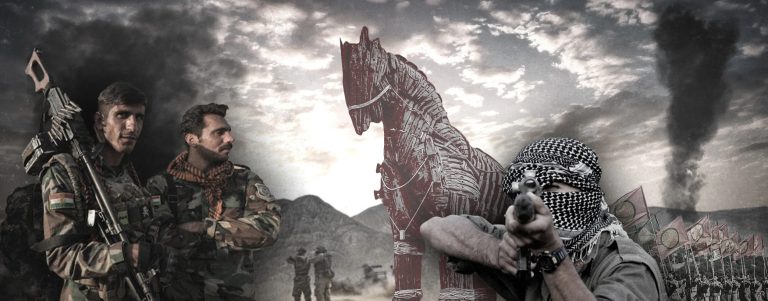
The geopolitical logic that made Rojava useful to Washington has not disappeared — it has simply relocated. Iran’s Kurdish population, estimated at eight to ten million people concentrated in Kurdistan, Kermanshah, Ilam, and parts of West Azerbaijan, represents the most obvious pressure point. Three main factions compete for influence: the Kurdistan Democratic Party of Iran, rooted in traditional nationalism and increasingly engaged with Western governments; the Komala party’s Mohtadi wing, now aligned with U.S. maximum-pressure frameworks targeting Tehran; and the Kurdistan Free Life Party (PJAK), which operates from the Qandil Mountains and maintains organic ties with the PKK. Each has its own agenda. Each is also available for instrumentalization by outside powers.
Kurdish self-administration in Syria and Iraq has shaped political expectations among Kurdish populations in Iran, deepening Ankara’s anxiety over regional continuity of Kurdish autonomy and the possibility of a fourth Kurdish zone emerging within Turkey itself. That anxiety is mutual and contagious. Any move to activate Iranian Kurdish networks against Tehran will carry automatic implications for Turkey, Iraq, and the fragile new Syrian state — none of which Washington can fully control.
The structural pattern is consistent across decades. Kurdish movements offer external powers a cost-effective tool for pressuring adversaries. External powers accept, attach conditions, and eventually recalibrate. The United States has about 1,000 troops remaining in Syria, and with Assad toppled, Trump has developed close ties to al-Sharaa, lifting sanctions and welcoming Syria into an international anti-Islamic State coalition. The SDF, which helped destroy ISIS at enormous cost, watched its American patron transfer its counterterrorism responsibilities to Damascus within weeks of the January offensive. The communities that built Rojava over ten years absorbed that transition in days.
One chapter has closed. The next is already being written — and the Kurds of Iran are watching closely.
Original analysis inspired by Cradle Staff from The Cradle. Additional research and verification conducted through multiple sources.